

conservation of the final product, and the number and total biomass of harvested
fish was calculated.
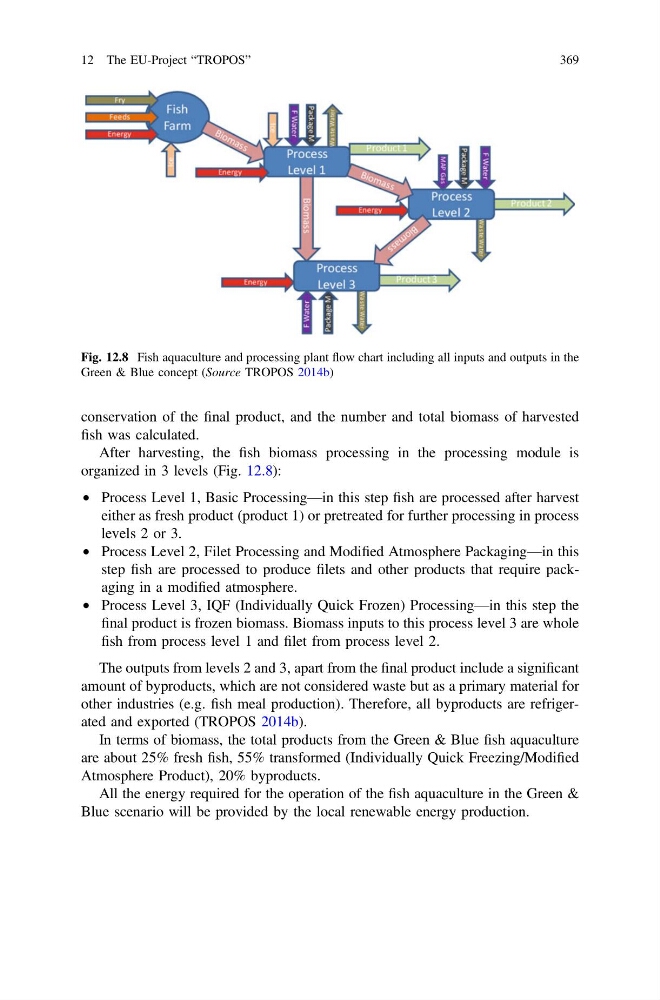
After harvesting, the fish biomass processing in the processing module is
organized in 3 levels (Fig. 12.8):
• Process Level 1, Basic Processing—in this step fish are processed after harvest
either as fresh product (product 1) or pretreated for further processing in process
levels 2 or 3.
• Process Level 2, Filet Processing and Modified Atmosphere Packaging—in this
step fish are processed to produce filets and other products that require packaging in a modified atmosphere.
• Process Level 3, IQF (Individually Quick Frozen) Processing—in this step the
final product is frozen biomass. Biomass inputs to this process level 3 are whole
fish from process level 1 and filet from process level 2.
The outputs from levels 2 and 3, apart from the final product include a significant
amount of byproducts, which are not considered waste but as a primary material for
other industries (e.g. fish meal production). Therefore, all byproducts are refrigerated and exported (TROPOS 2014b).
In terms of biomass, the total products from the Green & Blue fish aquaculture
are about 25% fresh fish, 55% transformed (Individually Quick Freezing/Modified
Atmosphere Product), 20% byproducts.
All the energy required for the operation of the fish aquaculture in the Green &
Blue scenario will be provided by the local renewable energy production.
Fig. 12.8 Fish aquaculture and processing plant flow chart including all inputs and outputs in the
Green & Blue concept (Source TROPOS 2014b)
12 The EU-Project “TROPOS”
369
fish was calculated.
After harvesting, the fish biomass processing in the processing module is
organized in 3 levels (Fig. 12.8):
• Process Level 1, Basic Processing—in this step fish are processed after harvest
either as fresh product (product 1) or pretreated for further processing in process
levels 2 or 3.
• Process Level 2, Filet Processing and Modified Atmosphere Packaging—in this
step fish are processed to produce filets and other products that require packaging in a modified atmosphere.
• Process Level 3, IQF (Individually Quick Frozen) Processing—in this step the
final product is frozen biomass. Biomass inputs to this process level 3 are whole
fish from process level 1 and filet from process level 2.
The outputs from levels 2 and 3, apart from the final product include a significant
amount of byproducts, which are not considered waste but as a primary material for
other industries (e.g. fish meal production). Therefore, all byproducts are refrigerated and exported (TROPOS 2014b).
In terms of biomass, the total products from the Green & Blue fish aquaculture
are about 25% fresh fish, 55% transformed (Individually Quick Freezing/Modified
Atmosphere Product), 20% byproducts.
All the energy required for the operation of the fish aquaculture in the Green &
Blue scenario will be provided by the local renewable energy production.
Fig. 12.8 Fish aquaculture and processing plant flow chart including all inputs and outputs in the
Green & Blue concept (Source TROPOS 2014b)
12 The EU-Project “TROPOS”
369