

The microalgae production unit or float containing the microalgae cultures is
connected to the triangular construction, one float per satellite unit, making a total
of 30 algae floats (Fig. 12.3). These photo-bioreactors are a closed system. The
dimensions of a float are 50 Â 200 m with an inserted phytoplankton unit of
400 m
3
. Two thrusters, located at the end of the plant, help to manoeuvre the
submersible culture system (Fig. 12.7).
The satellite units are unmanned and monitored, operated and controlled from
the central unit. The fish cages and the algae photo-bioreactors are equipped with
sensors for online control and monitoring from the aquaculture modules.
Energy demands of the sensors as well as of the automated fish feeding system
are met by the local production from wind and/or solar energy. Service and
maintenance are provided by a crew based on the central unit.
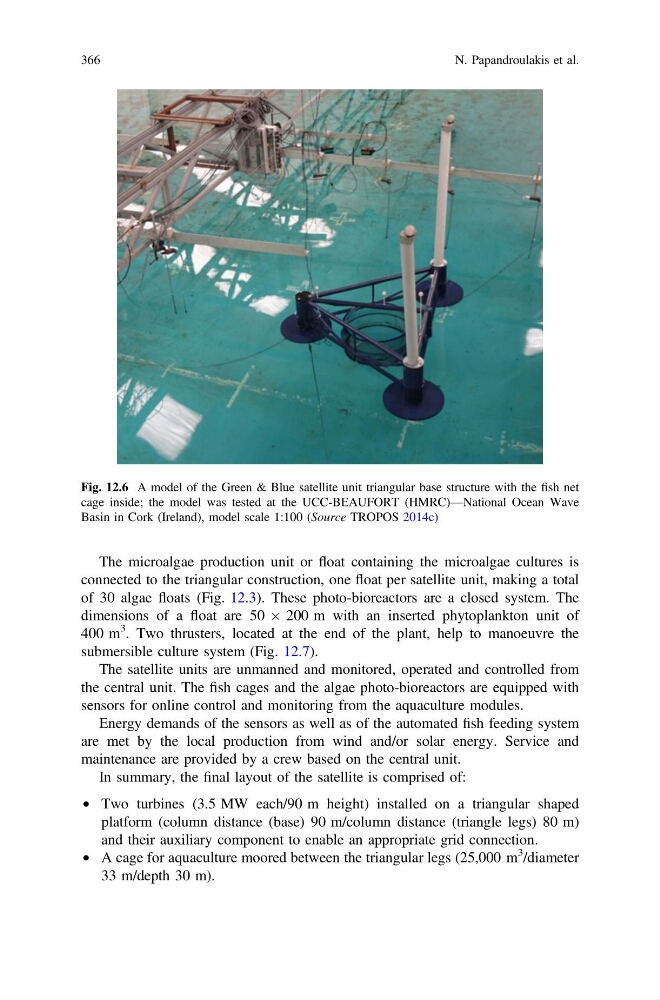
In summary, the final layout of the satellite is comprised of:
• Two turbines (3.5 MW each/90 m height) installed on a triangular shaped
platform (column distance (base) 90 m/column distance (triangle legs) 80 m)
and their auxiliary component to enable an appropriate grid connection.
• A cage for aquaculture moored between the triangular legs (25,000 m
3 /diameter
33 m/depth 30 m).
Fig. 12.6 A model of the Green & Blue satellite unit triangular base structure with the fish net
cage inside; the model was tested at the UCC-BEAUFORT (HMRC)—National Ocean Wave
Basin in Cork (Ireland), model scale 1:100 (Source TROPOS 2014c)
366
N. Papandroulakis et al.
connected to the triangular construction, one float per satellite unit, making a total
of 30 algae floats (Fig. 12.3). These photo-bioreactors are a closed system. The
dimensions of a float are 50 Â 200 m with an inserted phytoplankton unit of
400 m
3
. Two thrusters, located at the end of the plant, help to manoeuvre the
submersible culture system (Fig. 12.7).
The satellite units are unmanned and monitored, operated and controlled from
the central unit. The fish cages and the algae photo-bioreactors are equipped with
sensors for online control and monitoring from the aquaculture modules.
Energy demands of the sensors as well as of the automated fish feeding system
are met by the local production from wind and/or solar energy. Service and
maintenance are provided by a crew based on the central unit.
In summary, the final layout of the satellite is comprised of:
• Two turbines (3.5 MW each/90 m height) installed on a triangular shaped
platform (column distance (base) 90 m/column distance (triangle legs) 80 m)
and their auxiliary component to enable an appropriate grid connection.
• A cage for aquaculture moored between the triangular legs (25,000 m
3 /diameter
33 m/depth 30 m).
Fig. 12.6 A model of the Green & Blue satellite unit triangular base structure with the fish net
cage inside; the model was tested at the UCC-BEAUFORT (HMRC)—National Ocean Wave
Basin in Cork (Ireland), model scale 1:100 (Source TROPOS 2014c)
366
N. Papandroulakis et al.