

12.3.3 Satellite Units
The Green & Blue scenario off Crete consists of 30 floating triangular satellite units.
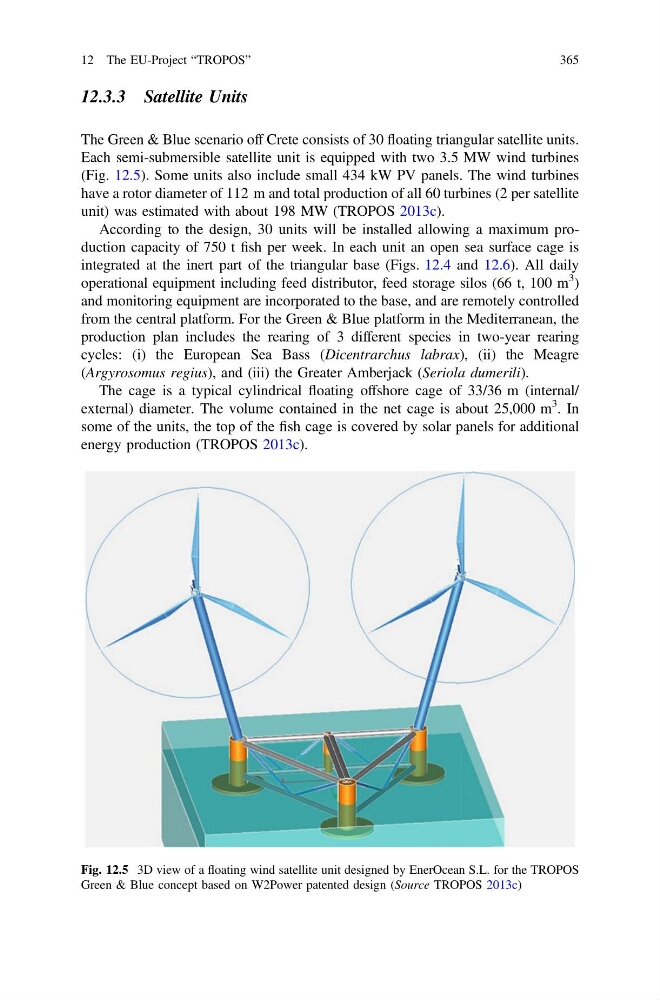
Each semi-submersible satellite unit is equipped with two 3.5 MW wind turbines
(Fig. 12.5). Some units also include small 434 kW PV panels. The wind turbines
have a rotor diameter of 112 m and total production of all 60 turbines (2 per satellite
unit) was estimated with about 198 MW (TROPOS 2013c).
According to the design, 30 units will be installed allowing a maximum production capacity of 750 t fish per week. In each unit an open sea surface cage is
integrated at the inert part of the triangular base (Figs. 12.4 and 12.6). All daily
operational equipment including feed distributor, feed storage silos (66 t, 100 m
3 )
and monitoring equipment are incorporated to the base, and are remotely controlled
from the central platform. For the Green & Blue platform in the Mediterranean, the
production plan includes the rearing of 3 different species in two-year rearing
cycles: (i) the European Sea Bass (Dicentrarchus labrax), (ii) the Meagre
(Argyrosomus regius), and (iii) the Greater Amberjack (Seriola dumerili).
The cage is a typical cylindrical floating offshore cage of 33/36 m (internal/
external) diameter. The volume contained in the net cage is about 25,000 m
3 . In
some of the units, the top of the fish cage is covered by solar panels for additional
energy production (TROPOS 2013c).
Fig. 12.5 3D view of a floating wind satellite unit designed by EnerOcean S.L. for the TROPOS
Green & Blue concept based on W2Power patented design (Source TROPOS 2013c)
12 The EU-Project “TROPOS”
365
The Green & Blue scenario off Crete consists of 30 floating triangular satellite units.
Each semi-submersible satellite unit is equipped with two 3.5 MW wind turbines
(Fig. 12.5). Some units also include small 434 kW PV panels. The wind turbines
have a rotor diameter of 112 m and total production of all 60 turbines (2 per satellite
unit) was estimated with about 198 MW (TROPOS 2013c).
According to the design, 30 units will be installed allowing a maximum production capacity of 750 t fish per week. In each unit an open sea surface cage is
integrated at the inert part of the triangular base (Figs. 12.4 and 12.6). All daily
operational equipment including feed distributor, feed storage silos (66 t, 100 m
3 )
and monitoring equipment are incorporated to the base, and are remotely controlled
from the central platform. For the Green & Blue platform in the Mediterranean, the
production plan includes the rearing of 3 different species in two-year rearing
cycles: (i) the European Sea Bass (Dicentrarchus labrax), (ii) the Meagre
(Argyrosomus regius), and (iii) the Greater Amberjack (Seriola dumerili).
The cage is a typical cylindrical floating offshore cage of 33/36 m (internal/
external) diameter. The volume contained in the net cage is about 25,000 m
3 . In
some of the units, the top of the fish cage is covered by solar panels for additional
energy production (TROPOS 2013c).
Fig. 12.5 3D view of a floating wind satellite unit designed by EnerOcean S.L. for the TROPOS
Green & Blue concept based on W2Power patented design (Source TROPOS 2013c)
12 The EU-Project “TROPOS”
365