

11.5 Stakeholder Attitudes, Perceptions and Concerns
While early studies mostly focussed on technological feasibility, environmental
impacts, and profitability, the perceptions of stakeholders in the offshore realm have
experienced increasing attention in the North Sea context. A number of studies have
collected and analysed stakeholder attitudes, their interests and concerns over the
past decade (Michler-Cieluch et al. 2009a, b; Michler-Cieluch and Kodeih 2008;
Michler-Cieluch and Krause 2008; Vollstedt 2011; Wever et al. 2015;
Michler-Cieluch 2009) (Projects No. 4 “Coastal Futures”, Project No. 13 “Open
Ocean Multi-Use”). Many of the stakeholders from the fishery and offshore wind
industries, public administration, environmental groups and the research community have been part of the ongoing offshore research process since its very beginnings and still remain to date. Table 11.3 gives an overview of the most relevant
actor groups in this context.
In the early process of identifying key stakeholders in the offshore realm, it
became apparent that the types of actors involved in, or affected by offshore ventures clearly differ from stakeholders in coastal areas, and so do their interests and
concerns with respect to offshore uses (Krause et al. 2003; Michler-Cieluch 2009).
Coastal areas have a long history of a great variety of uses, so user patterns and
stakeholder networks have naturally grown over a long time period. Offshore areas
to the contrary have only recently experienced intense utilisation due to technological advancements. This resulted in conflicts, as new types of use emerged or
intensified, while other uses are marginalized or even banned. The offshore wind
energy sector has turned into a powerful, international player that has benefitted
immensely from the current political agenda in Germany. Other users, such as
fisheries, are pushed out of large areas of the ocean. Within this highly contested
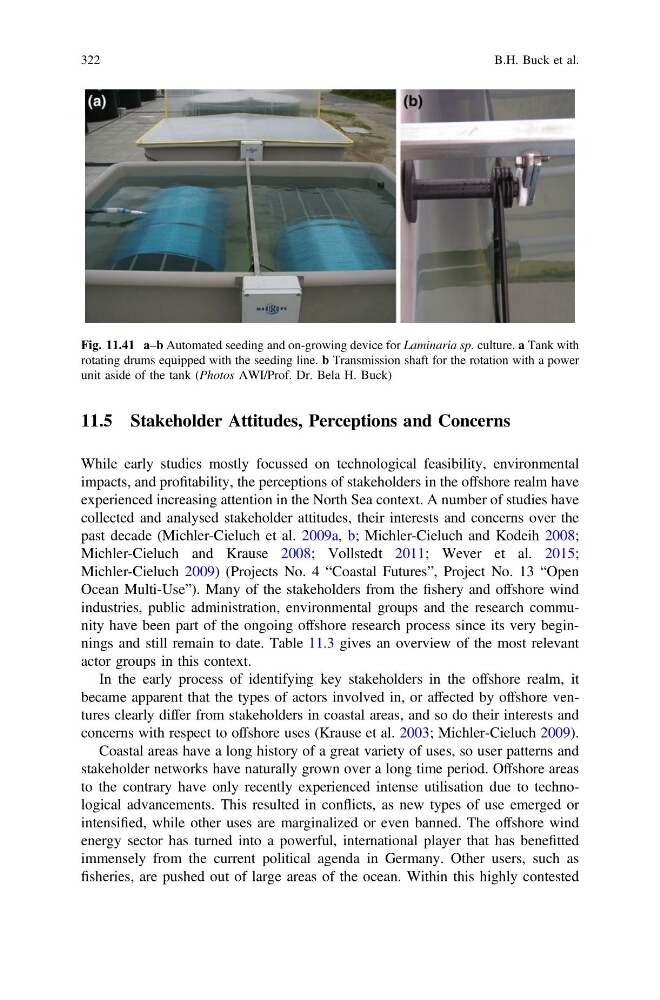
Fig. 11.41 a–b Automated seeding and on-growing device for Laminaria sp. culture. a Tank with
rotating drums equipped with the seeding line. b Transmission shaft for the rotation with a power
unit aside of the tank (Photos AWI/Prof. Dr. Bela H. Buck)
322
B.H. Buck et al.
While early studies mostly focussed on technological feasibility, environmental
impacts, and profitability, the perceptions of stakeholders in the offshore realm have
experienced increasing attention in the North Sea context. A number of studies have
collected and analysed stakeholder attitudes, their interests and concerns over the
past decade (Michler-Cieluch et al. 2009a, b; Michler-Cieluch and Kodeih 2008;
Michler-Cieluch and Krause 2008; Vollstedt 2011; Wever et al. 2015;
Michler-Cieluch 2009) (Projects No. 4 “Coastal Futures”, Project No. 13 “Open
Ocean Multi-Use”). Many of the stakeholders from the fishery and offshore wind
industries, public administration, environmental groups and the research community have been part of the ongoing offshore research process since its very beginnings and still remain to date. Table 11.3 gives an overview of the most relevant
actor groups in this context.
In the early process of identifying key stakeholders in the offshore realm, it
became apparent that the types of actors involved in, or affected by offshore ventures clearly differ from stakeholders in coastal areas, and so do their interests and
concerns with respect to offshore uses (Krause et al. 2003; Michler-Cieluch 2009).
Coastal areas have a long history of a great variety of uses, so user patterns and
stakeholder networks have naturally grown over a long time period. Offshore areas
to the contrary have only recently experienced intense utilisation due to technological advancements. This resulted in conflicts, as new types of use emerged or
intensified, while other uses are marginalized or even banned. The offshore wind
energy sector has turned into a powerful, international player that has benefitted
immensely from the current political agenda in Germany. Other users, such as
fisheries, are pushed out of large areas of the ocean. Within this highly contested
Fig. 11.41 a–b Automated seeding and on-growing device for Laminaria sp. culture. a Tank with
rotating drums equipped with the seeding line. b Transmission shaft for the rotation with a power
unit aside of the tank (Photos AWI/Prof. Dr. Bela H. Buck)
322
B.H. Buck et al.