

construction had been in use off the Isle of Man (Kain 1991) and in Brittany (Perez
et al. 1992). Based on the above and our own experiences, a grid system depicted in
Fig. 11.32g was set up. The grid measured 60 m  30 m and was submerged at a
depth of 1.2 m. The grid was designed to hold 1400 m of culture line in an area of
0.18 ha. A radial mooring system was used with 10 concrete blocks (2.5–4.5 t).
The frame material employed tube was a “Herkules” rope, which is commonly used
in commercial fisheries. This rope contains in its core several subcores, each made
of six strands of steel. This way the rope was heavier than the surrounding seawater,
which reduced the risk of potential damage at the weight attachment points. The
inner supporting ropes of the construction were made of Polystar, a mixture of
polypropylene and polyethylene, a material with excellent references in steel
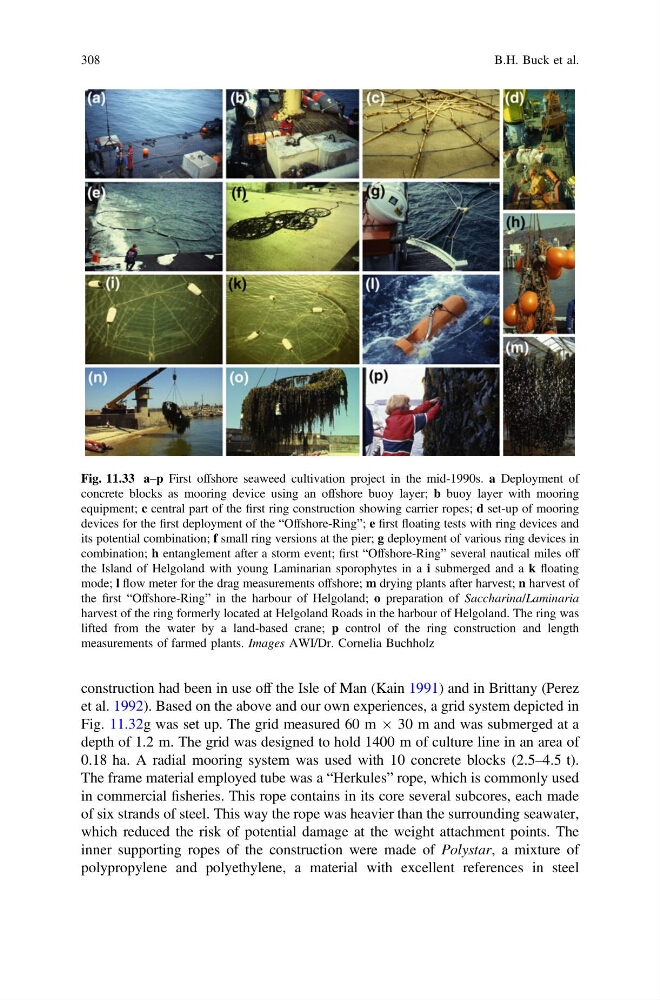
Fig. 11.33 a–p First offshore seaweed cultivation project in the mid-1990s. a Deployment of
concrete blocks as mooring device using an offshore buoy layer; b buoy layer with mooring
equipment; c central part of the first ring construction showing carrier ropes; d set-up of mooring
devices for the first deployment of the “Offshore-Ring”; e first floating tests with ring devices and
its potential combination; f small ring versions at the pier; g deployment of various ring devices in
combination; h entanglement after a storm event; first “Offshore-Ring” several nautical miles off
the Island of Helgoland with young Laminarian sporophytes in a i submerged and a k floating
mode; l flow meter for the drag measurements offshore; m drying plants after harvest; n harvest of
the first “Offshore-Ring” in the harbour of Helgoland; o preparation of Saccharina/Laminaria
harvest of the ring formerly located at Helgoland Roads in the harbour of Helgoland. The ring was
lifted from the water by a land-based crane; p control of the ring construction and length
measurements of farmed plants. Images AWI/Dr. Cornelia Buchholz
308
B.H. Buck et al.
et al. 1992). Based on the above and our own experiences, a grid system depicted in
Fig. 11.32g was set up. The grid measured 60 m  30 m and was submerged at a
depth of 1.2 m. The grid was designed to hold 1400 m of culture line in an area of
0.18 ha. A radial mooring system was used with 10 concrete blocks (2.5–4.5 t).
The frame material employed tube was a “Herkules” rope, which is commonly used
in commercial fisheries. This rope contains in its core several subcores, each made
of six strands of steel. This way the rope was heavier than the surrounding seawater,
which reduced the risk of potential damage at the weight attachment points. The
inner supporting ropes of the construction were made of Polystar, a mixture of
polypropylene and polyethylene, a material with excellent references in steel
Fig. 11.33 a–p First offshore seaweed cultivation project in the mid-1990s. a Deployment of
concrete blocks as mooring device using an offshore buoy layer; b buoy layer with mooring
equipment; c central part of the first ring construction showing carrier ropes; d set-up of mooring
devices for the first deployment of the “Offshore-Ring”; e first floating tests with ring devices and
its potential combination; f small ring versions at the pier; g deployment of various ring devices in
combination; h entanglement after a storm event; first “Offshore-Ring” several nautical miles off
the Island of Helgoland with young Laminarian sporophytes in a i submerged and a k floating
mode; l flow meter for the drag measurements offshore; m drying plants after harvest; n harvest of
the first “Offshore-Ring” in the harbour of Helgoland; o preparation of Saccharina/Laminaria
harvest of the ring formerly located at Helgoland Roads in the harbour of Helgoland. The ring was
lifted from the water by a land-based crane; p control of the ring construction and length
measurements of farmed plants. Images AWI/Dr. Cornelia Buchholz
308
B.H. Buck et al.