

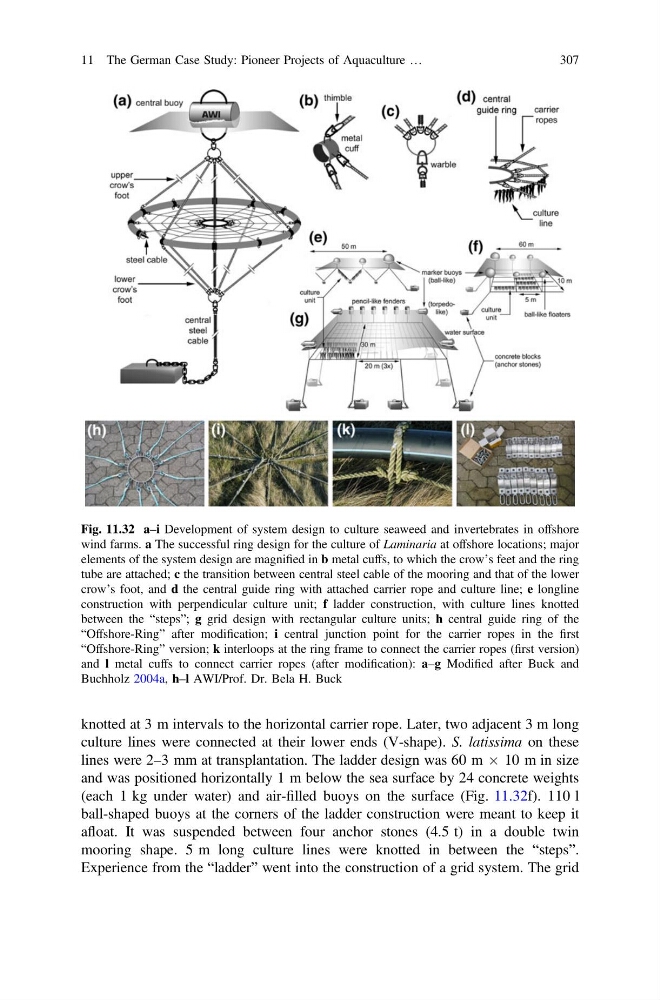
knotted at 3 m intervals to the horizontal carrier rope. Later, two adjacent 3 m long
culture lines were connected at their lower ends (V-shape). S. latissima on these
lines were 2–3 mm at transplantation. The ladder design was 60 m  10 m in size
and was positioned horizontally 1 m below the sea surface by 24 concrete weights
(each 1 kg under water) and air-filled buoys on the surface (Fig. 11.32f). 110 l
ball-shaped buoys at the corners of the ladder construction were meant to keep it
afloat. It was suspended between four anchor stones (4.5 t) in a double twin
mooring shape. 5 m long culture lines were knotted in between the “steps”.
Experience from the “ladder” went into the construction of a grid system. The grid
Fig. 11.32 a–i Development of system design to culture seaweed and invertebrates in offshore
wind farms. a The successful ring design for the culture of Laminaria at offshore locations; major
elements of the system design are magnified in b metal cuffs, to which the crow’s feet and the ring
tube are attached; c the transition between central steel cable of the mooring and that of the lower
crow’s foot, and d the central guide ring with attached carrier rope and culture line; e longline
construction with perpendicular culture unit; f ladder construction, with culture lines knotted
between the “steps”; g grid design with rectangular culture units; h central guide ring of the
“Offshore-Ring” after modification; i central junction point for the carrier ropes in the first
“Offshore-Ring” version; k interloops at the ring frame to connect the carrier ropes (first version)
and l metal cuffs to connect carrier ropes (after modification): a–g Modified after Buck and
Buchholz 2004a, h–l AWI/Prof. Dr. Bela H. Buck
11 The German Case Study: Pioneer Projects of Aquaculture …
307
culture lines were connected at their lower ends (V-shape). S. latissima on these
lines were 2–3 mm at transplantation. The ladder design was 60 m  10 m in size
and was positioned horizontally 1 m below the sea surface by 24 concrete weights
(each 1 kg under water) and air-filled buoys on the surface (Fig. 11.32f). 110 l
ball-shaped buoys at the corners of the ladder construction were meant to keep it
afloat. It was suspended between four anchor stones (4.5 t) in a double twin
mooring shape. 5 m long culture lines were knotted in between the “steps”.
Experience from the “ladder” went into the construction of a grid system. The grid
Fig. 11.32 a–i Development of system design to culture seaweed and invertebrates in offshore
wind farms. a The successful ring design for the culture of Laminaria at offshore locations; major
elements of the system design are magnified in b metal cuffs, to which the crow’s feet and the ring
tube are attached; c the transition between central steel cable of the mooring and that of the lower
crow’s foot, and d the central guide ring with attached carrier rope and culture line; e longline
construction with perpendicular culture unit; f ladder construction, with culture lines knotted
between the “steps”; g grid design with rectangular culture units; h central guide ring of the
“Offshore-Ring” after modification; i central junction point for the carrier ropes in the first
“Offshore-Ring” version; k interloops at the ring frame to connect the carrier ropes (first version)
and l metal cuffs to connect carrier ropes (after modification): a–g Modified after Buck and
Buchholz 2004a, h–l AWI/Prof. Dr. Bela H. Buck
11 The German Case Study: Pioneer Projects of Aquaculture …
307