

caused by the fact that marine areas occupied by offshore platforms are off limits for
commercial fishing vessels due to safety reasons (Berkenhagen et al. 2010). This
results in an increase in biomass of fish or other species and/or a greater number of
species in this area aggregating at the artificial reefs. These areas then can be
considered as more or less a marine protected area (MPA). Marine scientists have
therefore suggested preserving much of this marine life and encouraging further
natural productivity (Jensen et al. 2000). While the operator benefits by avoiding
the substantial cost of removal, populations of marine species benefit from the
refuge the structures provide. These findings encouraged recreational fisherman,
divers, offshore oil and gas operators, aquaculturists and others who could benefit
from the increased density to establish the “Rigs-to-Reefs” program in American
and European Seas (Reggio 1987), where decommissioned offshore oil and gas rigs
were turned into artificial reefs. Since then many scientists have reported that these
artificial reefs increase the number and diversity of marine organisms adjacent to
these sites (e.g. Bohnsack et al. 1994; Zalmon et al. 2002) including many commercially important fish, shellfish and crustacean species (Bohnsack et al. 1991;
Jensen et al. 2000).
To this point, some efforts have been carried out to successfully install offshore
aquaculture constructions as pilot systems even in the open Pacific but none have so
far reached a continuous commercial operation. In particular, projects carried out in
the USA were of prime importance for the successful installation of various offshore
systems (e.g. Loverich 1997, 1998; Loverich and Gace 1997; Braginton-Smith and
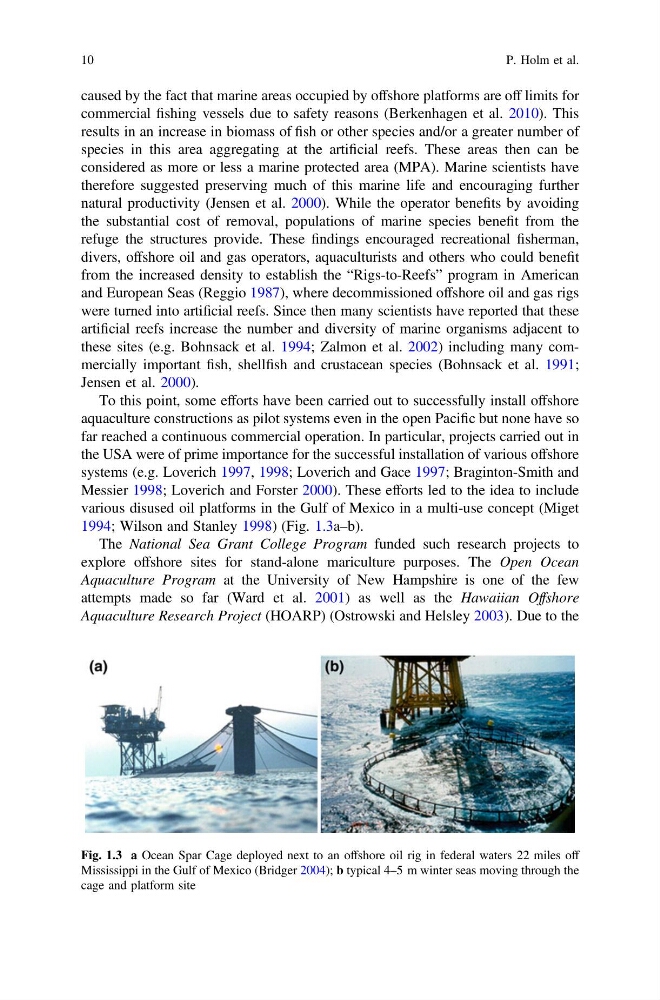
Messier 1998; Loverich and Forster 2000). These efforts led to the idea to include
various disused oil platforms in the Gulf of Mexico in a multi-use concept (Miget
1994; Wilson and Stanley 1998) (Fig. 1.3a–b).
The National Sea Grant College Program funded such research projects to
explore offshore sites for stand-alone mariculture purposes. The Open Ocean
Aquaculture Program at the University of New Hampshire is one of the few
attempts made so far (Ward et al. 2001) as well as the Hawaiian Offshore
Aquaculture Research Project (HOARP) (Ostrowski and Helsley 2003). Due to the
Fig. 1.3 a Ocean Spar Cage deployed next to an offshore oil rig in federal waters 22 miles off
Mississippi in the Gulf of Mexico (Bridger 2004); b typical 4–5 m winter seas moving through the
cage and platform site
10
P. Holm et al.
commercial fishing vessels due to safety reasons (Berkenhagen et al. 2010). This
results in an increase in biomass of fish or other species and/or a greater number of
species in this area aggregating at the artificial reefs. These areas then can be
considered as more or less a marine protected area (MPA). Marine scientists have
therefore suggested preserving much of this marine life and encouraging further
natural productivity (Jensen et al. 2000). While the operator benefits by avoiding
the substantial cost of removal, populations of marine species benefit from the
refuge the structures provide. These findings encouraged recreational fisherman,
divers, offshore oil and gas operators, aquaculturists and others who could benefit
from the increased density to establish the “Rigs-to-Reefs” program in American
and European Seas (Reggio 1987), where decommissioned offshore oil and gas rigs
were turned into artificial reefs. Since then many scientists have reported that these
artificial reefs increase the number and diversity of marine organisms adjacent to
these sites (e.g. Bohnsack et al. 1994; Zalmon et al. 2002) including many commercially important fish, shellfish and crustacean species (Bohnsack et al. 1991;
Jensen et al. 2000).
To this point, some efforts have been carried out to successfully install offshore
aquaculture constructions as pilot systems even in the open Pacific but none have so
far reached a continuous commercial operation. In particular, projects carried out in
the USA were of prime importance for the successful installation of various offshore
systems (e.g. Loverich 1997, 1998; Loverich and Gace 1997; Braginton-Smith and
Messier 1998; Loverich and Forster 2000). These efforts led to the idea to include
various disused oil platforms in the Gulf of Mexico in a multi-use concept (Miget
1994; Wilson and Stanley 1998) (Fig. 1.3a–b).
The National Sea Grant College Program funded such research projects to
explore offshore sites for stand-alone mariculture purposes. The Open Ocean
Aquaculture Program at the University of New Hampshire is one of the few
attempts made so far (Ward et al. 2001) as well as the Hawaiian Offshore
Aquaculture Research Project (HOARP) (Ostrowski and Helsley 2003). Due to the
Fig. 1.3 a Ocean Spar Cage deployed next to an offshore oil rig in federal waters 22 miles off
Mississippi in the Gulf of Mexico (Bridger 2004); b typical 4–5 m winter seas moving through the
cage and platform site
10
P. Holm et al.