

and is thought to be a suitable species for cultivation in multi-use approaches in
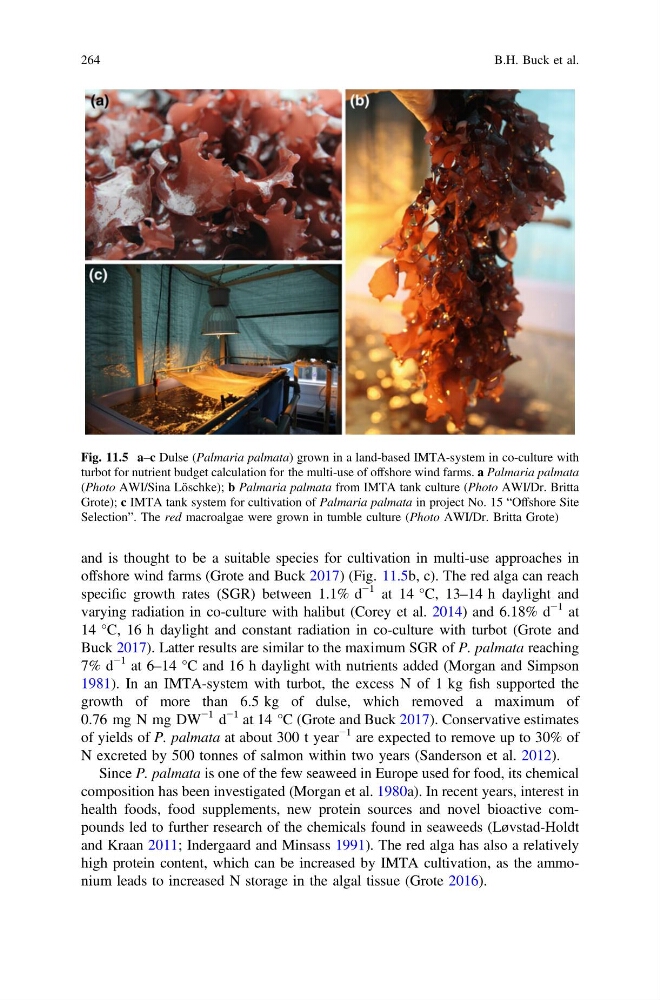
offshore wind farms (Grote and Buck 2017) (Fig. 11.5b, c). The red alga can reach
specific growth rates (SGR) between 1.1% d
−1 at 14 °C, 13–14 h daylight and
varying radiation in co-culture with halibut (Corey et al. 2014) and 6.18% d
−1 at
14 °C, 16 h daylight and constant radiation in co-culture with turbot (Grote and
Buck 2017). Latter results are similar to the maximum SGR of P. palmata reaching
7% d
−1 at 6–14 °C and 16 h daylight with nutrients added (Morgan and Simpson
1981). In an IMTA-system with turbot, the excess N of 1 kg fish supported the
growth of more than 6.5 kg of dulse, which removed a maximum of
0.76 mg N mg DW
−1 d
−1 at 14 °C (Grote and Buck 2017). Conservative estimates
of yields of P. palmata at about 300 t year
−1 are expected to remove up to 30% of
N excreted by 500 tonnes of salmon within two years (Sanderson et al. 2012).
Since P. palmata is one of the few seaweed in Europe used for food, its chemical
composition has been investigated (Morgan et al. 1980a). In recent years, interest in
health foods, food supplements, new protein sources and novel bioactive compounds led to further research of the chemicals found in seaweeds (Løvstad-Holdt
and Kraan 2011; Indergaard and Minsass 1991). The red alga has also a relatively
high protein content, which can be increased by IMTA cultivation, as the ammonium leads to increased N storage in the algal tissue (Grote 2016).
Fig. 11.5 a–c Dulse (Palmaria palmata) grown in a land-based IMTA-system in co-culture with
turbot for nutrient budget calculation for the multi-use of offshore wind farms. a Palmaria palmata
(Photo AWI/Sina Löschke); b Palmaria palmata from IMTA tank culture (Photo AWI/Dr. Britta
Grote); c IMTA tank system for cultivation of Palmaria palmata in project No. 15 “Offshore Site
Selection”. The red macroalgae were grown in tumble culture (Photo AWI/Dr. Britta Grote)
264
B.H. Buck et al.
offshore wind farms (Grote and Buck 2017) (Fig. 11.5b, c). The red alga can reach
specific growth rates (SGR) between 1.1% d
−1 at 14 °C, 13–14 h daylight and
varying radiation in co-culture with halibut (Corey et al. 2014) and 6.18% d
−1 at
14 °C, 16 h daylight and constant radiation in co-culture with turbot (Grote and
Buck 2017). Latter results are similar to the maximum SGR of P. palmata reaching
7% d
−1 at 6–14 °C and 16 h daylight with nutrients added (Morgan and Simpson
1981). In an IMTA-system with turbot, the excess N of 1 kg fish supported the
growth of more than 6.5 kg of dulse, which removed a maximum of
0.76 mg N mg DW
−1 d
−1 at 14 °C (Grote and Buck 2017). Conservative estimates
of yields of P. palmata at about 300 t year
−1 are expected to remove up to 30% of
N excreted by 500 tonnes of salmon within two years (Sanderson et al. 2012).
Since P. palmata is one of the few seaweed in Europe used for food, its chemical
composition has been investigated (Morgan et al. 1980a). In recent years, interest in
health foods, food supplements, new protein sources and novel bioactive compounds led to further research of the chemicals found in seaweeds (Løvstad-Holdt
and Kraan 2011; Indergaard and Minsass 1991). The red alga has also a relatively
high protein content, which can be increased by IMTA cultivation, as the ammonium leads to increased N storage in the algal tissue (Grote 2016).
Fig. 11.5 a–c Dulse (Palmaria palmata) grown in a land-based IMTA-system in co-culture with
turbot for nutrient budget calculation for the multi-use of offshore wind farms. a Palmaria palmata
(Photo AWI/Sina Löschke); b Palmaria palmata from IMTA tank culture (Photo AWI/Dr. Britta
Grote); c IMTA tank system for cultivation of Palmaria palmata in project No. 15 “Offshore Site
Selection”. The red macroalgae were grown in tumble culture (Photo AWI/Dr. Britta Grote)
264
B.H. Buck et al.