

7.3 Developing a Multi-level Governance Framework
for Offshore Aquaculture
In contrast to terrestrial systems, knowledge on marine ecosystems is more limited,
e.g. pertaining to the existence of spatial and temporal data, species distribution and
data format issues (Martin et al. 2014). Furthermore, ocean governance is still in its
infancy as it confronts political, legal and economic development options for ocean
use as well as efforts to restore marine ecosystems and the services they provide
(WBGU 2013). The recognition of the latter gap is reflected by the significant
efforts to develop and reshape various concepts over the last 30 years. These
address the objective of influencing marine environments positively and purposively through human and societal engagement by management and governance
means. Integrated Coastal Zone Management (e.g. Cicin-Sain and Knecht 1998)
and more recently also Coastal and Ocean Governance (Olsen 2003; WBGU 2013)
are the most prominent and influential examples (Stead et al. 2002; Stead 2005).
With respect to management measures such as marine protected areas, for example,
Heylings and Bravo (2007) heralded the benefits of developing a co-management
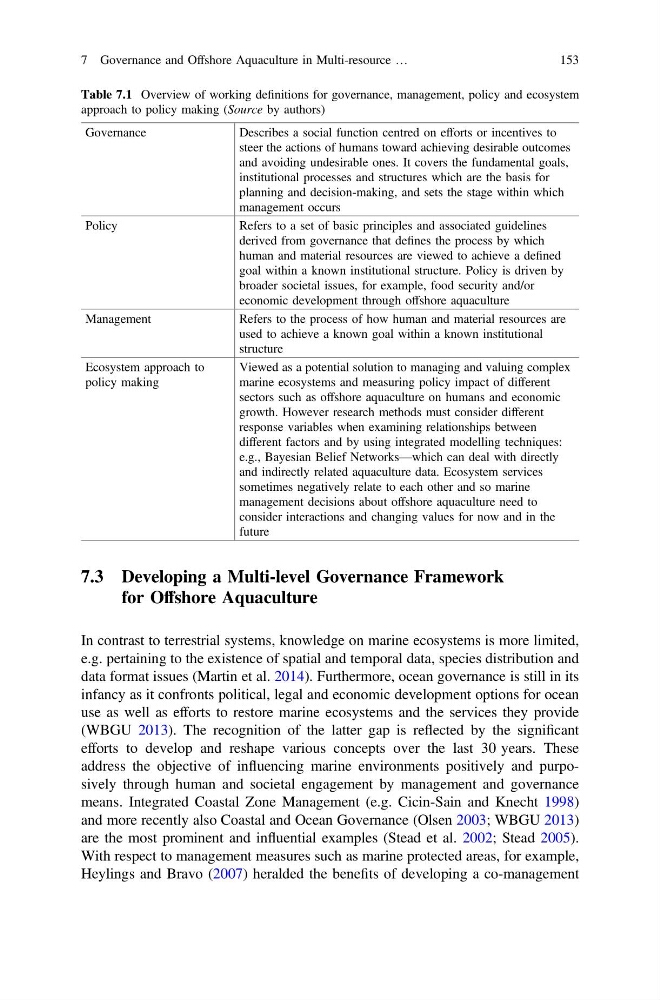
Table 7.1 Overview of working definitions for governance, management, policy and ecosystem
approach to policy making (Source by authors)
Governance
Describes a social function centred on efforts or incentives to
steer the actions of humans toward achieving desirable outcomes
and avoiding undesirable ones. It covers the fundamental goals,
institutional processes and structures which are the basis for
planning and decision-making, and sets the stage within which
management occurs
Policy
Refers to a set of basic principles and associated guidelines
derived from governance that defines the process by which
human and material resources are viewed to achieve a defined
goal within a known institutional structure. Policy is driven by
broader societal issues, for example, food security and/or
economic development through offshore aquaculture
Management
Refers to the process of how human and material resources are
used to achieve a known goal within a known institutional
structure
Ecosystem approach to
policy making
Viewed as a potential solution to managing and valuing complex
marine ecosystems and measuring policy impact of different
sectors such as offshore aquaculture on humans and economic
growth. However research methods must consider different
response variables when examining relationships between
different factors and by using integrated modelling techniques:
e.g., Bayesian Belief Networks—which can deal with directly
and indirectly related aquaculture data. Ecosystem services
sometimes negatively relate to each other and so marine
management decisions about offshore aquaculture need to
consider interactions and changing values for now and in the
future
7 Governance and Offshore Aquaculture in Multi-resource …
153
for Offshore Aquaculture
In contrast to terrestrial systems, knowledge on marine ecosystems is more limited,
e.g. pertaining to the existence of spatial and temporal data, species distribution and
data format issues (Martin et al. 2014). Furthermore, ocean governance is still in its
infancy as it confronts political, legal and economic development options for ocean
use as well as efforts to restore marine ecosystems and the services they provide
(WBGU 2013). The recognition of the latter gap is reflected by the significant
efforts to develop and reshape various concepts over the last 30 years. These
address the objective of influencing marine environments positively and purposively through human and societal engagement by management and governance
means. Integrated Coastal Zone Management (e.g. Cicin-Sain and Knecht 1998)
and more recently also Coastal and Ocean Governance (Olsen 2003; WBGU 2013)
are the most prominent and influential examples (Stead et al. 2002; Stead 2005).
With respect to management measures such as marine protected areas, for example,
Heylings and Bravo (2007) heralded the benefits of developing a co-management
Table 7.1 Overview of working definitions for governance, management, policy and ecosystem
approach to policy making (Source by authors)
Governance
Describes a social function centred on efforts or incentives to
steer the actions of humans toward achieving desirable outcomes
and avoiding undesirable ones. It covers the fundamental goals,
institutional processes and structures which are the basis for
planning and decision-making, and sets the stage within which
management occurs
Policy
Refers to a set of basic principles and associated guidelines
derived from governance that defines the process by which
human and material resources are viewed to achieve a defined
goal within a known institutional structure. Policy is driven by
broader societal issues, for example, food security and/or
economic development through offshore aquaculture
Management
Refers to the process of how human and material resources are
used to achieve a known goal within a known institutional
structure
Ecosystem approach to
policy making
Viewed as a potential solution to managing and valuing complex
marine ecosystems and measuring policy impact of different
sectors such as offshore aquaculture on humans and economic
growth. However research methods must consider different
response variables when examining relationships between
different factors and by using integrated modelling techniques:
e.g., Bayesian Belief Networks—which can deal with directly
and indirectly related aquaculture data. Ecosystem services
sometimes negatively relate to each other and so marine
management decisions about offshore aquaculture need to
consider interactions and changing values for now and in the
future
7 Governance and Offshore Aquaculture in Multi-resource …
153