

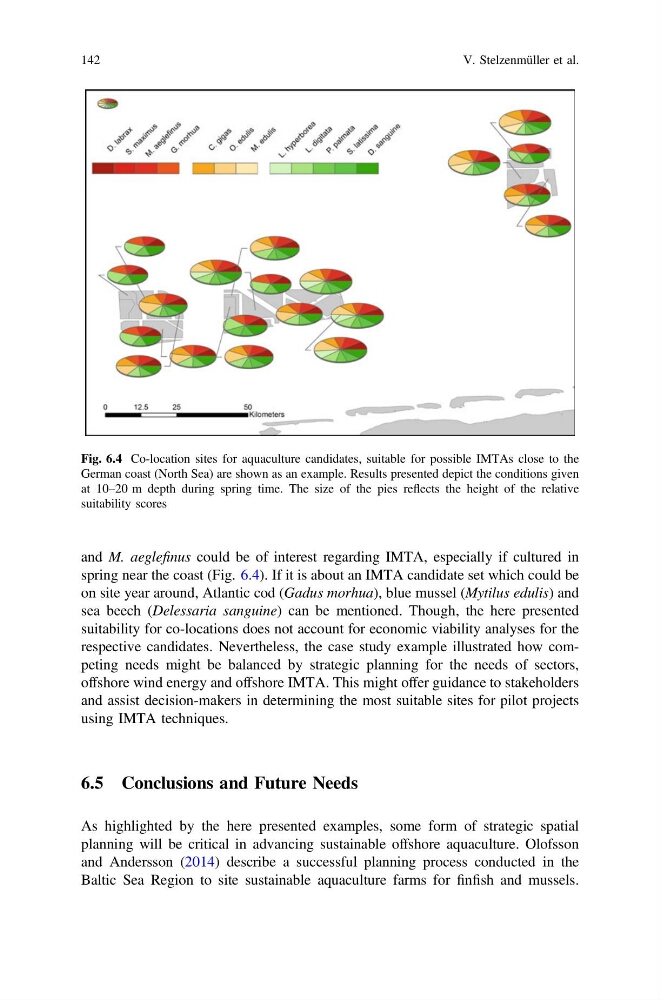
and M. aeglefinus could be of interest regarding IMTA, especially if cultured in
spring near the coast (Fig. 6.4). If it is about an IMTA candidate set which could be
on site year around, Atlantic cod (Gadus morhua), blue mussel (Mytilus edulis) and
sea beech (Delessaria sanguine) can be mentioned. Though, the here presented
suitability for co-locations does not account for economic viability analyses for the
respective candidates. Nevertheless, the case study example illustrated how competing needs might be balanced by strategic planning for the needs of sectors,
offshore wind energy and offshore IMTA. This might offer guidance to stakeholders
and assist decision-makers in determining the most suitable sites for pilot projects
using IMTA techniques.
6.5 Conclusions and Future Needs
As highlighted by the here presented examples, some form of strategic spatial
planning will be critical in advancing sustainable offshore aquaculture. Olofsson
and Andersson (2014) describe a successful planning process conducted in the
Baltic Sea Region to site sustainable aquaculture farms for finfish and mussels.
Fig. 6.4 Co-location sites for aquaculture candidates, suitable for possible IMTAs close to the
German coast (North Sea) are shown as an example. Results presented depict the conditions given
at 10–20 m depth during spring time. The size of the pies reflects the height of the relative
suitability scores
142
V. Stelzenmüller et al.
spring near the coast (Fig. 6.4). If it is about an IMTA candidate set which could be
on site year around, Atlantic cod (Gadus morhua), blue mussel (Mytilus edulis) and
sea beech (Delessaria sanguine) can be mentioned. Though, the here presented
suitability for co-locations does not account for economic viability analyses for the
respective candidates. Nevertheless, the case study example illustrated how competing needs might be balanced by strategic planning for the needs of sectors,
offshore wind energy and offshore IMTA. This might offer guidance to stakeholders
and assist decision-makers in determining the most suitable sites for pilot projects
using IMTA techniques.
6.5 Conclusions and Future Needs
As highlighted by the here presented examples, some form of strategic spatial
planning will be critical in advancing sustainable offshore aquaculture. Olofsson
and Andersson (2014) describe a successful planning process conducted in the
Baltic Sea Region to site sustainable aquaculture farms for finfish and mussels.
Fig. 6.4 Co-location sites for aquaculture candidates, suitable for possible IMTAs close to the
German coast (North Sea) are shown as an example. Results presented depict the conditions given
at 10–20 m depth during spring time. The size of the pies reflects the height of the relative
suitability scores
142
V. Stelzenmüller et al.