

While the conditions for fish proved to be highly suitable during summer, the
mussels and algae revealed peak suitability in spring. Still, when examining suitable
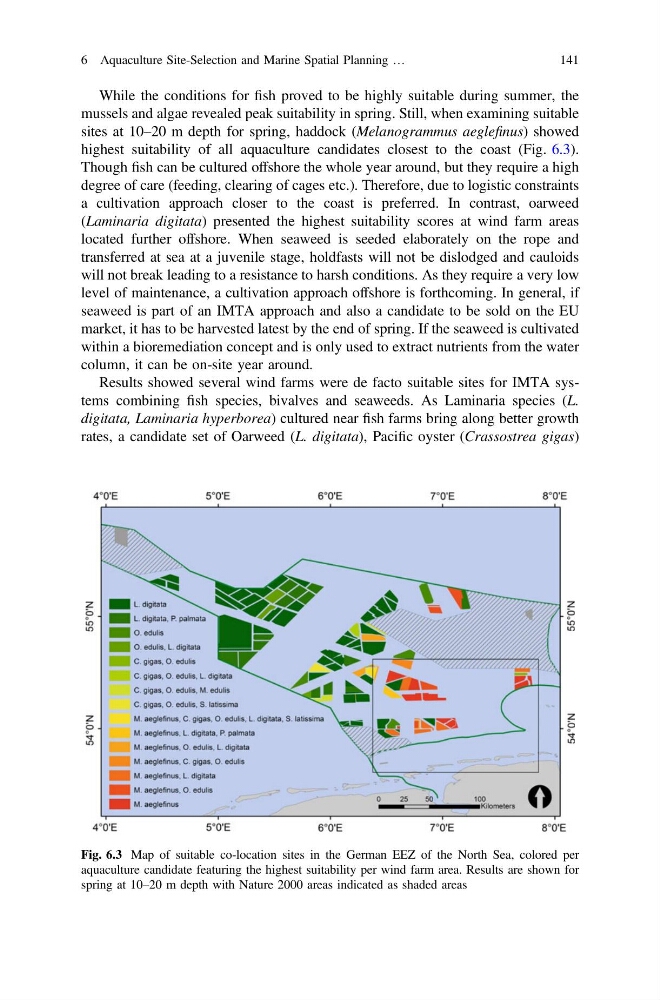
sites at 10–20 m depth for spring, haddock (Melanogrammus aeglefinus) showed
highest suitability of all aquaculture candidates closest to the coast (Fig. 6.3).
Though fish can be cultured offshore the whole year around, but they require a high
degree of care (feeding, clearing of cages etc.). Therefore, due to logistic constraints
a cultivation approach closer to the coast is preferred. In contrast, oarweed
(Laminaria digitata) presented the highest suitability scores at wind farm areas
located further offshore. When seaweed is seeded elaborately on the rope and
transferred at sea at a juvenile stage, holdfasts will not be dislodged and cauloids
will not break leading to a resistance to harsh conditions. As they require a very low
level of maintenance, a cultivation approach offshore is forthcoming. In general, if
seaweed is part of an IMTA approach and also a candidate to be sold on the EU
market, it has to be harvested latest by the end of spring. If the seaweed is cultivated
within a bioremediation concept and is only used to extract nutrients from the water
column, it can be on-site year around.
Results showed several wind farms were de facto suitable sites for IMTA systems combining fish species, bivalves and seaweeds. As Laminaria species (L.
digitata, Laminaria hyperborea) cultured near fish farms bring along better growth
rates, a candidate set of Oarweed (L. digitata), Pacific oyster (Crassostrea gigas)
Fig. 6.3 Map of suitable co-location sites in the German EEZ of the North Sea, colored per
aquaculture candidate featuring the highest suitability per wind farm area. Results are shown for
spring at 10–20 m depth with Nature 2000 areas indicated as shaded areas
6 Aquaculture Site-Selection and Marine Spatial Planning …
141
mussels and algae revealed peak suitability in spring. Still, when examining suitable
sites at 10–20 m depth for spring, haddock (Melanogrammus aeglefinus) showed
highest suitability of all aquaculture candidates closest to the coast (Fig. 6.3).
Though fish can be cultured offshore the whole year around, but they require a high
degree of care (feeding, clearing of cages etc.). Therefore, due to logistic constraints
a cultivation approach closer to the coast is preferred. In contrast, oarweed
(Laminaria digitata) presented the highest suitability scores at wind farm areas
located further offshore. When seaweed is seeded elaborately on the rope and
transferred at sea at a juvenile stage, holdfasts will not be dislodged and cauloids
will not break leading to a resistance to harsh conditions. As they require a very low
level of maintenance, a cultivation approach offshore is forthcoming. In general, if
seaweed is part of an IMTA approach and also a candidate to be sold on the EU
market, it has to be harvested latest by the end of spring. If the seaweed is cultivated
within a bioremediation concept and is only used to extract nutrients from the water
column, it can be on-site year around.
Results showed several wind farms were de facto suitable sites for IMTA systems combining fish species, bivalves and seaweeds. As Laminaria species (L.
digitata, Laminaria hyperborea) cultured near fish farms bring along better growth
rates, a candidate set of Oarweed (L. digitata), Pacific oyster (Crassostrea gigas)
Fig. 6.3 Map of suitable co-location sites in the German EEZ of the North Sea, colored per
aquaculture candidate featuring the highest suitability per wind farm area. Results are shown for
spring at 10–20 m depth with Nature 2000 areas indicated as shaded areas
6 Aquaculture Site-Selection and Marine Spatial Planning …
141