

5.5 Conclusions and Recommendations
The combination of different activities offshore influences the assessment of risks
arising from multi-use offshore platforms. The exact details of the processes
involved in such multi-use offshore activities are still unknown and hence estimations are uncertain.
The main risk of a combined wind-mussel farm investigated here is that of a
drifting aquaculture construction. Two major scenarios and related questions were
investigated:
1. Is there a risk that a drifting aquaculture constructions strikes the turbine
foundation and causes a significant damage to the foundation?
2. What is the risk if a drifting aquaculture construction gets stuck around the
turbine foundation and thus increases its surface area? Can the foundation
handle the extra (drag) forces involved?
A preliminary qualitative assessment of these scenarios yields that scenario 1
(impact between offshore aquaculture and wind turbine foundation) is not a real
threat in case of mussel and seaweed farms. It is highly unlikely that aquafarm
structures will be used that are heavy and rigid enough to cause significant structural damage. The (anticorrosive) paint of the turbine foundation might get damaged in case of an impact, but this will not lead to short term structural damage. In
order to prevent corrosion and damage risks in the long term, appropriate actions
(i.e. repair) can and should be taken. For fish farms the situation in scenario 1 may
vary with the type and size of cages that are used and the way they are constructed.
Potential risks of consequences of the impact should be assessed already in the
design phase of such combined infrastructure.
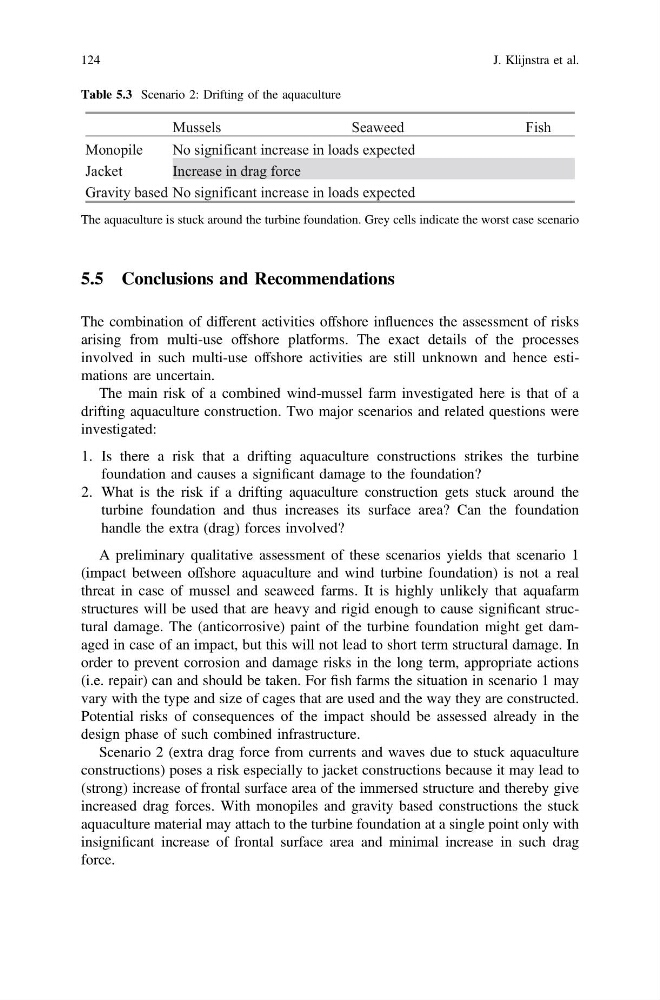
Scenario 2 (extra drag force from currents and waves due to stuck aquaculture
constructions) poses a risk especially to jacket constructions because it may lead to
(strong) increase of frontal surface area of the immersed structure and thereby give
increased drag forces. With monopiles and gravity based constructions the stuck
aquaculture material may attach to the turbine foundation at a single point only with
insignificant increase of frontal surface area and minimal increase in such drag
force.
Table 5.3 Scenario 2: Drifting of the aquaculture
Mussels
Seaweed
Fish
Monopile
No significant increase in loads expected
Jacket
Increase in drag force
Gravity based No significant increase in loads expected
The aquaculture is stuck around the turbine foundation. Grey cells indicate the worst case scenario
124
J. Klijnstra et al.
The combination of different activities offshore influences the assessment of risks
arising from multi-use offshore platforms. The exact details of the processes
involved in such multi-use offshore activities are still unknown and hence estimations are uncertain.
The main risk of a combined wind-mussel farm investigated here is that of a
drifting aquaculture construction. Two major scenarios and related questions were
investigated:
1. Is there a risk that a drifting aquaculture constructions strikes the turbine
foundation and causes a significant damage to the foundation?
2. What is the risk if a drifting aquaculture construction gets stuck around the
turbine foundation and thus increases its surface area? Can the foundation
handle the extra (drag) forces involved?
A preliminary qualitative assessment of these scenarios yields that scenario 1
(impact between offshore aquaculture and wind turbine foundation) is not a real
threat in case of mussel and seaweed farms. It is highly unlikely that aquafarm
structures will be used that are heavy and rigid enough to cause significant structural damage. The (anticorrosive) paint of the turbine foundation might get damaged in case of an impact, but this will not lead to short term structural damage. In
order to prevent corrosion and damage risks in the long term, appropriate actions
(i.e. repair) can and should be taken. For fish farms the situation in scenario 1 may
vary with the type and size of cages that are used and the way they are constructed.
Potential risks of consequences of the impact should be assessed already in the
design phase of such combined infrastructure.
Scenario 2 (extra drag force from currents and waves due to stuck aquaculture
constructions) poses a risk especially to jacket constructions because it may lead to
(strong) increase of frontal surface area of the immersed structure and thereby give
increased drag forces. With monopiles and gravity based constructions the stuck
aquaculture material may attach to the turbine foundation at a single point only with
insignificant increase of frontal surface area and minimal increase in such drag
force.
Table 5.3 Scenario 2: Drifting of the aquaculture
Mussels
Seaweed
Fish
Monopile
No significant increase in loads expected
Jacket
Increase in drag force
Gravity based No significant increase in loads expected
The aquaculture is stuck around the turbine foundation. Grey cells indicate the worst case scenario
124
J. Klijnstra et al.