

Scenario 1: Impact. Drifting aquaculture strikes the turbine foundation
It is possible that a drifting aquaculture (e.g. the longline construction, whether
or not overgrown) strikes a turbine foundation. In such a case there are three main
parameters that determine the risk of damage to the foundation:
1. the mass
2. the impact velocity
3. the deformability/robustness of the aquaculture construction
As mussel and seaweed farms mainly consist of nets and ropes, the deformability
of such structures is large. In case of an accident, it is the aquaculture construction
that deforms, and not the foundation. Probably this also holds for most fish cages.
Elastic fish cages will not damage the foundation structure; only larger, more rigid
cages have the potential to do so.
Damage to the protective coating of the foundation structures when they are hit,
is possible in all cases. On a longer term, this could induce additional corrosion
risks and negatively influence the safety of the construction. Inspections are
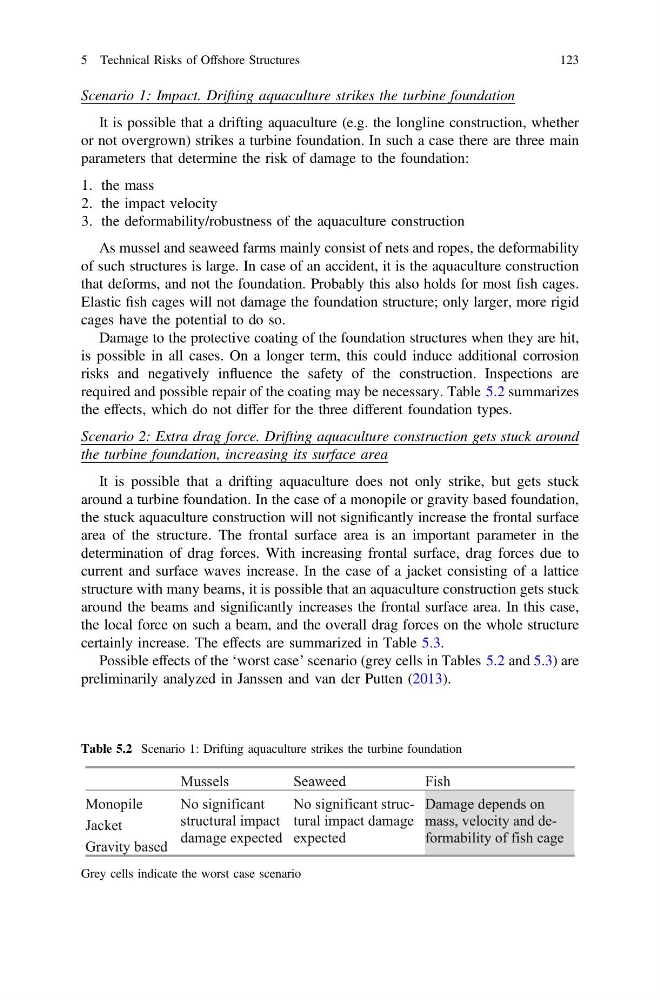
required and possible repair of the coating may be necessary. Table 5.2 summarizes
the effects, which do not differ for the three different foundation types.
Scenario 2: Extra drag force. Drifting aquaculture construction gets stuck around
the turbine foundation, increasing its surface area
It is possible that a drifting aquaculture does not only strike, but gets stuck
around a turbine foundation. In the case of a monopile or gravity based foundation,
the stuck aquaculture construction will not significantly increase the frontal surface
area of the structure. The frontal surface area is an important parameter in the
determination of drag forces. With increasing frontal surface, drag forces due to
current and surface waves increase. In the case of a jacket consisting of a lattice
structure with many beams, it is possible that an aquaculture construction gets stuck
around the beams and significantly increases the frontal surface area. In this case,
the local force on such a beam, and the overall drag forces on the whole structure
certainly increase. The effects are summarized in Table 5.3.
Possible effects of the ‘worst case’ scenario (grey cells in Tables 5.2 and 5.3) are
preliminarily analyzed in Janssen and van der Putten (2013).
Table 5.2 Scenario 1: Drifting aquaculture strikes the turbine foundation
Mussels
Seaweed
Fish
Monopile
No significant
structural impact
damage expected
No significant structural impact damage
expected
Damage depends on
mass, velocity and deformability of fish cage
Jacket
Gravity based
Grey cells indicate the worst case scenario
5 Technical Risks of Offshore Structures
123
It is possible that a drifting aquaculture (e.g. the longline construction, whether
or not overgrown) strikes a turbine foundation. In such a case there are three main
parameters that determine the risk of damage to the foundation:
1. the mass
2. the impact velocity
3. the deformability/robustness of the aquaculture construction
As mussel and seaweed farms mainly consist of nets and ropes, the deformability
of such structures is large. In case of an accident, it is the aquaculture construction
that deforms, and not the foundation. Probably this also holds for most fish cages.
Elastic fish cages will not damage the foundation structure; only larger, more rigid
cages have the potential to do so.
Damage to the protective coating of the foundation structures when they are hit,
is possible in all cases. On a longer term, this could induce additional corrosion
risks and negatively influence the safety of the construction. Inspections are
required and possible repair of the coating may be necessary. Table 5.2 summarizes
the effects, which do not differ for the three different foundation types.
Scenario 2: Extra drag force. Drifting aquaculture construction gets stuck around
the turbine foundation, increasing its surface area
It is possible that a drifting aquaculture does not only strike, but gets stuck
around a turbine foundation. In the case of a monopile or gravity based foundation,
the stuck aquaculture construction will not significantly increase the frontal surface
area of the structure. The frontal surface area is an important parameter in the
determination of drag forces. With increasing frontal surface, drag forces due to
current and surface waves increase. In the case of a jacket consisting of a lattice
structure with many beams, it is possible that an aquaculture construction gets stuck
around the beams and significantly increases the frontal surface area. In this case,
the local force on such a beam, and the overall drag forces on the whole structure
certainly increase. The effects are summarized in Table 5.3.
Possible effects of the ‘worst case’ scenario (grey cells in Tables 5.2 and 5.3) are
preliminarily analyzed in Janssen and van der Putten (2013).
Table 5.2 Scenario 1: Drifting aquaculture strikes the turbine foundation
Mussels
Seaweed
Fish
Monopile
No significant
structural impact
damage expected
No significant structural impact damage
expected
Damage depends on
mass, velocity and deformability of fish cage
Jacket
Gravity based
Grey cells indicate the worst case scenario
5 Technical Risks of Offshore Structures
123