

stability reasons. Similarly, the spherical fish cage had three force transducers
connecting from the equator of the sphere towards the tripiles plus a vertical force
transducer to bear the vertical forces. Highest tension forces appear at the
wave-facing tripile leg during the passage of the wave crest. In parallel, these forces
initiated by the wave at the front of the cylinder are also measured at the backward
force transducers but with opposite sign and vectorially separated.
In order to analyze the correlation between the wave heights and the caused
reaction forces a zero-crossing method has been applied to the water surface elevation measurement which was located besides the wave-facing front tripile of the
OWEC. Thereafter the maximum values of the surface elevation and the forces
have been collected. Experimentally, three different flow resistances are considered.
First, the fish cage is tested only with its support structure. One and two layers of
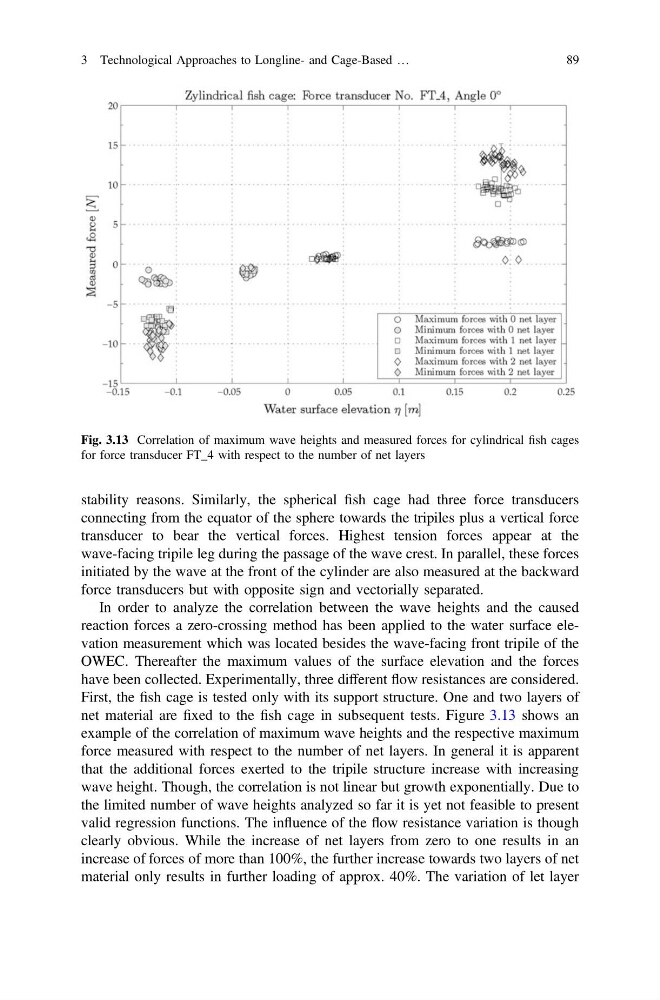
net material are fixed to the fish cage in subsequent tests. Figure 3.13 shows an
example of the correlation of maximum wave heights and the respective maximum
force measured with respect to the number of net layers. In general it is apparent
that the additional forces exerted to the tripile structure increase with increasing
wave height. Though, the correlation is not linear but growth exponentially. Due to
the limited number of wave heights analyzed so far it is yet not feasible to present
valid regression functions. The influence of the flow resistance variation is though
clearly obvious. While the increase of net layers from zero to one results in an
increase of forces of more than 100%, the further increase towards two layers of net
material only results in further loading of approx. 40%. The variation of let layer
Fig. 3.13 Correlation of maximum wave heights and measured forces for cylindrical fish cages
for force transducer FT_4 with respect to the number of net layers
3 Technological Approaches to Longline- and Cage-Based …
89
connecting from the equator of the sphere towards the tripiles plus a vertical force
transducer to bear the vertical forces. Highest tension forces appear at the
wave-facing tripile leg during the passage of the wave crest. In parallel, these forces
initiated by the wave at the front of the cylinder are also measured at the backward
force transducers but with opposite sign and vectorially separated.
In order to analyze the correlation between the wave heights and the caused
reaction forces a zero-crossing method has been applied to the water surface elevation measurement which was located besides the wave-facing front tripile of the
OWEC. Thereafter the maximum values of the surface elevation and the forces
have been collected. Experimentally, three different flow resistances are considered.
First, the fish cage is tested only with its support structure. One and two layers of
net material are fixed to the fish cage in subsequent tests. Figure 3.13 shows an
example of the correlation of maximum wave heights and the respective maximum
force measured with respect to the number of net layers. In general it is apparent
that the additional forces exerted to the tripile structure increase with increasing
wave height. Though, the correlation is not linear but growth exponentially. Due to
the limited number of wave heights analyzed so far it is yet not feasible to present
valid regression functions. The influence of the flow resistance variation is though
clearly obvious. While the increase of net layers from zero to one results in an
increase of forces of more than 100%, the further increase towards two layers of net
material only results in further loading of approx. 40%. The variation of let layer
Fig. 3.13 Correlation of maximum wave heights and measured forces for cylindrical fish cages
for force transducer FT_4 with respect to the number of net layers
3 Technological Approaches to Longline- and Cage-Based …
89