

64
3 SAMPA Chip Implementation
3.2.4 Data Compression
Even though the SAMPA has enough output data links to handle reading out raw
data, it is often not practical or economically feasible to do a raw readout. Different
compression methods are provided to reduce the data amount enough so that fewer
serial data links can be used. Both lossless and lossy compressions are available,
depending on the detectors needs and resources.
Zero suppression This method removes all data below a given threshold, leaving
only cluster data. As the data that is in between clusters are lost, it is a lossy
encoding. This method is highly dependent on having a stable baseline to achieve
good compression and minimal loss of information, so digital signal conditioning
is normally needed.
Zero suppression with cluster sum This method operates on the same principle
as zero suppression, but integrates the sample values in the cluster into one value.
This compression method is suitable for detectors that have very clean signals
and where only the time for the start of the cluster and the area is of interest.
Modified Huffman This compression method is a lossless compression, i.e. no
information is lost. It uses differential encoding of the data combined with a lookup
table to reduce the length of each word. This method is useful for detectors that
want all data, but has limited bandwidth available. Depending on the detector
data, it has a compression factor close to or better than zero suppression.
3.2.4.1 Zero Suppression
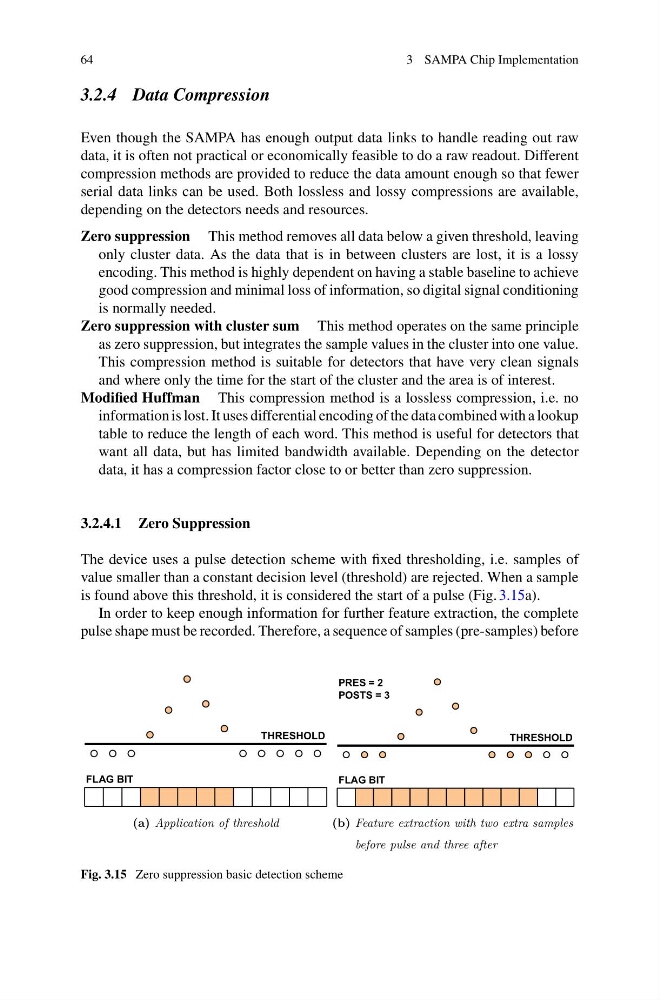
The device uses a pulse detection scheme with fixed thresholding, i.e. samples of
value smaller than a constant decision level (threshold) are rejected. When a sample
is found above this threshold, it is considered the start of a pulse (Fig. 3.15a).
In order to keep enough information for further feature extraction, the complete
pulse shape must be recorded. Therefore, a sequence of samples (pre-samples) before
THRESHOLD
FLAG BIT
(a) Application of threshold
THRESHOLD
FLAG BIT
PRES = 2
POSTS = 3
(b) Feature extraction with two extra samples
before pulse and three after
Fig. 3.15 Zero suppression basic detection scheme
3 SAMPA Chip Implementation
3.2.4 Data Compression
Even though the SAMPA has enough output data links to handle reading out raw
data, it is often not practical or economically feasible to do a raw readout. Different
compression methods are provided to reduce the data amount enough so that fewer
serial data links can be used. Both lossless and lossy compressions are available,
depending on the detectors needs and resources.
Zero suppression This method removes all data below a given threshold, leaving
only cluster data. As the data that is in between clusters are lost, it is a lossy
encoding. This method is highly dependent on having a stable baseline to achieve
good compression and minimal loss of information, so digital signal conditioning
is normally needed.
Zero suppression with cluster sum This method operates on the same principle
as zero suppression, but integrates the sample values in the cluster into one value.
This compression method is suitable for detectors that have very clean signals
and where only the time for the start of the cluster and the area is of interest.
Modified Huffman This compression method is a lossless compression, i.e. no
information is lost. It uses differential encoding of the data combined with a lookup
table to reduce the length of each word. This method is useful for detectors that
want all data, but has limited bandwidth available. Depending on the detector
data, it has a compression factor close to or better than zero suppression.
3.2.4.1 Zero Suppression
The device uses a pulse detection scheme with fixed thresholding, i.e. samples of
value smaller than a constant decision level (threshold) are rejected. When a sample
is found above this threshold, it is considered the start of a pulse (Fig. 3.15a).
In order to keep enough information for further feature extraction, the complete
pulse shape must be recorded. Therefore, a sequence of samples (pre-samples) before
THRESHOLD
FLAG BIT
(a) Application of threshold
THRESHOLD
FLAG BIT
PRES = 2
POSTS = 3
(b) Feature extraction with two extra samples
before pulse and three after
Fig. 3.15 Zero suppression basic detection scheme