

2.4 Digital Specification
37
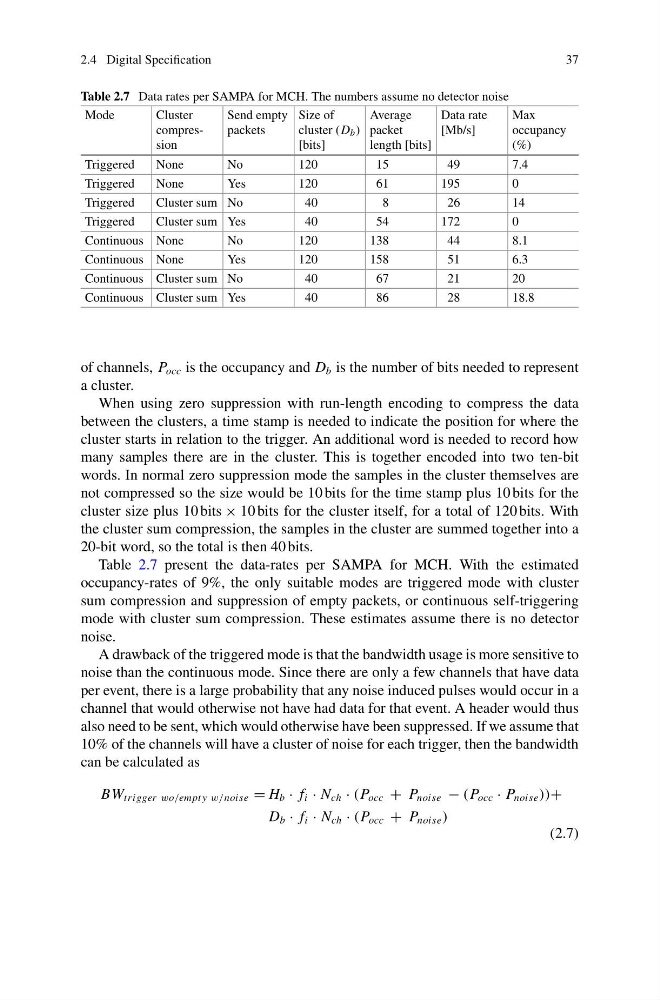
Table 2.7 Data rates per SAMPA for MCH. The numbers assume no detector noise
Mode
Cluster
compression
Send empty
packets
Size of
cluster (D b )
[bits]
Average
packet
length [bits]
Data rate
[Mb/s]
Max
occupancy
(%)
Triggered
None
No
120
15
49
7.4
Triggered
None
Yes
120
61
195
0
Triggered
Cluster sum No
40
8
26
14
Triggered
Cluster sum Yes
40
54
172
0
Continuous None
No
120
138
44
8.1
Continuous None
Yes
120
158
51
6.3
Continuous Cluster sum No
40
67
21
20
Continuous Cluster sum Yes
40
86
28
18.8
of channels, P occ is the occupancy and D b is the number of bits needed to represent
a cluster.
When using zero suppression with run-length encoding to compress the data
between the clusters, a time stamp is needed to indicate the position for where the
cluster starts in relation to the trigger. An additional word is needed to record how
many samples there are in the cluster. This is together encoded into two ten-bit
words. In normal zero suppression mode the samples in the cluster themselves are
not compressed so the size would be 10 bits for the time stamp plus 10 bits for the
cluster size plus 10 bits × 10 bits for the cluster itself, for a total of 120 bits. With
the cluster sum compression, the samples in the cluster are summed together into a
20-bit word, so the total is then 40 bits.
Table 2.7 present the data-rates per SAMPA for MCH. With the estimated
occupancy-rates of 9%, the only suitable modes are triggered mode with cluster
sum compression and suppression of empty packets, or continuous self-triggering
mode with cluster sum compression. These estimates assume there is no detector
noise.
A drawback of the triggered mode is that the bandwidth usage is more sensitive to
noise than the continuous mode. Since there are only a few channels that have data
per event, there is a large probability that any noise induced pulses would occur in a
channel that would otherwise not have had data for that event. A header would thus
also need to be sent, which would otherwise have been suppressed. If we assume that
10% of the channels will have a cluster of noise for each trigger, then the bandwidth
can be calculated as
BW trigger wo/empt y w/noise = H b · f i · N ch · (P occ + P noise − (P occ · P noise ))+
D b · f i · N ch · (P occ + P noise )
(2.7)
37
Table 2.7 Data rates per SAMPA for MCH. The numbers assume no detector noise
Mode
Cluster
compression
Send empty
packets
Size of
cluster (D b )
[bits]
Average
packet
length [bits]
Data rate
[Mb/s]
Max
occupancy
(%)
Triggered
None
No
120
15
49
7.4
Triggered
None
Yes
120
61
195
0
Triggered
Cluster sum No
40
8
26
14
Triggered
Cluster sum Yes
40
54
172
0
Continuous None
No
120
138
44
8.1
Continuous None
Yes
120
158
51
6.3
Continuous Cluster sum No
40
67
21
20
Continuous Cluster sum Yes
40
86
28
18.8
of channels, P occ is the occupancy and D b is the number of bits needed to represent
a cluster.
When using zero suppression with run-length encoding to compress the data
between the clusters, a time stamp is needed to indicate the position for where the
cluster starts in relation to the trigger. An additional word is needed to record how
many samples there are in the cluster. This is together encoded into two ten-bit
words. In normal zero suppression mode the samples in the cluster themselves are
not compressed so the size would be 10 bits for the time stamp plus 10 bits for the
cluster size plus 10 bits × 10 bits for the cluster itself, for a total of 120 bits. With
the cluster sum compression, the samples in the cluster are summed together into a
20-bit word, so the total is then 40 bits.
Table 2.7 present the data-rates per SAMPA for MCH. With the estimated
occupancy-rates of 9%, the only suitable modes are triggered mode with cluster
sum compression and suppression of empty packets, or continuous self-triggering
mode with cluster sum compression. These estimates assume there is no detector
noise.
A drawback of the triggered mode is that the bandwidth usage is more sensitive to
noise than the continuous mode. Since there are only a few channels that have data
per event, there is a large probability that any noise induced pulses would occur in a
channel that would otherwise not have had data for that event. A header would thus
also need to be sent, which would otherwise have been suppressed. If we assume that
10% of the channels will have a cluster of noise for each trigger, then the bandwidth
can be calculated as
BW trigger wo/empt y w/noise = H b · f i · N ch · (P occ + P noise − (P occ · P noise ))+
D b · f i · N ch · (P occ + P noise )
(2.7)