

2.4 Digital Specification
35
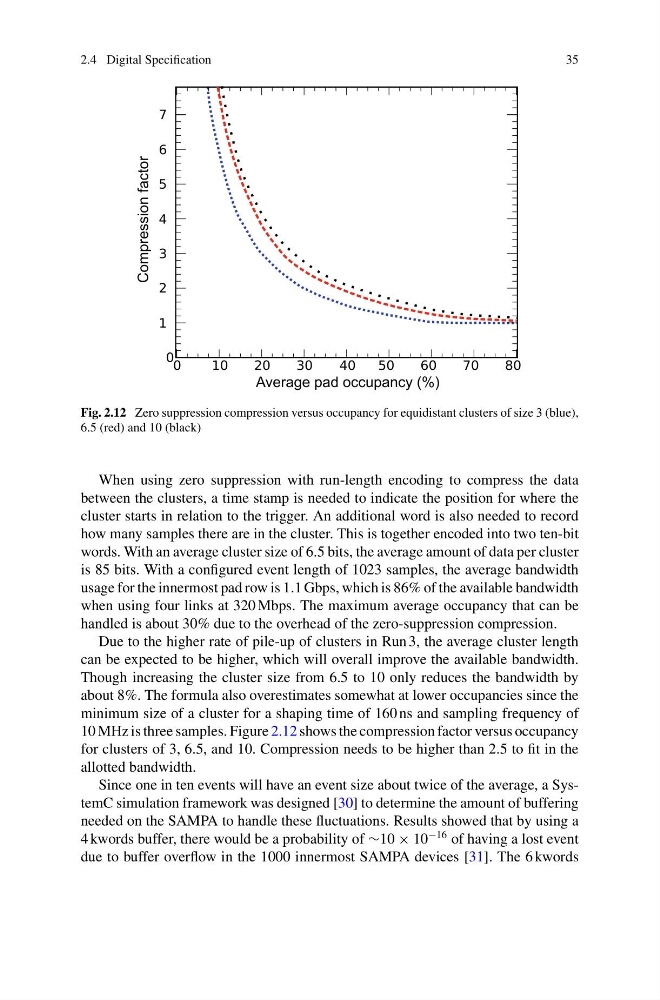
Fig. 2.12 Zero suppression compression versus occupancy for equidistant clusters of size 3 (blue),
6.5 (red) and 10 (black)
When using zero suppression with run-length encoding to compress the data
between the clusters, a time stamp is needed to indicate the position for where the
cluster starts in relation to the trigger. An additional word is also needed to record
how many samples there are in the cluster. This is together encoded into two ten-bit
words. With an average cluster size of 6.5 bits, the average amount of data per cluster
is 85 bits. With a configured event length of 1023 samples, the average bandwidth
usage for the innermost pad row is 1.1 Gbps, which is 86% of the available bandwidth
when using four links at 320 Mbps. The maximum average occupancy that can be
handled is about 30% due to the overhead of the zero-suppression compression.
Due to the higher rate of pile-up of clusters in Run 3, the average cluster length
can be expected to be higher, which will overall improve the available bandwidth.
Though increasing the cluster size from 6.5 to 10 only reduces the bandwidth by
about 8%. The formula also overestimates somewhat at lower occupancies since the
minimum size of a cluster for a shaping time of 160 ns and sampling frequency of
10 MHz is three samples. Figure 2.12 shows the compression factor versus occupancy
for clusters of 3, 6.5, and 10. Compression needs to be higher than 2.5 to fit in the
allotted bandwidth.
Since one in ten events will have an event size about twice of the average, a SystemC simulation framework was designed [30] to determine the amount of buffering
needed on the SAMPA to handle these fluctuations. Results showed that by using a
4 kwords buffer, there would be a probability of ∼10 × 10
−16 of having a lost event
due to buffer overflow in the 1000 innermost SAMPA devices [31]. The 6 kwords
35
Fig. 2.12 Zero suppression compression versus occupancy for equidistant clusters of size 3 (blue),
6.5 (red) and 10 (black)
When using zero suppression with run-length encoding to compress the data
between the clusters, a time stamp is needed to indicate the position for where the
cluster starts in relation to the trigger. An additional word is also needed to record
how many samples there are in the cluster. This is together encoded into two ten-bit
words. With an average cluster size of 6.5 bits, the average amount of data per cluster
is 85 bits. With a configured event length of 1023 samples, the average bandwidth
usage for the innermost pad row is 1.1 Gbps, which is 86% of the available bandwidth
when using four links at 320 Mbps. The maximum average occupancy that can be
handled is about 30% due to the overhead of the zero-suppression compression.
Due to the higher rate of pile-up of clusters in Run 3, the average cluster length
can be expected to be higher, which will overall improve the available bandwidth.
Though increasing the cluster size from 6.5 to 10 only reduces the bandwidth by
about 8%. The formula also overestimates somewhat at lower occupancies since the
minimum size of a cluster for a shaping time of 160 ns and sampling frequency of
10 MHz is three samples. Figure 2.12 shows the compression factor versus occupancy
for clusters of 3, 6.5, and 10. Compression needs to be higher than 2.5 to fit in the
allotted bandwidth.
Since one in ten events will have an event size about twice of the average, a SystemC simulation framework was designed [30] to determine the amount of buffering
needed on the SAMPA to handle these fluctuations. Results showed that by using a
4 kwords buffer, there would be a probability of ∼10 × 10
−16 of having a lost event
due to buffer overflow in the 1000 innermost SAMPA devices [31]. The 6 kwords