

26
2 Front-End Electronics
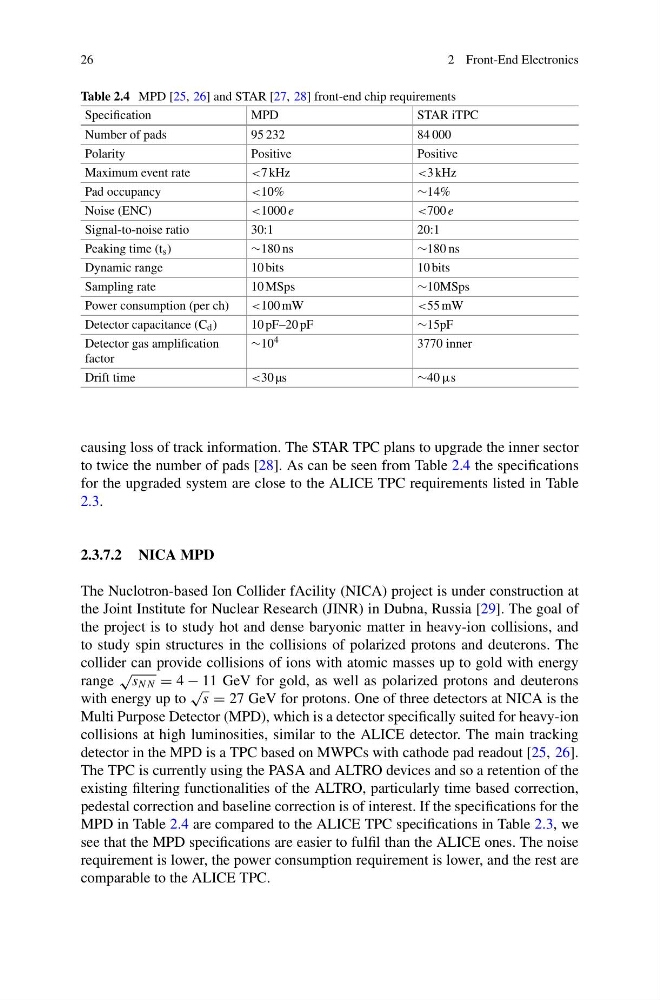
Table 2.4 MPD [25, 26] and STAR [27, 28] front-end chip requirements
Specification
MPD
STAR iTPC
Number of pads
95 232
84 000
Polarity
Positive
Positive
Maximum event rate
<7 kHz
<3 kHz
Pad occupancy
<10%
∼14%
Noise (ENC)
<1000 e
<700 e
Signal-to-noise ratio
30:1
20:1
Peaking time (t s )
∼180 ns
∼180 ns
Dynamic range
10 bits
10 bits
Sampling rate
10 MSps
∼10MSps
Power consumption (per ch)
<100 mW
<55 mW
Detector capacitance (C d )
10 pF–20 pF
∼15pF
Detector gas amplification
factor
∼10 4
3770 inner
Drift time
<30 µs
∼40 µs
causing loss of track information. The STAR TPC plans to upgrade the inner sector
to twice the number of pads [28]. As can be seen from Table 2.4 the specifications
for the upgraded system are close to the ALICE TPC requirements listed in Table
2.3.
2.3.7.2 NICA MPD
The Nuclotron-based Ion Collider fAcility (NICA) project is under construction at
the Joint Institute for Nuclear Research (JINR) in Dubna, Russia [29]. The goal of
the project is to study hot and dense baryonic matter in heavy-ion collisions, and
to study spin structures in the collisions of polarized protons and deuterons. The
collider can provide collisions of ions with atomic masses up to gold with energy
range
√
s N N = 4 − 11 GeV for gold, as well as polarized protons and deuterons
with energy up to
√
s = 27 GeV for protons. One of three detectors at NICA is the
Multi Purpose Detector (MPD), which is a detector specifically suited for heavy-ion
collisions at high luminosities, similar to the ALICE detector. The main tracking
detector in the MPD is a TPC based on MWPCs with cathode pad readout [25, 26].
The TPC is currently using the PASA and ALTRO devices and so a retention of the
existing filtering functionalities of the ALTRO, particularly time based correction,
pedestal correction and baseline correction is of interest. If the specifications for the
MPD in Table 2.4 are compared to the ALICE TPC specifications in Table 2.3, we
see that the MPD specifications are easier to fulfil than the ALICE ones. The noise
requirement is lower, the power consumption requirement is lower, and the rest are
comparable to the ALICE TPC.
2 Front-End Electronics
Table 2.4 MPD [25, 26] and STAR [27, 28] front-end chip requirements
Specification
MPD
STAR iTPC
Number of pads
95 232
84 000
Polarity
Positive
Positive
Maximum event rate
<7 kHz
<3 kHz
Pad occupancy
<10%
∼14%
Noise (ENC)
<1000 e
<700 e
Signal-to-noise ratio
30:1
20:1
Peaking time (t s )
∼180 ns
∼180 ns
Dynamic range
10 bits
10 bits
Sampling rate
10 MSps
∼10MSps
Power consumption (per ch)
<100 mW
<55 mW
Detector capacitance (C d )
10 pF–20 pF
∼15pF
Detector gas amplification
factor
∼10 4
3770 inner
Drift time
<30 µs
∼40 µs
causing loss of track information. The STAR TPC plans to upgrade the inner sector
to twice the number of pads [28]. As can be seen from Table 2.4 the specifications
for the upgraded system are close to the ALICE TPC requirements listed in Table
2.3.
2.3.7.2 NICA MPD
The Nuclotron-based Ion Collider fAcility (NICA) project is under construction at
the Joint Institute for Nuclear Research (JINR) in Dubna, Russia [29]. The goal of
the project is to study hot and dense baryonic matter in heavy-ion collisions, and
to study spin structures in the collisions of polarized protons and deuterons. The
collider can provide collisions of ions with atomic masses up to gold with energy
range
√
s N N = 4 − 11 GeV for gold, as well as polarized protons and deuterons
with energy up to
√
s = 27 GeV for protons. One of three detectors at NICA is the
Multi Purpose Detector (MPD), which is a detector specifically suited for heavy-ion
collisions at high luminosities, similar to the ALICE detector. The main tracking
detector in the MPD is a TPC based on MWPCs with cathode pad readout [25, 26].
The TPC is currently using the PASA and ALTRO devices and so a retention of the
existing filtering functionalities of the ALTRO, particularly time based correction,
pedestal correction and baseline correction is of interest. If the specifications for the
MPD in Table 2.4 are compared to the ALICE TPC specifications in Table 2.3, we
see that the MPD specifications are easier to fulfil than the ALICE ones. The noise
requirement is lower, the power consumption requirement is lower, and the rest are
comparable to the ALICE TPC.