

4
1 Introduction
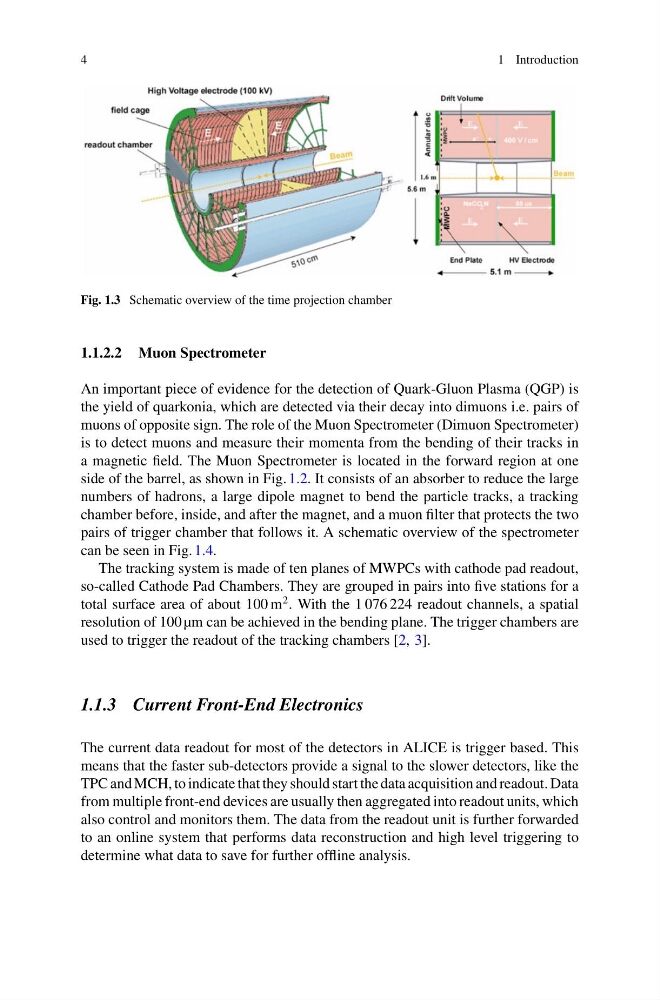
Fig. 1.3 Schematic overview of the time projection chamber
1.1.2.2 Muon Spectrometer
An important piece of evidence for the detection of Quark-Gluon Plasma (QGP) is
the yield of quarkonia, which are detected via their decay into dimuons i.e. pairs of
muons of opposite sign. The role of the Muon Spectrometer (Dimuon Spectrometer)
is to detect muons and measure their momenta from the bending of their tracks in
a magnetic field. The Muon Spectrometer is located in the forward region at one
side of the barrel, as shown in Fig. 1.2. It consists of an absorber to reduce the large
numbers of hadrons, a large dipole magnet to bend the particle tracks, a tracking
chamber before, inside, and after the magnet, and a muon filter that protects the two
pairs of trigger chamber that follows it. A schematic overview of the spectrometer
can be seen in Fig. 1.4.
The tracking system is made of ten planes of MWPCs with cathode pad readout,
so-called Cathode Pad Chambers. They are grouped in pairs into five stations for a
total surface area of about 100 m
2 . With the 1 076 224 readout channels, a spatial
resolution of 100 µm can be achieved in the bending plane. The trigger chambers are
used to trigger the readout of the tracking chambers [2, 3].
1.1.3 Current Front-End Electronics
The current data readout for most of the detectors in ALICE is trigger based. This
means that the faster sub-detectors provide a signal to the slower detectors, like the
TPC and MCH, to indicate that they should start the data acquisition and readout. Data
from multiple front-end devices are usually then aggregated into readout units, which
also control and monitors them. The data from the readout unit is further forwarded
to an online system that performs data reconstruction and high level triggering to
determine what data to save for further offline analysis.
1 Introduction
Fig. 1.3 Schematic overview of the time projection chamber
1.1.2.2 Muon Spectrometer
An important piece of evidence for the detection of Quark-Gluon Plasma (QGP) is
the yield of quarkonia, which are detected via their decay into dimuons i.e. pairs of
muons of opposite sign. The role of the Muon Spectrometer (Dimuon Spectrometer)
is to detect muons and measure their momenta from the bending of their tracks in
a magnetic field. The Muon Spectrometer is located in the forward region at one
side of the barrel, as shown in Fig. 1.2. It consists of an absorber to reduce the large
numbers of hadrons, a large dipole magnet to bend the particle tracks, a tracking
chamber before, inside, and after the magnet, and a muon filter that protects the two
pairs of trigger chamber that follows it. A schematic overview of the spectrometer
can be seen in Fig. 1.4.
The tracking system is made of ten planes of MWPCs with cathode pad readout,
so-called Cathode Pad Chambers. They are grouped in pairs into five stations for a
total surface area of about 100 m
2 . With the 1 076 224 readout channels, a spatial
resolution of 100 µm can be achieved in the bending plane. The trigger chambers are
used to trigger the readout of the tracking chambers [2, 3].
1.1.3 Current Front-End Electronics
The current data readout for most of the detectors in ALICE is trigger based. This
means that the faster sub-detectors provide a signal to the slower detectors, like the
TPC and MCH, to indicate that they should start the data acquisition and readout. Data
from multiple front-end devices are usually then aggregated into readout units, which
also control and monitors them. The data from the readout unit is further forwarded
to an online system that performs data reconstruction and high level triggering to
determine what data to save for further offline analysis.