

3.8 Thresholdless Lasers
81
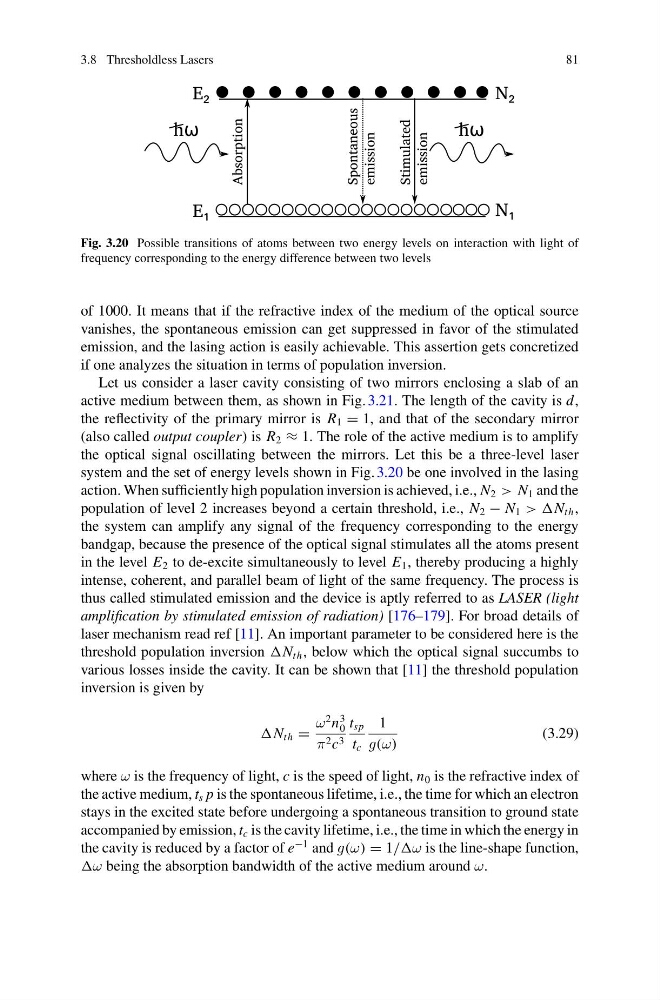
Fig. 3.20 Possible transitions of atoms between two energy levels on interaction with light of
frequency corresponding to the energy difference between two levels
of 1000. It means that if the refractive index of the medium of the optical source
vanishes, the spontaneous emission can get suppressed in favor of the stimulated
emission, and the lasing action is easily achievable. This assertion gets concretized
if one analyzes the situation in terms of population inversion.
Let us consider a laser cavity consisting of two mirrors enclosing a slab of an
active medium between them, as shown in Fig. 3.21. The length of the cavity is d,
the reflectivity of the primary mirror is R 1 = 1, and that of the secondary mirror
(also called output coupler) is R 2 ≈ 1. The role of the active medium is to amplify
the optical signal oscillating between the mirrors. Let this be a three-level laser
system and the set of energy levels shown in Fig. 3.20 be one involved in the lasing
action. When sufficiently high population inversion is achieved, i.e., N 2 > N 1 and the
population of level 2 increases beyond a certain threshold, i.e., N 2 − N 1 > >N th ,
the system can amplify any signal of the frequency corresponding to the energy
bandgap, because the presence of the optical signal stimulates all the atoms present
in the level E 2 to de-excite simultaneously to level E 1 , thereby producing a highly
intense, coherent, and parallel beam of light of the same frequency. The process is
thus called stimulated emission and the device is aptly referred to as LASER (light
amplification by stimulated emission of radiation) [176–179]. For broad details of
laser mechanism read ref [11]. An important parameter to be considered here is the
threshold population inversion th , below which the optical signal succumbs to
various losses inside the cavity. It can be shown that [11] the threshold population
inversion is given by
th =
ω
2 n
3
0
π 2 c 3
t sp
t c
1
g(ω)
(3.29)
where ω is the frequency of light, c is the speed of light, n 0 is the refractive index of
the active medium, t s p is the spontaneous lifetime, i.e., the time for which an electron
stays in the excited state before undergoing a spontaneous transition to ground state
accompanied by emission, t c is the cavity lifetime, i.e., the time in which the energy in
the cavity is reduced by a factor of e
−1 and g(ω) = 1//ω is the line-shape function,
being the absorption bandwidth of the active medium around ω.
81
Fig. 3.20 Possible transitions of atoms between two energy levels on interaction with light of
frequency corresponding to the energy difference between two levels
of 1000. It means that if the refractive index of the medium of the optical source
vanishes, the spontaneous emission can get suppressed in favor of the stimulated
emission, and the lasing action is easily achievable. This assertion gets concretized
if one analyzes the situation in terms of population inversion.
Let us consider a laser cavity consisting of two mirrors enclosing a slab of an
active medium between them, as shown in Fig. 3.21. The length of the cavity is d,
the reflectivity of the primary mirror is R 1 = 1, and that of the secondary mirror
(also called output coupler) is R 2 ≈ 1. The role of the active medium is to amplify
the optical signal oscillating between the mirrors. Let this be a three-level laser
system and the set of energy levels shown in Fig. 3.20 be one involved in the lasing
action. When sufficiently high population inversion is achieved, i.e., N 2 > N 1 and the
population of level 2 increases beyond a certain threshold, i.e., N 2 − N 1 > >N th ,
the system can amplify any signal of the frequency corresponding to the energy
bandgap, because the presence of the optical signal stimulates all the atoms present
in the level E 2 to de-excite simultaneously to level E 1 , thereby producing a highly
intense, coherent, and parallel beam of light of the same frequency. The process is
thus called stimulated emission and the device is aptly referred to as LASER (light
amplification by stimulated emission of radiation) [176–179]. For broad details of
laser mechanism read ref [11]. An important parameter to be considered here is the
threshold population inversion th , below which the optical signal succumbs to
various losses inside the cavity. It can be shown that [11] the threshold population
inversion is given by
th =
ω
2 n
3
0
π 2 c 3
t sp
t c
1
g(ω)
(3.29)
where ω is the frequency of light, c is the speed of light, n 0 is the refractive index of
the active medium, t s p is the spontaneous lifetime, i.e., the time for which an electron
stays in the excited state before undergoing a spontaneous transition to ground state
accompanied by emission, t c is the cavity lifetime, i.e., the time in which the energy in
the cavity is reduced by a factor of e
−1 and g(ω) = 1//ω is the line-shape function,
being the absorption bandwidth of the active medium around ω.