

80
3 Applications of Zero-Index Metamaterials
U 21 = A 21 N 2
(3.20)
At thermal equilibrium, the total number of transitions from 1 to 2 is equal to the
total number of transitions from 2 to 1, i.e.,
12 = 21 + U 21
(3.21)
B 12 N 1 u(ω) = B 21 N 2 u(ω) + A 21 N 2
(3.22)
or
u(ω) =
A 21
(N 1 /N 2 )B 12 − B 21
(3.23)
=
A 21
B 12 e ω/K B T − B 21
(3.24)
According to Planck’s law of radiation, the energy density per unit frequency interval
is given as [174, 175]
u(ω) =
ω
3 n
3
0
π 2 c 3
1
e ω/K B T − 1
(3.25)
where K B = 1.38 × 10
−23 J/K is Boltzmann’s constant, c is the velocity of light,
and n 0 is the refractive index of the medium. Comparing Eq. 3.24 and Eq. 3.25, we
get
B 12 = B 21 = B
(3.26)
and
A 21
B 21
=
A
B
=
ω
3 n
3
0
π 2 c 3
(3.27)
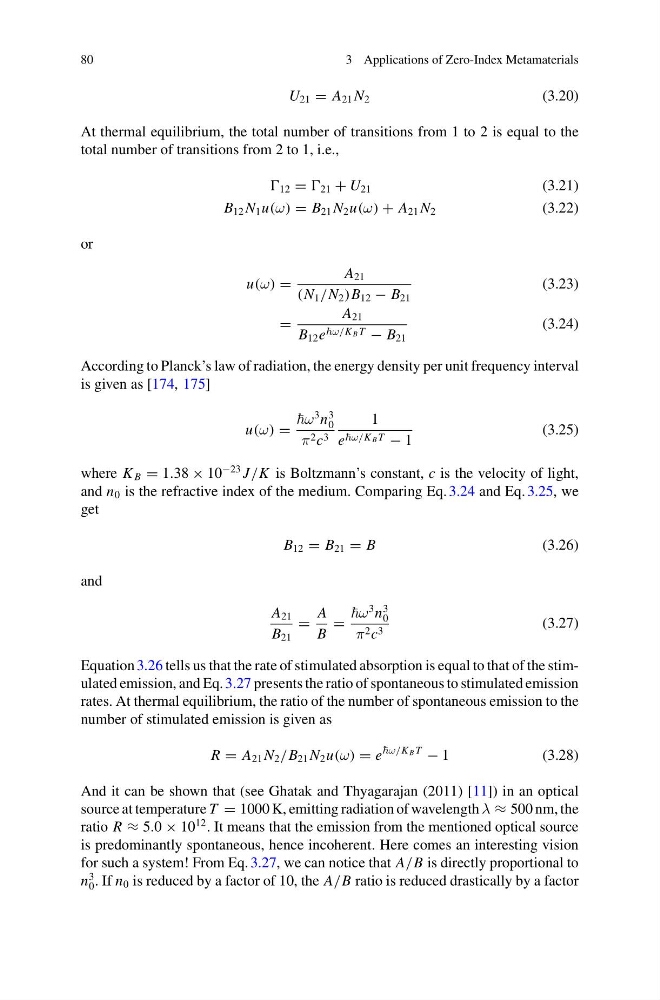
Equation 3.26 tells us that the rate of stimulated absorption is equal to that of the stimulated emission, and Eq. 3.27 presents the ratio of spontaneous to stimulated emission
rates. At thermal equilibrium, the ratio of the number of spontaneous emission to the
number of stimulated emission is given as
R = A 21 N 2 /B 21 N 2 u(ω) = e
ω/K B T
− 1
(3.28)
And it can be shown that (see Ghatak and Thyagarajan (2011) [11]) in an optical
source at temperature T = 1000 K, emitting radiation of wavelength λ ≈ 500 nm, the
ratio R ≈ 5.0 × 10
12 . It means that the emission from the mentioned optical source
is predominantly spontaneous, hence incoherent. Here comes an interesting vision
for such a system! From Eq. 3.27, we can notice that A/B is directly proportional to
n
3
0 . If n 0 is reduced by a factor of 10, the A/B ratio is reduced drastically by a factor
3 Applications of Zero-Index Metamaterials
U 21 = A 21 N 2
(3.20)
At thermal equilibrium, the total number of transitions from 1 to 2 is equal to the
total number of transitions from 2 to 1, i.e.,
12 = 21 + U 21
(3.21)
B 12 N 1 u(ω) = B 21 N 2 u(ω) + A 21 N 2
(3.22)
or
u(ω) =
A 21
(N 1 /N 2 )B 12 − B 21
(3.23)
=
A 21
B 12 e ω/K B T − B 21
(3.24)
According to Planck’s law of radiation, the energy density per unit frequency interval
is given as [174, 175]
u(ω) =
ω
3 n
3
0
π 2 c 3
1
e ω/K B T − 1
(3.25)
where K B = 1.38 × 10
−23 J/K is Boltzmann’s constant, c is the velocity of light,
and n 0 is the refractive index of the medium. Comparing Eq. 3.24 and Eq. 3.25, we
get
B 12 = B 21 = B
(3.26)
and
A 21
B 21
=
A
B
=
ω
3 n
3
0
π 2 c 3
(3.27)
Equation 3.26 tells us that the rate of stimulated absorption is equal to that of the stimulated emission, and Eq. 3.27 presents the ratio of spontaneous to stimulated emission
rates. At thermal equilibrium, the ratio of the number of spontaneous emission to the
number of stimulated emission is given as
R = A 21 N 2 /B 21 N 2 u(ω) = e
ω/K B T
− 1
(3.28)
And it can be shown that (see Ghatak and Thyagarajan (2011) [11]) in an optical
source at temperature T = 1000 K, emitting radiation of wavelength λ ≈ 500 nm, the
ratio R ≈ 5.0 × 10
12 . It means that the emission from the mentioned optical source
is predominantly spontaneous, hence incoherent. Here comes an interesting vision
for such a system! From Eq. 3.27, we can notice that A/B is directly proportional to
n
3
0 . If n 0 is reduced by a factor of 10, the A/B ratio is reduced drastically by a factor