

3.2 Electromagnetic Tunneling
61
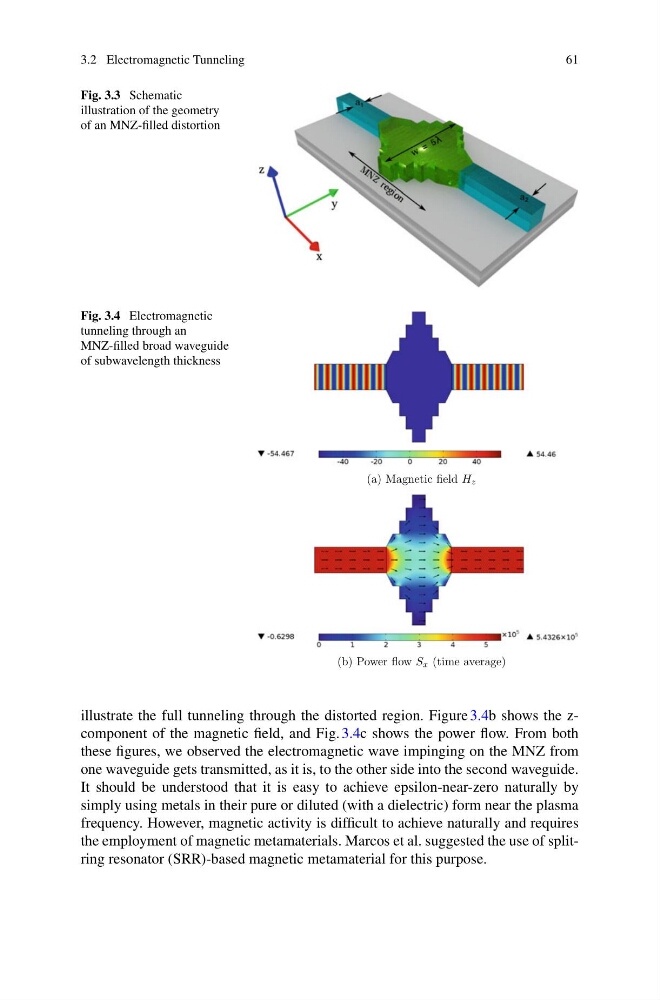
Fig. 3.3 Schematic
illustration of the geometry
of an MNZ-filled distortion
Fig. 3.4 Electromagnetic
tunneling through an
MNZ-filled broad waveguide
of subwavelength thickness
(a) Magnetic field H z
(b) Power flow S x (time average)
illustrate the full tunneling through the distorted region. Figure 3.4b shows the zcomponent of the magnetic field, and Fig. 3.4c shows the power flow. From both
these figures, we observed the electromagnetic wave impinging on the MNZ from
one waveguide gets transmitted, as it is, to the other side into the second waveguide.
It should be understood that it is easy to achieve epsilon-near-zero naturally by
simply using metals in their pure or diluted (with a dielectric) form near the plasma
frequency. However, magnetic activity is difficult to achieve naturally and requires
the employment of magnetic metamaterials. Marcos et al. suggested the use of splitring resonator (SRR)-based magnetic metamaterial for this purpose.
61
Fig. 3.3 Schematic
illustration of the geometry
of an MNZ-filled distortion
Fig. 3.4 Electromagnetic
tunneling through an
MNZ-filled broad waveguide
of subwavelength thickness
(a) Magnetic field H z
(b) Power flow S x (time average)
illustrate the full tunneling through the distorted region. Figure 3.4b shows the zcomponent of the magnetic field, and Fig. 3.4c shows the power flow. From both
these figures, we observed the electromagnetic wave impinging on the MNZ from
one waveguide gets transmitted, as it is, to the other side into the second waveguide.
It should be understood that it is easy to achieve epsilon-near-zero naturally by
simply using metals in their pure or diluted (with a dielectric) form near the plasma
frequency. However, magnetic activity is difficult to achieve naturally and requires
the employment of magnetic metamaterials. Marcos et al. suggested the use of splitring resonator (SRR)-based magnetic metamaterial for this purpose.