

60
3 Applications of Zero-Index Metamaterials
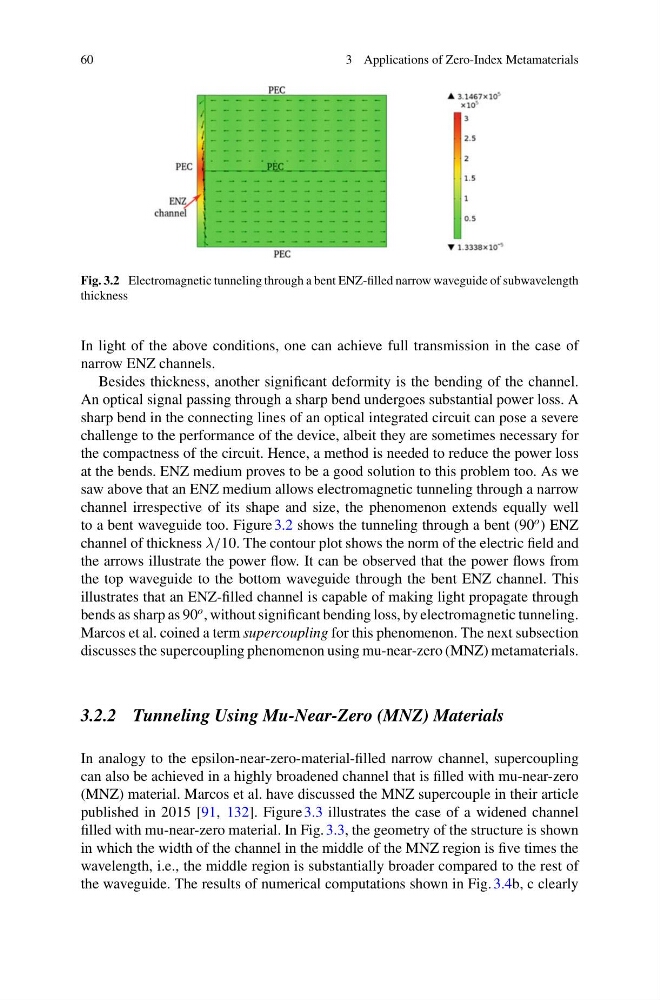
Fig. 3.2 Electromagnetic tunneling through a bent ENZ-filled narrow waveguide of subwavelength
thickness
In light of the above conditions, one can achieve full transmission in the case of
narrow ENZ channels.
Besides thickness, another significant deformity is the bending of the channel.
An optical signal passing through a sharp bend undergoes substantial power loss. A
sharp bend in the connecting lines of an optical integrated circuit can pose a severe
challenge to the performance of the device, albeit they are sometimes necessary for
the compactness of the circuit. Hence, a method is needed to reduce the power loss
at the bends. ENZ medium proves to be a good solution to this problem too. As we
saw above that an ENZ medium allows electromagnetic tunneling through a narrow
channel irrespective of its shape and size, the phenomenon extends equally well
to a bent waveguide too. Figure 3.2 shows the tunneling through a bent (90
o ) ENZ
channel of thickness λ/10. The contour plot shows the norm of the electric field and
the arrows illustrate the power flow. It can be observed that the power flows from
the top waveguide to the bottom waveguide through the bent ENZ channel. This
illustrates that an ENZ-filled channel is capable of making light propagate through
bends as sharp as 90
o , without significant bending loss, by electromagnetic tunneling.
Marcos et al. coined a term supercoupling for this phenomenon. The next subsection
discusses the supercoupling phenomenon using mu-near-zero (MNZ) metamaterials.
3.2.2 Tunneling Using Mu-Near-Zero (MNZ) Materials
In analogy to the epsilon-near-zero-material-filled narrow channel, supercoupling
can also be achieved in a highly broadened channel that is filled with mu-near-zero
(MNZ) material. Marcos et al. have discussed the MNZ supercouple in their article
published in 2015 [91, 132]. Figure 3.3 illustrates the case of a widened channel
filled with mu-near-zero material. In Fig. 3.3, the geometry of the structure is shown
in which the width of the channel in the middle of the MNZ region is five times the
wavelength, i.e., the middle region is substantially broader compared to the rest of
the waveguide. The results of numerical computations shown in Fig. 3.4b, c clearly
3 Applications of Zero-Index Metamaterials
Fig. 3.2 Electromagnetic tunneling through a bent ENZ-filled narrow waveguide of subwavelength
thickness
In light of the above conditions, one can achieve full transmission in the case of
narrow ENZ channels.
Besides thickness, another significant deformity is the bending of the channel.
An optical signal passing through a sharp bend undergoes substantial power loss. A
sharp bend in the connecting lines of an optical integrated circuit can pose a severe
challenge to the performance of the device, albeit they are sometimes necessary for
the compactness of the circuit. Hence, a method is needed to reduce the power loss
at the bends. ENZ medium proves to be a good solution to this problem too. As we
saw above that an ENZ medium allows electromagnetic tunneling through a narrow
channel irrespective of its shape and size, the phenomenon extends equally well
to a bent waveguide too. Figure 3.2 shows the tunneling through a bent (90
o ) ENZ
channel of thickness λ/10. The contour plot shows the norm of the electric field and
the arrows illustrate the power flow. It can be observed that the power flows from
the top waveguide to the bottom waveguide through the bent ENZ channel. This
illustrates that an ENZ-filled channel is capable of making light propagate through
bends as sharp as 90
o , without significant bending loss, by electromagnetic tunneling.
Marcos et al. coined a term supercoupling for this phenomenon. The next subsection
discusses the supercoupling phenomenon using mu-near-zero (MNZ) metamaterials.
3.2.2 Tunneling Using Mu-Near-Zero (MNZ) Materials
In analogy to the epsilon-near-zero-material-filled narrow channel, supercoupling
can also be achieved in a highly broadened channel that is filled with mu-near-zero
(MNZ) material. Marcos et al. have discussed the MNZ supercouple in their article
published in 2015 [91, 132]. Figure 3.3 illustrates the case of a widened channel
filled with mu-near-zero material. In Fig. 3.3, the geometry of the structure is shown
in which the width of the channel in the middle of the MNZ region is five times the
wavelength, i.e., the middle region is substantially broader compared to the rest of
the waveguide. The results of numerical computations shown in Fig. 3.4b, c clearly