

2.6 Reflection and Refraction by Zero-Index Metamaterials
43
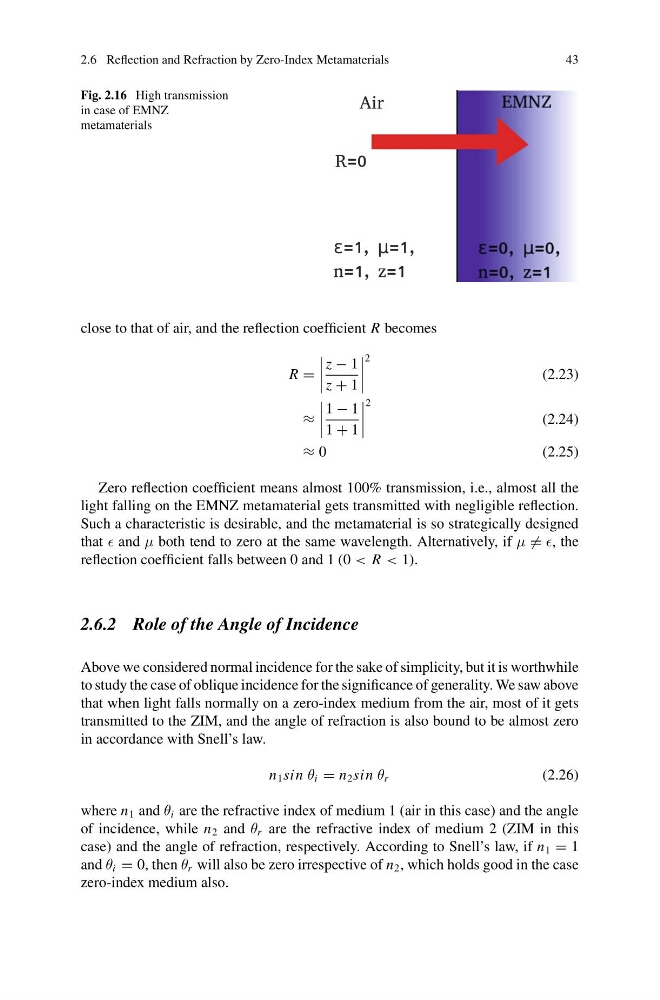
Fig. 2.16 High transmission
in case of EMNZ
metamaterials
close to that of air, and the reflection coefficient R becomes
R =
z − 1
z + 1
2
(2.23)
≈
1 − 1
1 + 1
2
(2.24)
≈ 0
(2.25)
Zero reflection coefficient means almost 100% transmission, i.e., almost all the
light falling on the EMNZ metamaterial gets transmitted with negligible reflection.
Such a characteristic is desirable, and the metamaterial is so strategically designed
that and μ both tend to zero at the same wavelength. Alternatively, if μ = , the
reflection coefficient falls between 0 and 1 (0 < R < 1).
2.6.2 Role of the Angle of Incidence
Above we considered normal incidence for the sake of simplicity, but it is worthwhile
to study the case of oblique incidence for the significance of generality. We saw above
that when light falls normally on a zero-index medium from the air, most of it gets
transmitted to the ZIM, and the angle of refraction is also bound to be almost zero
in accordance with Snell’s law.
n 1 sin θ i = n 2 sin θ r
(2.26)
where n 1 and θ i are the refractive index of medium 1 (air in this case) and the angle
of incidence, while n 2 and θ r are the refractive index of medium 2 (ZIM in this
case) and the angle of refraction, respectively. According to Snell’s law, if n 1 = 1
and θ i = 0, then θ r will also be zero irrespective of n 2 , which holds good in the case
zero-index medium also.
43
Fig. 2.16 High transmission
in case of EMNZ
metamaterials
close to that of air, and the reflection coefficient R becomes
R =
z − 1
z + 1
2
(2.23)
≈
1 − 1
1 + 1
2
(2.24)
≈ 0
(2.25)
Zero reflection coefficient means almost 100% transmission, i.e., almost all the
light falling on the EMNZ metamaterial gets transmitted with negligible reflection.
Such a characteristic is desirable, and the metamaterial is so strategically designed
that and μ both tend to zero at the same wavelength. Alternatively, if μ = , the
reflection coefficient falls between 0 and 1 (0 < R < 1).
2.6.2 Role of the Angle of Incidence
Above we considered normal incidence for the sake of simplicity, but it is worthwhile
to study the case of oblique incidence for the significance of generality. We saw above
that when light falls normally on a zero-index medium from the air, most of it gets
transmitted to the ZIM, and the angle of refraction is also bound to be almost zero
in accordance with Snell’s law.
n 1 sin θ i = n 2 sin θ r
(2.26)
where n 1 and θ i are the refractive index of medium 1 (air in this case) and the angle
of incidence, while n 2 and θ r are the refractive index of medium 2 (ZIM in this
case) and the angle of refraction, respectively. According to Snell’s law, if n 1 = 1
and θ i = 0, then θ r will also be zero irrespective of n 2 , which holds good in the case
zero-index medium also.