

42
2 Zero-Index Metamaterials
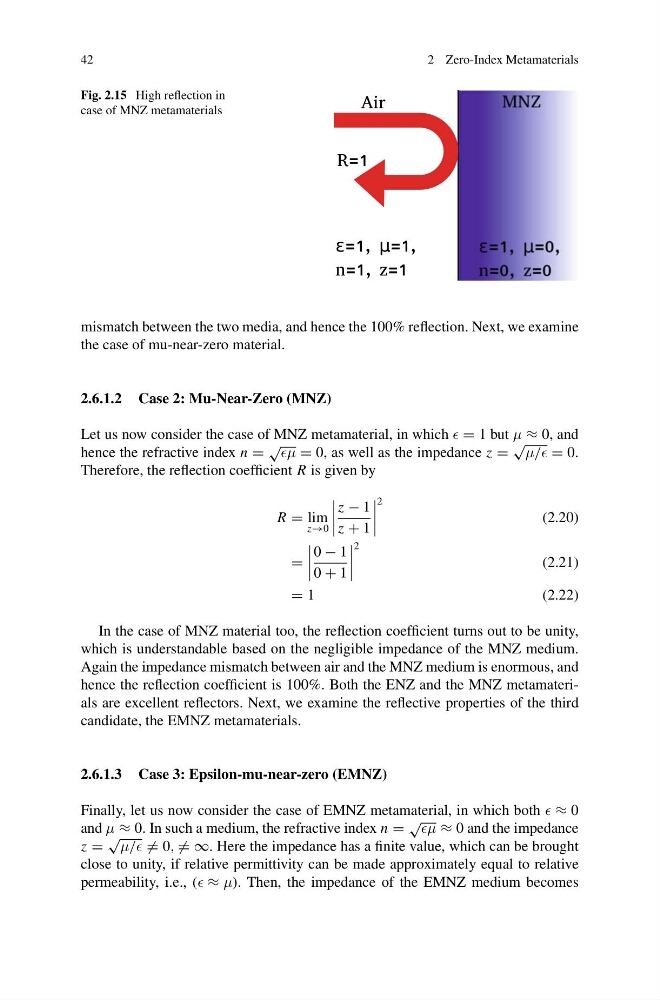
Fig. 2.15 High reflection in
case of MNZ metamaterials
mismatch between the two media, and hence the 100% reflection. Next, we examine
the case of mu-near-zero material.
2.6.1.2 Case 2: Mu-Near-Zero (MNZ)
Let us now consider the case of MNZ metamaterial, in which = 1 but μ ≈ 0, and
hence the refractive index n =
√ = 0, as well as the impedance z =
√
μ/ = 0.
Therefore, the reflection coefficient R is given by
R = lim
z→0
z − 1
z + 1
2
(2.20)
=
0 − 1
0 + 1
2
(2.21)
= 1
(2.22)
In the case of MNZ material too, the reflection coefficient turns out to be unity,
which is understandable based on the negligible impedance of the MNZ medium.
Again the impedance mismatch between air and the MNZ medium is enormous, and
hence the reflection coefficient is 100%. Both the ENZ and the MNZ metamaterials are excellent reflectors. Next, we examine the reflective properties of the third
candidate, the EMNZ metamaterials.
2.6.1.3 Case 3: Epsilon-mu-near-zero (EMNZ)
Finally, let us now consider the case of EMNZ metamaterial, in which both ≈ 0
and μ ≈ 0. In such a medium, the refractive index n =
√
μ ≈ 0 and the impedance
z =
√
μ/ = 0, = ∞. Here the impedance has a finite value, which can be brought
close to unity, if relative permittivity can be made approximately equal to relative
permeability, i.e., ( ≈ μ). Then, the impedance of the EMNZ medium becomes
2 Zero-Index Metamaterials
Fig. 2.15 High reflection in
case of MNZ metamaterials
mismatch between the two media, and hence the 100% reflection. Next, we examine
the case of mu-near-zero material.
2.6.1.2 Case 2: Mu-Near-Zero (MNZ)
Let us now consider the case of MNZ metamaterial, in which = 1 but μ ≈ 0, and
hence the refractive index n =
√ = 0, as well as the impedance z =
√
μ/ = 0.
Therefore, the reflection coefficient R is given by
R = lim
z→0
z − 1
z + 1
2
(2.20)
=
0 − 1
0 + 1
2
(2.21)
= 1
(2.22)
In the case of MNZ material too, the reflection coefficient turns out to be unity,
which is understandable based on the negligible impedance of the MNZ medium.
Again the impedance mismatch between air and the MNZ medium is enormous, and
hence the reflection coefficient is 100%. Both the ENZ and the MNZ metamaterials are excellent reflectors. Next, we examine the reflective properties of the third
candidate, the EMNZ metamaterials.
2.6.1.3 Case 3: Epsilon-mu-near-zero (EMNZ)
Finally, let us now consider the case of EMNZ metamaterial, in which both ≈ 0
and μ ≈ 0. In such a medium, the refractive index n =
√
μ ≈ 0 and the impedance
z =
√
μ/ = 0, = ∞. Here the impedance has a finite value, which can be brought
close to unity, if relative permittivity can be made approximately equal to relative
permeability, i.e., ( ≈ μ). Then, the impedance of the EMNZ medium becomes