

1.6 Reciprocal Lattice and Brillouin Zone
15
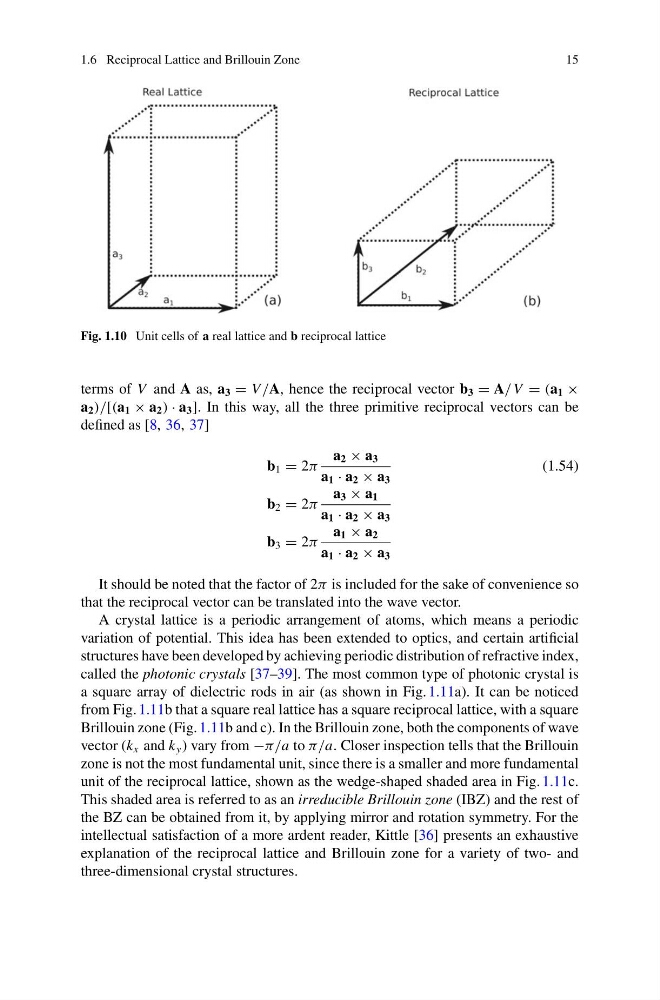
Fig. 1.10 Unit cells of a real lattice and b reciprocal lattice
terms of V and A as, a 3 = V /A, hence the reciprocal vector b 3 = A/V = (a 1 ×
a 2 )/[(a 1 × a 2 ) · a 3 ]. In this way, all the three primitive reciprocal vectors can be
defined as [8, 36, 37]
b 1 = 2π
a 2 × a 3
a 1 · a 2 × a 3
(1.54)
b 2 = 2π
a 3 × a 1
a 1 · a 2 × a 3
b 3 = 2π
a 1 × a 2
a 1 · a 2 × a 3
It should be noted that the factor of 2π is included for the sake of convenience so
that the reciprocal vector can be translated into the wave vector.
A crystal lattice is a periodic arrangement of atoms, which means a periodic
variation of potential. This idea has been extended to optics, and certain artificial
structures have been developed by achieving periodic distribution of refractive index,
called the photonic crystals [37–39]. The most common type of photonic crystal is
a square array of dielectric rods in air (as shown in Fig. 1.11a). It can be noticed
from Fig. 1.11b that a square real lattice has a square reciprocal lattice, with a square
Brillouin zone (Fig. 1.11b and c). In the Brillouin zone, both the components of wave
vector (k x and k y ) vary from −π/a to π/a. Closer inspection tells that the Brillouin
zone is not the most fundamental unit, since there is a smaller and more fundamental
unit of the reciprocal lattice, shown as the wedge-shaped shaded area in Fig. 1.11c.
This shaded area is referred to as an irreducible Brillouin zone (IBZ) and the rest of
the BZ can be obtained from it, by applying mirror and rotation symmetry. For the
intellectual satisfaction of a more ardent reader, Kittle [36] presents an exhaustive
explanation of the reciprocal lattice and Brillouin zone for a variety of two- and
three-dimensional crystal structures.
15
Fig. 1.10 Unit cells of a real lattice and b reciprocal lattice
terms of V and A as, a 3 = V /A, hence the reciprocal vector b 3 = A/V = (a 1 ×
a 2 )/[(a 1 × a 2 ) · a 3 ]. In this way, all the three primitive reciprocal vectors can be
defined as [8, 36, 37]
b 1 = 2π
a 2 × a 3
a 1 · a 2 × a 3
(1.54)
b 2 = 2π
a 3 × a 1
a 1 · a 2 × a 3
b 3 = 2π
a 1 × a 2
a 1 · a 2 × a 3
It should be noted that the factor of 2π is included for the sake of convenience so
that the reciprocal vector can be translated into the wave vector.
A crystal lattice is a periodic arrangement of atoms, which means a periodic
variation of potential. This idea has been extended to optics, and certain artificial
structures have been developed by achieving periodic distribution of refractive index,
called the photonic crystals [37–39]. The most common type of photonic crystal is
a square array of dielectric rods in air (as shown in Fig. 1.11a). It can be noticed
from Fig. 1.11b that a square real lattice has a square reciprocal lattice, with a square
Brillouin zone (Fig. 1.11b and c). In the Brillouin zone, both the components of wave
vector (k x and k y ) vary from −π/a to π/a. Closer inspection tells that the Brillouin
zone is not the most fundamental unit, since there is a smaller and more fundamental
unit of the reciprocal lattice, shown as the wedge-shaped shaded area in Fig. 1.11c.
This shaded area is referred to as an irreducible Brillouin zone (IBZ) and the rest of
the BZ can be obtained from it, by applying mirror and rotation symmetry. For the
intellectual satisfaction of a more ardent reader, Kittle [36] presents an exhaustive
explanation of the reciprocal lattice and Brillouin zone for a variety of two- and
three-dimensional crystal structures.