

14
1 Electromagnetics for Zero-Index Metamaterials
f d = 0.2
f d = 0.4
f d = 0.6
f d = 0.8
(a)
f d = 0.2
f d = 0.4
f d = 0.6
f d = 0.8
(b)
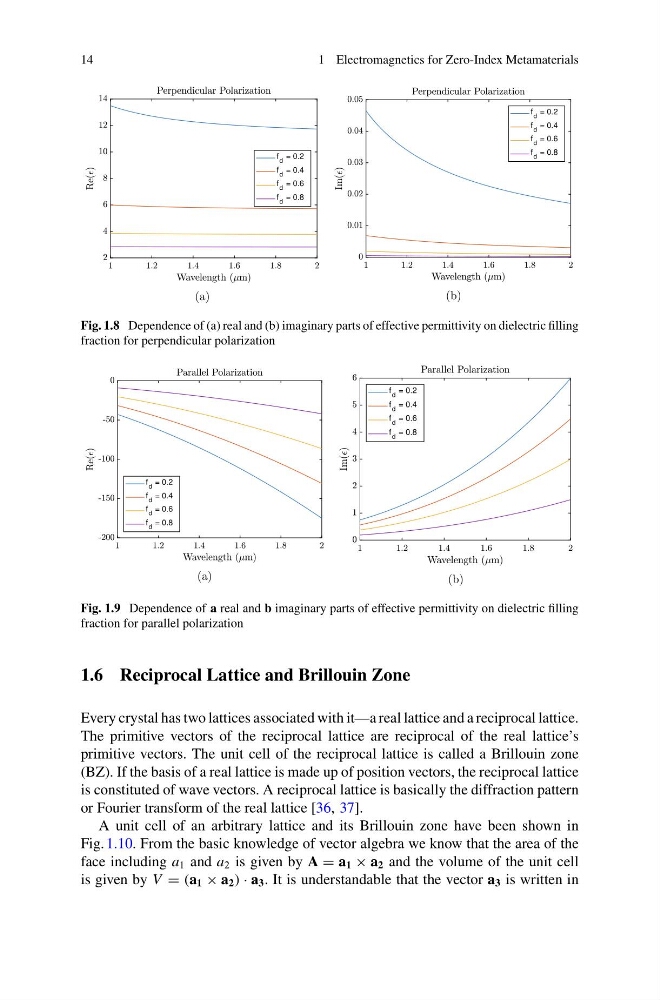
Fig. 1.8 Dependence of (a) real and (b) imaginary parts of effective permittivity on dielectric filling
fraction for perpendicular polarization
f d = 0.2
f d = 0.4
f d = 0.6
f d = 0.8
(a)
f d = 0.2
f d = 0.4
f d = 0.6
f d = 0.8
(b)
Fig. 1.9 Dependence of a real and b imaginary parts of effective permittivity on dielectric filling
fraction for parallel polarization
1.6 Reciprocal Lattice and Brillouin Zone
Every crystal has two lattices associated with it—a real lattice and a reciprocal lattice.
The primitive vectors of the reciprocal lattice are reciprocal of the real lattice’s
primitive vectors. The unit cell of the reciprocal lattice is called a Brillouin zone
(BZ). If the basis of a real lattice is made up of position vectors, the reciprocal lattice
is constituted of wave vectors. A reciprocal lattice is basically the diffraction pattern
or Fourier transform of the real lattice [36, 37].
A unit cell of an arbitrary lattice and its Brillouin zone have been shown in
Fig. 1.10. From the basic knowledge of vector algebra we know that the area of the
face including a 1 and a 2 is given by A = a 1 × a 2 and the volume of the unit cell
is given by V = (a 1 × a 2 ) · a 3 . It is understandable that the vector a 3 is written in
1 Electromagnetics for Zero-Index Metamaterials
f d = 0.2
f d = 0.4
f d = 0.6
f d = 0.8
(a)
f d = 0.2
f d = 0.4
f d = 0.6
f d = 0.8
(b)
Fig. 1.8 Dependence of (a) real and (b) imaginary parts of effective permittivity on dielectric filling
fraction for perpendicular polarization
f d = 0.2
f d = 0.4
f d = 0.6
f d = 0.8
(a)
f d = 0.2
f d = 0.4
f d = 0.6
f d = 0.8
(b)
Fig. 1.9 Dependence of a real and b imaginary parts of effective permittivity on dielectric filling
fraction for parallel polarization
1.6 Reciprocal Lattice and Brillouin Zone
Every crystal has two lattices associated with it—a real lattice and a reciprocal lattice.
The primitive vectors of the reciprocal lattice are reciprocal of the real lattice’s
primitive vectors. The unit cell of the reciprocal lattice is called a Brillouin zone
(BZ). If the basis of a real lattice is made up of position vectors, the reciprocal lattice
is constituted of wave vectors. A reciprocal lattice is basically the diffraction pattern
or Fourier transform of the real lattice [36, 37].
A unit cell of an arbitrary lattice and its Brillouin zone have been shown in
Fig. 1.10. From the basic knowledge of vector algebra we know that the area of the
face including a 1 and a 2 is given by A = a 1 × a 2 and the volume of the unit cell
is given by V = (a 1 × a 2 ) · a 3 . It is understandable that the vector a 3 is written in