

1.4 Origin of Refractive Index
11
r = 1 +
Nq
2
m 0 (ω
2
0 − ω 2 − 2i K ω)
(1.39)
It can be noticed that the relative permittivity is complex in nature, which implies that
the refractive index is complex too. Let the complex refractive index be represented
as
n = η + iκ
(1.40)
Then,
n
2
= r = (η + iκ)
2
= η
2
− κ
2
+ 2iηκ
(1.41)
On comparing Eqs. 1.39 and 1.41, we get
(η + iκ)
2
= 1 +
Nq
2
m 0 (ω
2
0 − ω 2 − 2i K ω)
(1.42)
= 1 +
Nq
2
(ω
2
0 − ω
2
+ 2i K ω)
m 0 (ω
2
0 − ω 2 − 2i K ω)(ω
2
0 − ω 2 + 2i K ω)
(1.43)
or
η
2
− κ
2
= 1 +
Nq
2
(ω
2
0 − ω
2
)
m 0 [(ω
2
0 − ω 2 ) 2 + 4K 2 ω 2 ]
(1.44)
and
2ηκ =
Nq
2
(2K ω)
m 0 [(ω
2
0 − ω 2 ) 2 + 4K 2 ω 2 ]
(1.45)
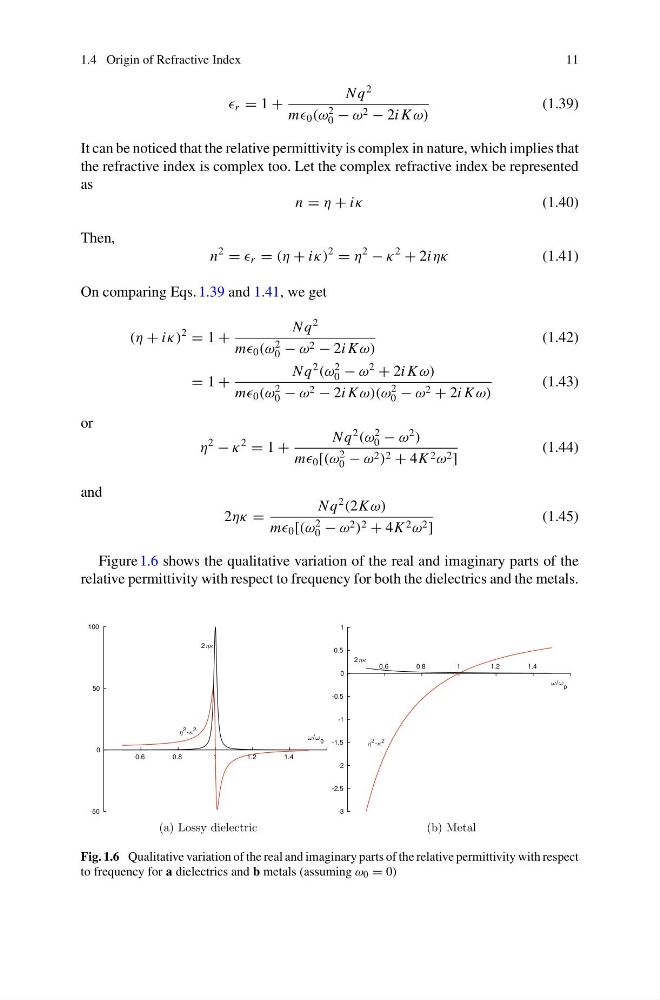
Figure 1.6 shows the qualitative variation of the real and imaginary parts of the
relative permittivity with respect to frequency for both the dielectrics and the metals.
0.6
0.8
1
1.2
1.4
/ 0
-50
0
50
100
2 - 2
2
(a) Lossy dielectric
0.6
0.8
1
1.2
1.4
/ p
-3
-2.5
-2
-1.5
-1
-0.5
0
0.5
1
2 - 2
2
(b) Metal
Fig. 1.6 Qualitative variation of the real and imaginary parts of the relative permittivity with respect
to frequency for a dielectrics and b metals (assuming ω 0 = 0)
11
r = 1 +
Nq
2
m 0 (ω
2
0 − ω 2 − 2i K ω)
(1.39)
It can be noticed that the relative permittivity is complex in nature, which implies that
the refractive index is complex too. Let the complex refractive index be represented
as
n = η + iκ
(1.40)
Then,
n
2
= r = (η + iκ)
2
= η
2
− κ
2
+ 2iηκ
(1.41)
On comparing Eqs. 1.39 and 1.41, we get
(η + iκ)
2
= 1 +
Nq
2
m 0 (ω
2
0 − ω 2 − 2i K ω)
(1.42)
= 1 +
Nq
2
(ω
2
0 − ω
2
+ 2i K ω)
m 0 (ω
2
0 − ω 2 − 2i K ω)(ω
2
0 − ω 2 + 2i K ω)
(1.43)
or
η
2
− κ
2
= 1 +
Nq
2
(ω
2
0 − ω
2
)
m 0 [(ω
2
0 − ω 2 ) 2 + 4K 2 ω 2 ]
(1.44)
and
2ηκ =
Nq
2
(2K ω)
m 0 [(ω
2
0 − ω 2 ) 2 + 4K 2 ω 2 ]
(1.45)
Figure 1.6 shows the qualitative variation of the real and imaginary parts of the
relative permittivity with respect to frequency for both the dielectrics and the metals.
0.6
0.8
1
1.2
1.4
/ 0
-50
0
50
100
2 - 2
2
(a) Lossy dielectric
0.6
0.8
1
1.2
1.4
/ p
-3
-2.5
-2
-1.5
-1
-0.5
0
0.5
1
2 - 2
2
(b) Metal
Fig. 1.6 Qualitative variation of the real and imaginary parts of the relative permittivity with respect
to frequency for a dielectrics and b metals (assuming ω 0 = 0)