

10
1 Electromagnetics for Zero-Index Metamaterials
= A +
B
λ
2
0
(1.31)
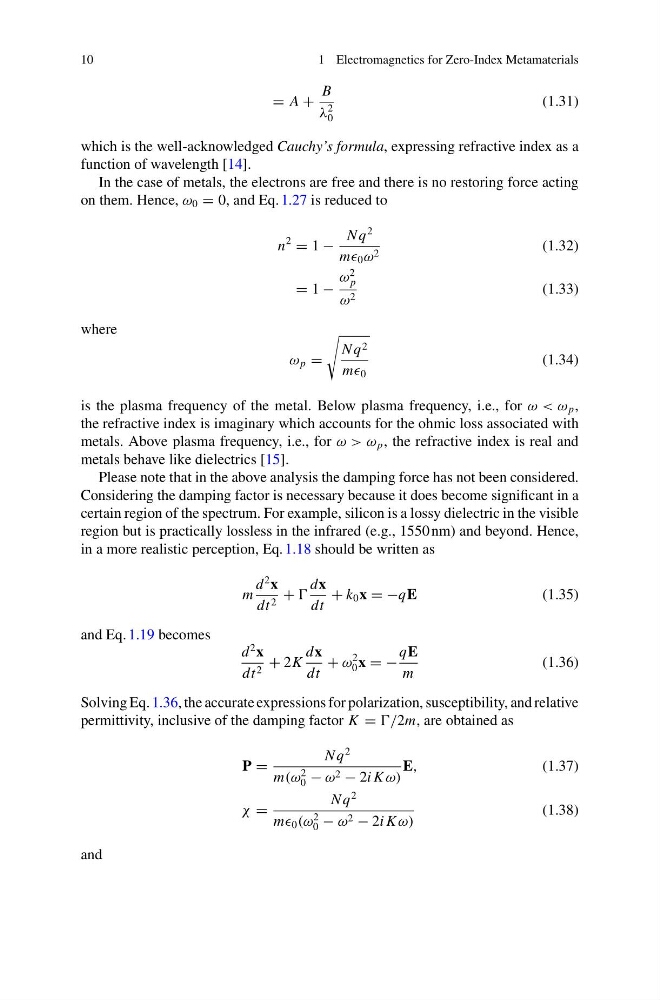
which is the well-acknowledged Cauchy’s formula, expressing refractive index as a
function of wavelength [14].
In the case of metals, the electrons are free and there is no restoring force acting
on them. Hence, ω 0 = 0, and Eq. 1.27 is reduced to
n
2
= 1 −
Nq
2
m 0 ω 2
(1.32)
= 1 −
ω
2
p
ω 2
(1.33)
where
ω p =
Nq 2
m 0
(1.34)
is the plasma frequency of the metal. Below plasma frequency, i.e., for ω < ω p ,
the refractive index is imaginary which accounts for the ohmic loss associated with
metals. Above plasma frequency, i.e., for ω > ω p , the refractive index is real and
metals behave like dielectrics [15].
Please note that in the above analysis the damping force has not been considered.
Considering the damping factor is necessary because it does become significant in a
certain region of the spectrum. For example, silicon is a lossy dielectric in the visible
region but is practically lossless in the infrared (e.g., 1550 nm) and beyond. Hence,
in a more realistic perception, Eq. 1.18 should be written as
m
d
2 x
dt 2 +
dx
dt
+ k 0 x = −qE
(1.35)
and Eq. 1.19 becomes
d
2 x
dt 2 + 2K
dx
dt
+ ω
2
0 x = −
qE
m
(1.36)
Solving Eq. 1.36, the accurate expressions for polarization, susceptibility, and relative
permittivity, inclusive of the damping factor K = /2m, are obtained as
P =
Nq
2
m(ω
2
0 − ω 2 − 2i K ω)
E,
(1.37)
χ =
Nq
2
m 0 (ω
2
0 − ω 2 − 2i K ω)
(1.38)
and
1 Electromagnetics for Zero-Index Metamaterials
= A +
B
λ
2
0
(1.31)
which is the well-acknowledged Cauchy’s formula, expressing refractive index as a
function of wavelength [14].
In the case of metals, the electrons are free and there is no restoring force acting
on them. Hence, ω 0 = 0, and Eq. 1.27 is reduced to
n
2
= 1 −
Nq
2
m 0 ω 2
(1.32)
= 1 −
ω
2
p
ω 2
(1.33)
where
ω p =
Nq 2
m 0
(1.34)
is the plasma frequency of the metal. Below plasma frequency, i.e., for ω < ω p ,
the refractive index is imaginary which accounts for the ohmic loss associated with
metals. Above plasma frequency, i.e., for ω > ω p , the refractive index is real and
metals behave like dielectrics [15].
Please note that in the above analysis the damping force has not been considered.
Considering the damping factor is necessary because it does become significant in a
certain region of the spectrum. For example, silicon is a lossy dielectric in the visible
region but is practically lossless in the infrared (e.g., 1550 nm) and beyond. Hence,
in a more realistic perception, Eq. 1.18 should be written as
m
d
2 x
dt 2 +
dx
dt
+ k 0 x = −qE
(1.35)
and Eq. 1.19 becomes
d
2 x
dt 2 + 2K
dx
dt
+ ω
2
0 x = −
qE
m
(1.36)
Solving Eq. 1.36, the accurate expressions for polarization, susceptibility, and relative
permittivity, inclusive of the damping factor K = /2m, are obtained as
P =
Nq
2
m(ω
2
0 − ω 2 − 2i K ω)
E,
(1.37)
χ =
Nq
2
m 0 (ω
2
0 − ω 2 − 2i K ω)
(1.38)
and