

118
4 Nonlinear Optics with Zero-Index Metamaterials
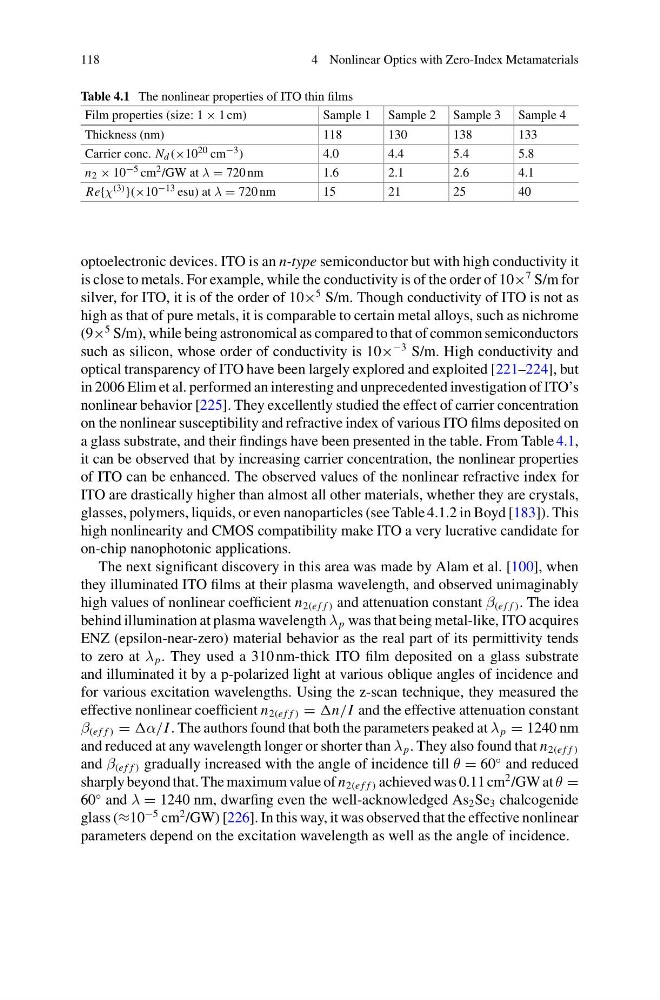
Table 4.1 The nonlinear properties of ITO thin films
Film properties (size: 1 × 1 cm)
Sample 1 Sample 2 Sample 3 Sample 4
Thickness (nm)
118
130
138
133
Carrier conc. N d (×10 20 cm −3 )
4.0
4.4
5.4
5.8
n 2 × 10 −5 cm 2 /GW at λ = 720 nm
1.6
2.1
2.6
4.1
Re{χ (3) }(×10 −13 esu) at λ = 720 nm
15
21
25
40
optoelectronic devices. ITO is an n-type semiconductor but with high conductivity it
is close to metals. For example, while the conductivity is of the order of 10×
7 S/m for
silver, for ITO, it is of the order of 10×
5 S/m. Though conductivity of ITO is not as
high as that of pure metals, it is comparable to certain metal alloys, such as nichrome
(9×
5 S/m), while being astronomical as compared to that of common semiconductors
such as silicon, whose order of conductivity is 10×
−3 S/m. High conductivity and
optical transparency of ITO have been largely explored and exploited [221–224], but
in 2006 Elim et al. performed an interesting and unprecedented investigation of ITO’s
nonlinear behavior [225]. They excellently studied the effect of carrier concentration
on the nonlinear susceptibility and refractive index of various ITO films deposited on
a glass substrate, and their findings have been presented in the table. From Table 4.1,
it can be observed that by increasing carrier concentration, the nonlinear properties
of ITO can be enhanced. The observed values of the nonlinear refractive index for
ITO are drastically higher than almost all other materials, whether they are crystals,
glasses, polymers, liquids, or even nanoparticles (see Table 4.1.2 in Boyd [183]). This
high nonlinearity and CMOS compatibility make ITO a very lucrative candidate for
on-chip nanophotonic applications.
The next significant discovery in this area was made by Alam et al. [100], when
they illuminated ITO films at their plasma wavelength, and observed unimaginably
high values of nonlinear coefficient n 2(e f f ) and attenuation constant β (e f f ) . The idea
behind illumination at plasma wavelength λ p was that being metal-like, ITO acquires
ENZ (epsilon-near-zero) material behavior as the real part of its permittivity tends
to zero at λ p . They used a 310 nm-thick ITO film deposited on a glass substrate
and illuminated it by a p-polarized light at various oblique angles of incidence and
for various excitation wavelengths. Using the z-scan technique, they measured the
effective nonlinear coefficient n 2(e f f ) = n/I and the effective attenuation constant
β (e f f ) = α/I . The authors found that both the parameters peaked at λ p = 1240 nm
and reduced at any wavelength longer or shorter than λ p . They also found that n 2(e f f )
and β (e f f ) gradually increased with the angle of incidence till θ = 60
◦ and reduced
sharply beyond that. The maximum value of n 2(e f f ) achieved was 0.11 cm
2 /GW at θ =
60
◦ and λ = 1240 nm, dwarfing even the well-acknowledged As 2 Se 3 chalcogenide
glass (≈10
−5 cm
2 /GW) [226]. In this way, it was observed that the effective nonlinear
parameters depend on the excitation wavelength as well as the angle of incidence.
4 Nonlinear Optics with Zero-Index Metamaterials
Table 4.1 The nonlinear properties of ITO thin films
Film properties (size: 1 × 1 cm)
Sample 1 Sample 2 Sample 3 Sample 4
Thickness (nm)
118
130
138
133
Carrier conc. N d (×10 20 cm −3 )
4.0
4.4
5.4
5.8
n 2 × 10 −5 cm 2 /GW at λ = 720 nm
1.6
2.1
2.6
4.1
Re{χ (3) }(×10 −13 esu) at λ = 720 nm
15
21
25
40
optoelectronic devices. ITO is an n-type semiconductor but with high conductivity it
is close to metals. For example, while the conductivity is of the order of 10×
7 S/m for
silver, for ITO, it is of the order of 10×
5 S/m. Though conductivity of ITO is not as
high as that of pure metals, it is comparable to certain metal alloys, such as nichrome
(9×
5 S/m), while being astronomical as compared to that of common semiconductors
such as silicon, whose order of conductivity is 10×
−3 S/m. High conductivity and
optical transparency of ITO have been largely explored and exploited [221–224], but
in 2006 Elim et al. performed an interesting and unprecedented investigation of ITO’s
nonlinear behavior [225]. They excellently studied the effect of carrier concentration
on the nonlinear susceptibility and refractive index of various ITO films deposited on
a glass substrate, and their findings have been presented in the table. From Table 4.1,
it can be observed that by increasing carrier concentration, the nonlinear properties
of ITO can be enhanced. The observed values of the nonlinear refractive index for
ITO are drastically higher than almost all other materials, whether they are crystals,
glasses, polymers, liquids, or even nanoparticles (see Table 4.1.2 in Boyd [183]). This
high nonlinearity and CMOS compatibility make ITO a very lucrative candidate for
on-chip nanophotonic applications.
The next significant discovery in this area was made by Alam et al. [100], when
they illuminated ITO films at their plasma wavelength, and observed unimaginably
high values of nonlinear coefficient n 2(e f f ) and attenuation constant β (e f f ) . The idea
behind illumination at plasma wavelength λ p was that being metal-like, ITO acquires
ENZ (epsilon-near-zero) material behavior as the real part of its permittivity tends
to zero at λ p . They used a 310 nm-thick ITO film deposited on a glass substrate
and illuminated it by a p-polarized light at various oblique angles of incidence and
for various excitation wavelengths. Using the z-scan technique, they measured the
effective nonlinear coefficient n 2(e f f ) = n/I and the effective attenuation constant
β (e f f ) = α/I . The authors found that both the parameters peaked at λ p = 1240 nm
and reduced at any wavelength longer or shorter than λ p . They also found that n 2(e f f )
and β (e f f ) gradually increased with the angle of incidence till θ = 60
◦ and reduced
sharply beyond that. The maximum value of n 2(e f f ) achieved was 0.11 cm
2 /GW at θ =
60
◦ and λ = 1240 nm, dwarfing even the well-acknowledged As 2 Se 3 chalcogenide
glass (≈10
−5 cm
2 /GW) [226]. In this way, it was observed that the effective nonlinear
parameters depend on the excitation wavelength as well as the angle of incidence.