

4.4 Phase Matching
91
A 3 (z) =
2id e f f ω
2
3 A 1 A 2
k 3 c 2
e
ikz dz
(4.47)
=
2id e f f ω
2
3 A 1 A 2
k 3 c 2
e
ikz
ik
+ const.
(4.48)
where const. is the constant of integration. Considering the boundary condition
A 3 (0) = 0 (no ω 3 at the input end), we get
const. = −
2id e f f ω
2
3 A 1 A 2
k 3 c 2
1
ik
(4.49)
Hence, eventually
A 3 (z) =
2id e f f ω
2
3 A 1 A 2
k 3 c 2
e
ikL
− 1
ik
(4.50)
Now from the field amplitudes, one can calculate the respective intensities as
I i (z) = 2n i 0 c|A i |
2
, i = 1, 2, 3
(4.51)
Therefore, we get the intensity of the generated frequency as a function of distance
and phase mismatch
I 3 (z) =
8n 3 0 d
2
e f f ω
4
3 |A 1 |
2
|A 2 |
2
k
2
3 c 3
e
ikz
− 1
k
2
(4.52)
Substituting A 1 and A 2 in terms of I 1 and I 2 from Eq. 1.52, we get
I 3 (z) =
8d
2
e f f ω
2
3 I 1 I 2
n 1 n 2 n 3 0 c 2
e
ikz
− 1
k
2
(4.53)
=
8d
2
e f f ω
2
3 I 1 I 2
n 1 n 2 n 3 0 c 2 z
2
sin((kz/2)
kz/2
2
(4.54)
=
8d
2
e f f ω
2
3 I 1 I 2
n 1 n 2 n 3 0 c 2 z
2 sinc
2
kz
2
(4.55)
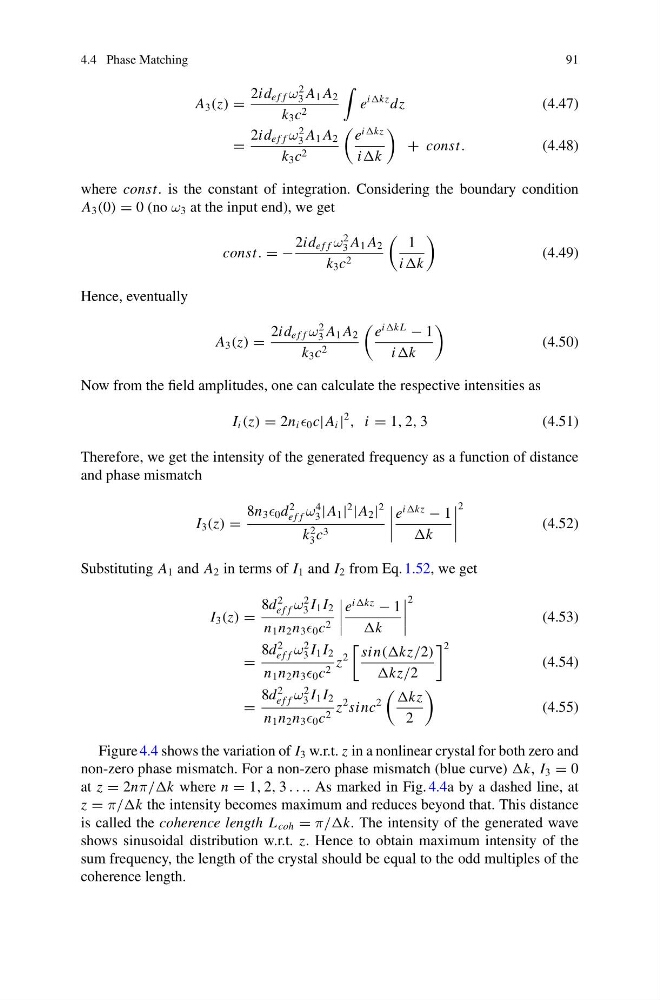
Figure 4.4 shows the variation of I 3 w.r.t. z in a nonlinear crystal for both zero and
non-zero phase mismatch. For a non-zero phase mismatch (blue curve) k, I 3 = 0
at z = 2nπ//k where n = 1, 2, 3 . . .. As marked in Fig.4.4a by a dashed line, at
z = π//k the intensity becomes maximum and reduces beyond that. This distance
is called the coherence length L coh = π//k. The intensity of the generated wave
shows sinusoidal distribution w.r.t. z. Hence to obtain maximum intensity of the
sum frequency, the length of the crystal should be equal to the odd multiples of the
coherence length.
91
A 3 (z) =
2id e f f ω
2
3 A 1 A 2
k 3 c 2
e
ikz dz
(4.47)
=
2id e f f ω
2
3 A 1 A 2
k 3 c 2
e
ikz
ik
+ const.
(4.48)
where const. is the constant of integration. Considering the boundary condition
A 3 (0) = 0 (no ω 3 at the input end), we get
const. = −
2id e f f ω
2
3 A 1 A 2
k 3 c 2
1
ik
(4.49)
Hence, eventually
A 3 (z) =
2id e f f ω
2
3 A 1 A 2
k 3 c 2
e
ikL
− 1
ik
(4.50)
Now from the field amplitudes, one can calculate the respective intensities as
I i (z) = 2n i 0 c|A i |
2
, i = 1, 2, 3
(4.51)
Therefore, we get the intensity of the generated frequency as a function of distance
and phase mismatch
I 3 (z) =
8n 3 0 d
2
e f f ω
4
3 |A 1 |
2
|A 2 |
2
k
2
3 c 3
e
ikz
− 1
k
2
(4.52)
Substituting A 1 and A 2 in terms of I 1 and I 2 from Eq. 1.52, we get
I 3 (z) =
8d
2
e f f ω
2
3 I 1 I 2
n 1 n 2 n 3 0 c 2
e
ikz
− 1
k
2
(4.53)
=
8d
2
e f f ω
2
3 I 1 I 2
n 1 n 2 n 3 0 c 2 z
2
sin((kz/2)
kz/2
2
(4.54)
=
8d
2
e f f ω
2
3 I 1 I 2
n 1 n 2 n 3 0 c 2 z
2 sinc
2
kz
2
(4.55)
Figure 4.4 shows the variation of I 3 w.r.t. z in a nonlinear crystal for both zero and
non-zero phase mismatch. For a non-zero phase mismatch (blue curve) k, I 3 = 0
at z = 2nπ//k where n = 1, 2, 3 . . .. As marked in Fig.4.4a by a dashed line, at
z = π//k the intensity becomes maximum and reduces beyond that. This distance
is called the coherence length L coh = π//k. The intensity of the generated wave
shows sinusoidal distribution w.r.t. z. Hence to obtain maximum intensity of the
sum frequency, the length of the crystal should be equal to the odd multiples of the
coherence length.