

90
4 Nonlinear Optics with Zero-Index Metamaterials
where d e f f = χ
(2)
/2. The term d e f f hails from the tensor representation of nonlinear
susceptibility. For a more detailed explanation of d e f f , the reader is advised to read
Boyd [183].
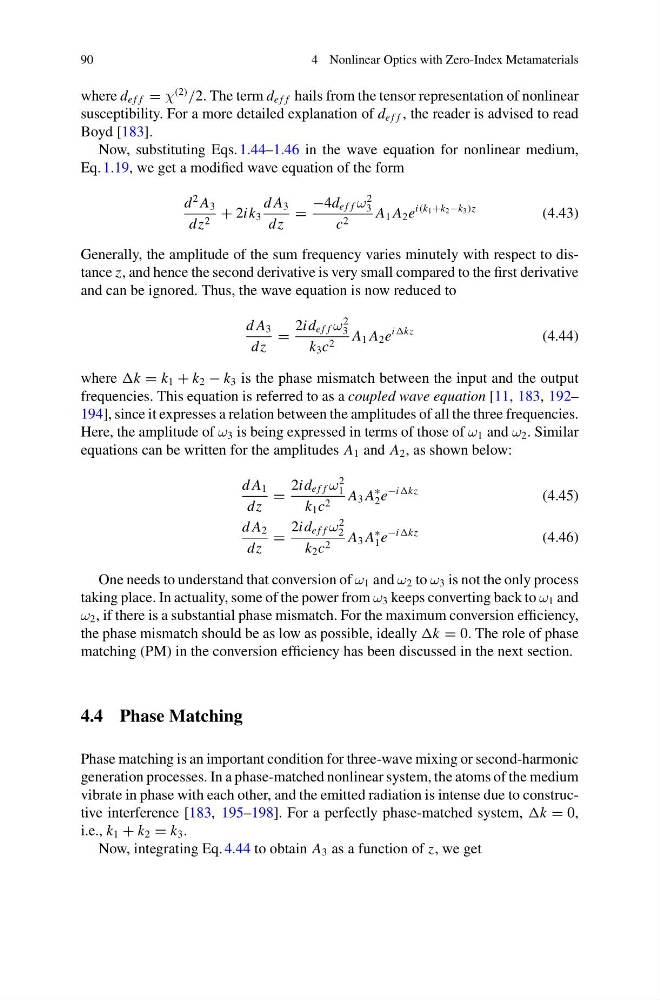
Now, substituting Eqs. 1.44–1.46 in the wave equation for nonlinear medium,
Eq. 1.19, we get a modified wave equation of the form
d
2 A 3
dz 2 + 2ik 3
d A 3
dz
=
−4d e f f ω
2
3
c 2
A 1 A 2 e
i(k 1 +k 2 −k 3 )z
(4.43)
Generally, the amplitude of the sum frequency varies minutely with respect to distance z, and hence the second derivative is very small compared to the first derivative
and can be ignored. Thus, the wave equation is now reduced to
d A 3
dz
=
2id e f f ω
2
3
k 3 c 2 A 1 A 2 e
ikz
(4.44)
where k = k 1 + k 2 − k 3 is the phase mismatch between the input and the output
frequencies. This equation is referred to as a coupled wave equation [11, 183, 192–
194], since it expresses a relation between the amplitudes of all the three frequencies.
Here, the amplitude of ω 3 is being expressed in terms of those of ω 1 and ω 2 . Similar
equations can be written for the amplitudes A 1 and A 2 , as shown below:
d A 1
dz
=
2id e f f ω
2
1
k 1 c 2 A 3 A
∗
2 e
−ikz
(4.45)
d A 2
dz
=
2id e f f ω
2
2
k 2 c 2 A 3 A
∗
1 e
−ikz
(4.46)
One needs to understand that conversion of ω 1 and ω 2 to ω 3 is not the only process
taking place. In actuality, some of the power from ω 3 keeps converting back to ω 1 and
ω 2 , if there is a substantial phase mismatch. For the maximum conversion efficiency,
the phase mismatch should be as low as possible, ideally k = 0. The role of phase
matching (PM) in the conversion efficiency has been discussed in the next section.
4.4 Phase Matching
Phase matching is an important condition for three-wave mixing or second-harmonic
generation processes. In a phase-matched nonlinear system, the atoms of the medium
vibrate in phase with each other, and the emitted radiation is intense due to constructive interference [183, 195–198]. For a perfectly phase-matched system, k = 0,
i.e., k 1 + k 2 = k 3 .
Now, integrating Eq. 4.44 to obtain A 3 as a function of z, we get
4 Nonlinear Optics with Zero-Index Metamaterials
where d e f f = χ
(2)
/2. The term d e f f hails from the tensor representation of nonlinear
susceptibility. For a more detailed explanation of d e f f , the reader is advised to read
Boyd [183].
Now, substituting Eqs. 1.44–1.46 in the wave equation for nonlinear medium,
Eq. 1.19, we get a modified wave equation of the form
d
2 A 3
dz 2 + 2ik 3
d A 3
dz
=
−4d e f f ω
2
3
c 2
A 1 A 2 e
i(k 1 +k 2 −k 3 )z
(4.43)
Generally, the amplitude of the sum frequency varies minutely with respect to distance z, and hence the second derivative is very small compared to the first derivative
and can be ignored. Thus, the wave equation is now reduced to
d A 3
dz
=
2id e f f ω
2
3
k 3 c 2 A 1 A 2 e
ikz
(4.44)
where k = k 1 + k 2 − k 3 is the phase mismatch between the input and the output
frequencies. This equation is referred to as a coupled wave equation [11, 183, 192–
194], since it expresses a relation between the amplitudes of all the three frequencies.
Here, the amplitude of ω 3 is being expressed in terms of those of ω 1 and ω 2 . Similar
equations can be written for the amplitudes A 1 and A 2 , as shown below:
d A 1
dz
=
2id e f f ω
2
1
k 1 c 2 A 3 A
∗
2 e
−ikz
(4.45)
d A 2
dz
=
2id e f f ω
2
2
k 2 c 2 A 3 A
∗
1 e
−ikz
(4.46)
One needs to understand that conversion of ω 1 and ω 2 to ω 3 is not the only process
taking place. In actuality, some of the power from ω 3 keeps converting back to ω 1 and
ω 2 , if there is a substantial phase mismatch. For the maximum conversion efficiency,
the phase mismatch should be as low as possible, ideally k = 0. The role of phase
matching (PM) in the conversion efficiency has been discussed in the next section.
4.4 Phase Matching
Phase matching is an important condition for three-wave mixing or second-harmonic
generation processes. In a phase-matched nonlinear system, the atoms of the medium
vibrate in phase with each other, and the emitted radiation is intense due to constructive interference [183, 195–198]. For a perfectly phase-matched system, k = 0,
i.e., k 1 + k 2 = k 3 .
Now, integrating Eq. 4.44 to obtain A 3 as a function of z, we get