

5.5 Impact Assessment (Phase 3)
81
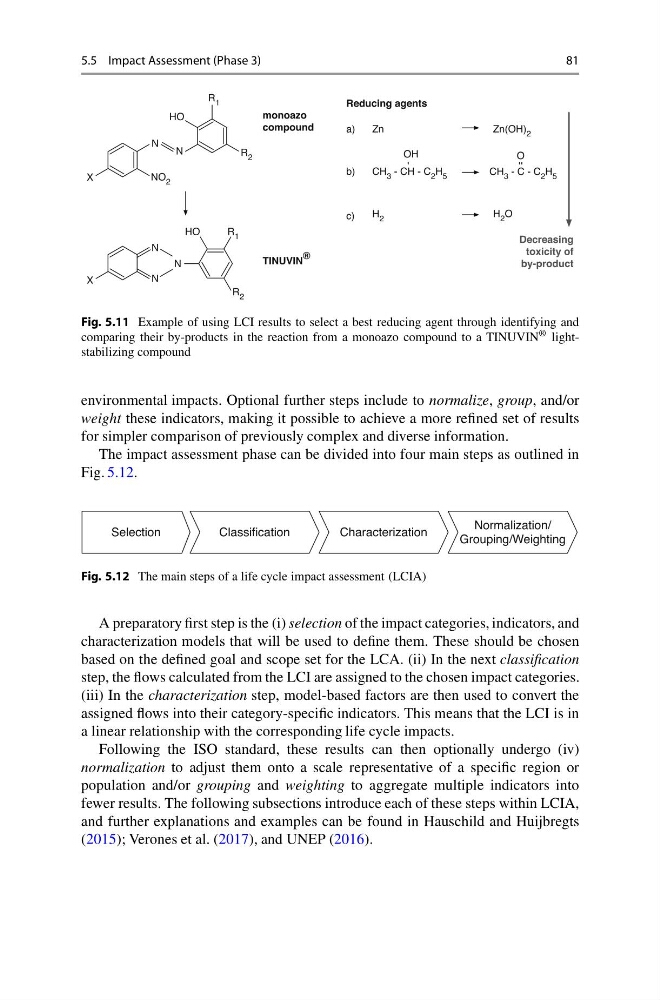
Fig. 5.11 Example of using LCI results to select a best reducing agent through identifying and
comparing their by-products in the reaction from a monoazo compound to a TINUVIN ® lightstabilizing compound
environmental impacts. Optional further steps include to normalize, group, and/or
weight these indicators, making it possible to achieve a more refined set of results
for simpler comparison of previously complex and diverse information.
The impact assessment phase can be divided into four main steps as outlined in
Fig. 5.12.
Fig. 5.12 The main steps of a life cycle impact assessment (LCIA)
A preparatory first step is the (i) selection of the impact categories, indicators, and
characterization models that will be used to define them. These should be chosen
based on the defined goal and scope set for the LCA. (ii) In the next classification
step, the flows calculated from the LCI are assigned to the chosen impact categories.
(iii) In the characterization step, model-based factors are then used to convert the
assigned flows into their category-specific indicators. This means that the LCI is in
a linear relationship with the corresponding life cycle impacts.
Following the ISO standard, these results can then optionally undergo (iv)
normalization to adjust them onto a scale representative of a specific region or
population and/or grouping and weighting to aggregate multiple indicators into
fewer results. The following subsections introduce each of these steps within LCIA,
and further explanations and examples can be found in Hauschild and Huijbregts
(2015); Verones et al. (2017), and UNEP (2016).
81
Fig. 5.11 Example of using LCI results to select a best reducing agent through identifying and
comparing their by-products in the reaction from a monoazo compound to a TINUVIN ® lightstabilizing compound
environmental impacts. Optional further steps include to normalize, group, and/or
weight these indicators, making it possible to achieve a more refined set of results
for simpler comparison of previously complex and diverse information.
The impact assessment phase can be divided into four main steps as outlined in
Fig. 5.12.
Fig. 5.12 The main steps of a life cycle impact assessment (LCIA)
A preparatory first step is the (i) selection of the impact categories, indicators, and
characterization models that will be used to define them. These should be chosen
based on the defined goal and scope set for the LCA. (ii) In the next classification
step, the flows calculated from the LCI are assigned to the chosen impact categories.
(iii) In the characterization step, model-based factors are then used to convert the
assigned flows into their category-specific indicators. This means that the LCI is in
a linear relationship with the corresponding life cycle impacts.
Following the ISO standard, these results can then optionally undergo (iv)
normalization to adjust them onto a scale representative of a specific region or
population and/or grouping and weighting to aggregate multiple indicators into
fewer results. The following subsections introduce each of these steps within LCIA,
and further explanations and examples can be found in Hauschild and Huijbregts
(2015); Verones et al. (2017), and UNEP (2016).