

82
5 Life Cycle Assessment of Chemical Products and Processes
5.5.1 Step 1: Selection of Impact Categories, Indicators,
and Characterization Models
In this first step, impact categories need to be selected that are of interest and help
to answer questions set within the goal of the LCA. For example, if the LCA aims
to optimize the natural resources (both abiotic and biotic) used during a production
process, then impacts related to, for example, water use, fossil resource use, and
land use might be good impact categories to select. These would all be examples of
midpoint impact categories, which are representative of intermediate impacts along
the pathway to calculating endpoint damages to areas of protection such as human
health, ecosystems, and resource availability.
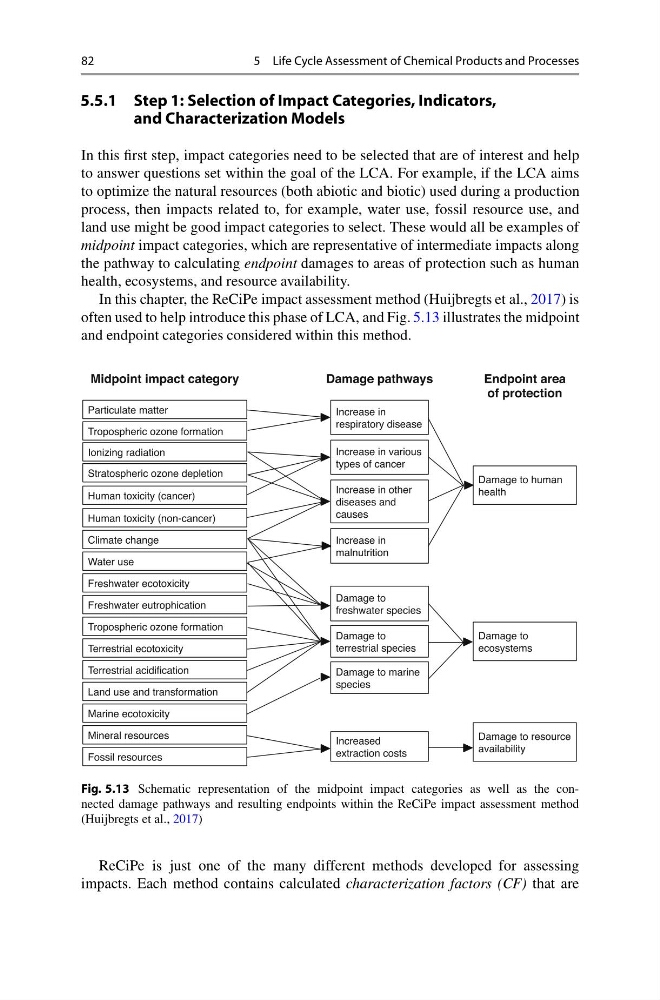
In this chapter, the ReCiPe impact assessment method (Huijbregts et al., 2017) is
often used to help introduce this phase of LCA, and Fig. 5.13 illustrates the midpoint
and endpoint categories considered within this method.
Fig. 5.13 Schematic representation of the midpoint impact categories as well as the connected damage pathways and resulting endpoints within the ReCiPe impact assessment method
(Huijbregts et al., 2017)
ReCiPe is just one of the many different methods developed for assessing
impacts. Each method contains calculated characterization factors (CF) that are
5 Life Cycle Assessment of Chemical Products and Processes
5.5.1 Step 1: Selection of Impact Categories, Indicators,
and Characterization Models
In this first step, impact categories need to be selected that are of interest and help
to answer questions set within the goal of the LCA. For example, if the LCA aims
to optimize the natural resources (both abiotic and biotic) used during a production
process, then impacts related to, for example, water use, fossil resource use, and
land use might be good impact categories to select. These would all be examples of
midpoint impact categories, which are representative of intermediate impacts along
the pathway to calculating endpoint damages to areas of protection such as human
health, ecosystems, and resource availability.
In this chapter, the ReCiPe impact assessment method (Huijbregts et al., 2017) is
often used to help introduce this phase of LCA, and Fig. 5.13 illustrates the midpoint
and endpoint categories considered within this method.
Fig. 5.13 Schematic representation of the midpoint impact categories as well as the connected damage pathways and resulting endpoints within the ReCiPe impact assessment method
(Huijbregts et al., 2017)
ReCiPe is just one of the many different methods developed for assessing
impacts. Each method contains calculated characterization factors (CF) that are