

78
5 Life Cycle Assessment of Chemical Products and Processes
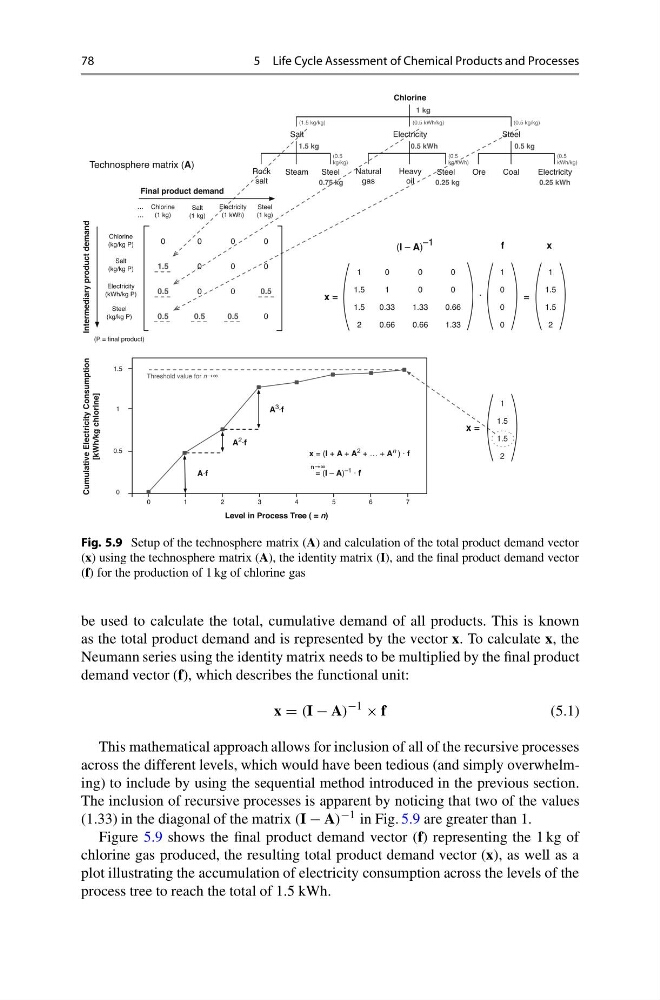
Fig. 5.9 Setup of the technosphere matrix (A) and calculation of the total product demand vector
(x) using the technosphere matrix (A), the identity matrix (I), and the final product demand vector
(f) for the production of 1 kg of chlorine gas
be used to calculate the total, cumulative demand of all products. This is known
as the total product demand and is represented by the vector x. To calculate x, the
Neumann series using the identity matrix needs to be multiplied by the final product
demand vector (f), which describes the functional unit:
x = (I − A)
−1
× f
(5.1)
This mathematical approach allows for inclusion of all of the recursive processes
across the different levels, which would have been tedious (and simply overwhelming) to include by using the sequential method introduced in the previous section.
The inclusion of recursive processes is apparent by noticing that two of the values
(1.33) in the diagonal of the matrix (I − A) −1 in Fig. 5.9 are greater than 1.
Figure 5.9 shows the final product demand vector (f) representing the 1 kg of
chlorine gas produced, the resulting total product demand vector (x), as well as a
plot illustrating the accumulation of electricity consumption across the levels of the
process tree to reach the total of 1.5 kWh.
5 Life Cycle Assessment of Chemical Products and Processes
Fig. 5.9 Setup of the technosphere matrix (A) and calculation of the total product demand vector
(x) using the technosphere matrix (A), the identity matrix (I), and the final product demand vector
(f) for the production of 1 kg of chlorine gas
be used to calculate the total, cumulative demand of all products. This is known
as the total product demand and is represented by the vector x. To calculate x, the
Neumann series using the identity matrix needs to be multiplied by the final product
demand vector (f), which describes the functional unit:
x = (I − A)
−1
× f
(5.1)
This mathematical approach allows for inclusion of all of the recursive processes
across the different levels, which would have been tedious (and simply overwhelming) to include by using the sequential method introduced in the previous section.
The inclusion of recursive processes is apparent by noticing that two of the values
(1.33) in the diagonal of the matrix (I − A) −1 in Fig. 5.9 are greater than 1.
Figure 5.9 shows the final product demand vector (f) representing the 1 kg of
chlorine gas produced, the resulting total product demand vector (x), as well as a
plot illustrating the accumulation of electricity consumption across the levels of the
process tree to reach the total of 1.5 kWh.