

5.4 Inventory Analysis (Phase 2)
71
5.4
Inventory Analysis (Phase 2)
The second phase of LCA involves the creation of the life cycle inventory (LCI),
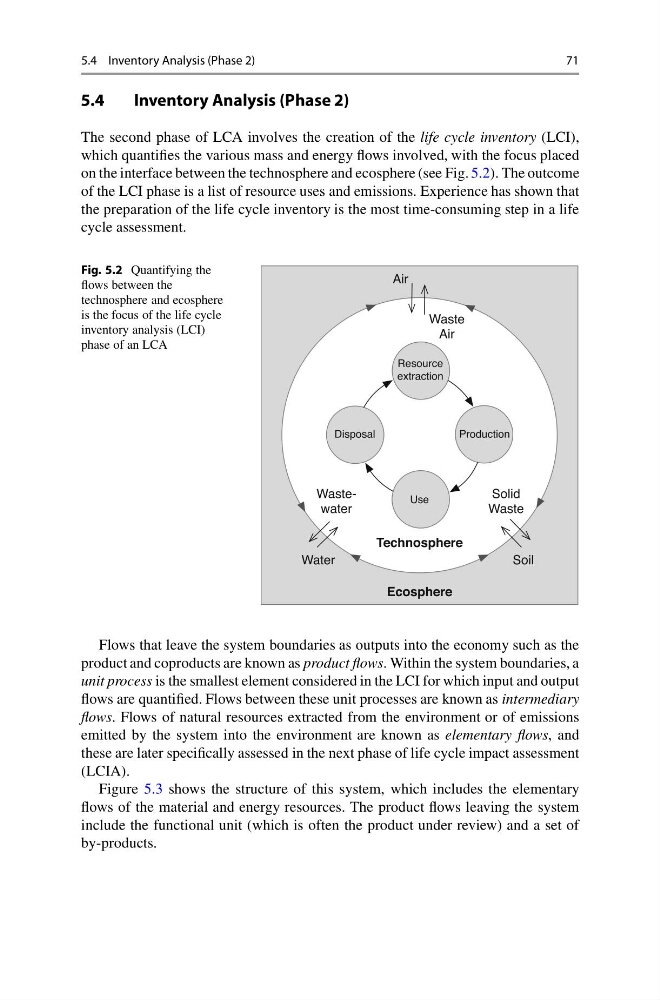
which quantifies the various mass and energy flows involved, with the focus placed
on the interface between the technosphere and ecosphere (see Fig. 5.2). The outcome
of the LCI phase is a list of resource uses and emissions. Experience has shown that
the preparation of the life cycle inventory is the most time-consuming step in a life
cycle assessment.
Fig. 5.2 Quantifying the
flows between the
technosphere and ecosphere
is the focus of the life cycle
inventory analysis (LCI)
phase of an LCA
Flows that leave the system boundaries as outputs into the economy such as the
product and coproducts are known as product flows. Within the system boundaries, a
unit process is the smallest element considered in the LCI for which input and output
flows are quantified. Flows between these unit processes are known as intermediary
flows. Flows of natural resources extracted from the environment or of emissions
emitted by the system into the environment are known as elementary flows, and
these are later specifically assessed in the next phase of life cycle impact assessment
(LCIA).
Figure 5.3 shows the structure of this system, which includes the elementary
flows of the material and energy resources. The product flows leaving the system
include the functional unit (which is often the product under review) and a set of
by-products.
71
5.4
Inventory Analysis (Phase 2)
The second phase of LCA involves the creation of the life cycle inventory (LCI),
which quantifies the various mass and energy flows involved, with the focus placed
on the interface between the technosphere and ecosphere (see Fig. 5.2). The outcome
of the LCI phase is a list of resource uses and emissions. Experience has shown that
the preparation of the life cycle inventory is the most time-consuming step in a life
cycle assessment.
Fig. 5.2 Quantifying the
flows between the
technosphere and ecosphere
is the focus of the life cycle
inventory analysis (LCI)
phase of an LCA
Flows that leave the system boundaries as outputs into the economy such as the
product and coproducts are known as product flows. Within the system boundaries, a
unit process is the smallest element considered in the LCI for which input and output
flows are quantified. Flows between these unit processes are known as intermediary
flows. Flows of natural resources extracted from the environment or of emissions
emitted by the system into the environment are known as elementary flows, and
these are later specifically assessed in the next phase of life cycle impact assessment
(LCIA).
Figure 5.3 shows the structure of this system, which includes the elementary
flows of the material and energy resources. The product flows leaving the system
include the functional unit (which is often the product under review) and a set of
by-products.