

304
G Case Study Solutions
G.2
Process Risk Assessment
G.2.1 Step 2: Definition of Safe Process Conditions
(a) Yes, from the data collected in step 1, it is clear that HCN and methyl ethyl
ketone are highly flammable, 3-methylpyridine is flammable, and 3-chloro-2isopropylthio aniline reaches the flash point during the synthesis reaction. To
ensure safe process conditions, ignition sources should be removed, and the
reactor should be inerted.
These safety measures should be applied during the entire process step (in
both the synthesis and precipitation reactions).
(b) Under acidic conditions, CuCN and Na 2 S can react to form HCN and H 2 S,
respectively. Both substances are highly toxic and flammable. In addition, HCN
is formed during the precipitation reaction with Na 2 S. Safe process conditions
require that the presence of acidic conditions in the reactor is avoided and
permanent monitoring of HCN levels.
(c) During the synthesis reaction, the temperature is controlled by the reflux
conditions. During the precipitation reaction, the temperature is controlled by
adjusting the addition rate of Na 2 S.
The synthesis reaction takes place at 190 ◦ C due to a large activation barrier.
Operating at 10 ◦ C below the boiling point of the reaction mixture ensures
process safety by avoiding the excessive formation of vapors, which might
exceed the capacity of the condenser leading to pressure build-up and difficulties
to control the temperature. Another aspect to keep in mind is that operating
below the boiling point is also more energy efficient.
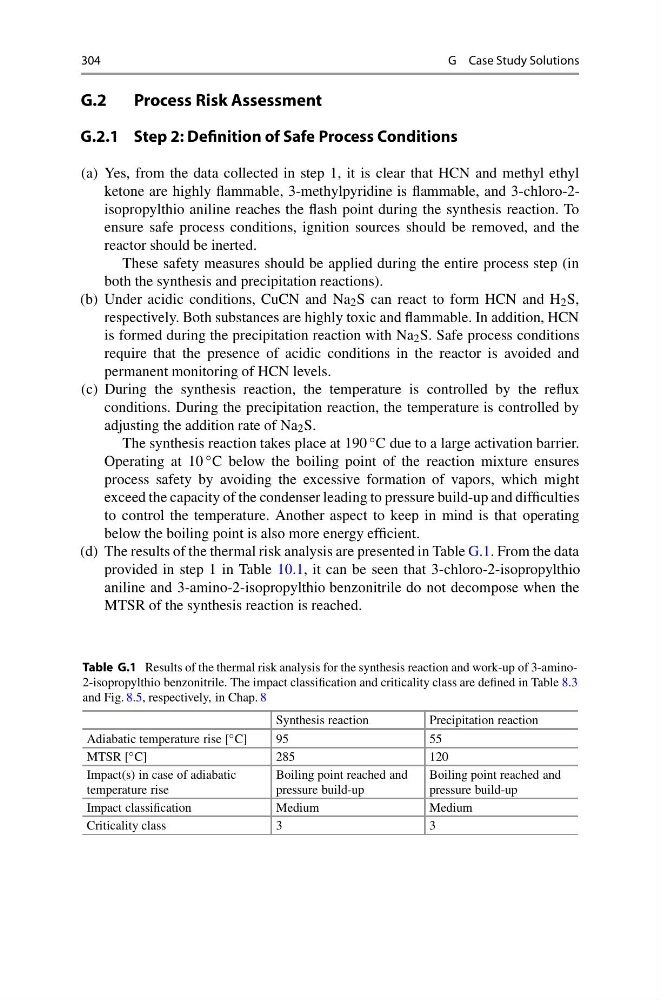
(d) The results of the thermal risk analysis are presented in Table G.1. From the data
provided in step 1 in Table 10.1, it can be seen that 3-chloro-2-isopropylthio
aniline and 3-amino-2-isopropylthio benzonitrile do not decompose when the
MTSR of the synthesis reaction is reached.
Table G.1 Results of the thermal risk analysis for the synthesis reaction and work-up of 3-amino2-isopropylthio benzonitrile. The impact classification and criticality class are defined in Table 8.3
and Fig. 8.5, respectively, in Chap. 8
Synthesis reaction
Precipitation reaction
Adiabatic temperature rise [ ◦ C]
95
55
MTSR [ ◦ C]
285
120
Impact(s) in case of adiabatic
temperature rise
Boiling point reached and
pressure build-up
Boiling point reached and
pressure build-up
Impact classification
Medium
Medium
Criticality class
3
3
G Case Study Solutions
G.2
Process Risk Assessment
G.2.1 Step 2: Definition of Safe Process Conditions
(a) Yes, from the data collected in step 1, it is clear that HCN and methyl ethyl
ketone are highly flammable, 3-methylpyridine is flammable, and 3-chloro-2isopropylthio aniline reaches the flash point during the synthesis reaction. To
ensure safe process conditions, ignition sources should be removed, and the
reactor should be inerted.
These safety measures should be applied during the entire process step (in
both the synthesis and precipitation reactions).
(b) Under acidic conditions, CuCN and Na 2 S can react to form HCN and H 2 S,
respectively. Both substances are highly toxic and flammable. In addition, HCN
is formed during the precipitation reaction with Na 2 S. Safe process conditions
require that the presence of acidic conditions in the reactor is avoided and
permanent monitoring of HCN levels.
(c) During the synthesis reaction, the temperature is controlled by the reflux
conditions. During the precipitation reaction, the temperature is controlled by
adjusting the addition rate of Na 2 S.
The synthesis reaction takes place at 190 ◦ C due to a large activation barrier.
Operating at 10 ◦ C below the boiling point of the reaction mixture ensures
process safety by avoiding the excessive formation of vapors, which might
exceed the capacity of the condenser leading to pressure build-up and difficulties
to control the temperature. Another aspect to keep in mind is that operating
below the boiling point is also more energy efficient.
(d) The results of the thermal risk analysis are presented in Table G.1. From the data
provided in step 1 in Table 10.1, it can be seen that 3-chloro-2-isopropylthio
aniline and 3-amino-2-isopropylthio benzonitrile do not decompose when the
MTSR of the synthesis reaction is reached.
Table G.1 Results of the thermal risk analysis for the synthesis reaction and work-up of 3-amino2-isopropylthio benzonitrile. The impact classification and criticality class are defined in Table 8.3
and Fig. 8.5, respectively, in Chap. 8
Synthesis reaction
Precipitation reaction
Adiabatic temperature rise [ ◦ C]
95
55
MTSR [ ◦ C]
285
120
Impact(s) in case of adiabatic
temperature rise
Boiling point reached and
pressure build-up
Boiling point reached and
pressure build-up
Impact classification
Medium
Medium
Criticality class
3
3