

290
E Concepts of Probability Analysis
failure on demand (PFD) can be defined as:
P F D =
t unrevealed failure
t inspection
=
1
t inspection
t inspection
0
F (t)dt
(E.12)
When λt << 1, this can be simplified to:
P F D =
1
t inspection
t inspection
0
λt dt =
1
2
× λ × t inspection
(E.13)
This assumes that the time required to repair a failed component is much less
than the time that the undiscovered failure has existed (t unrevealed failure ). For a low
probability of failure on demand which is important for safety devices and ensuring
a set safety integrity level (SIL) (see Chap. 7), two parameters can be influenced: (1)
a low λ and/or (2) a short interval between inspections.
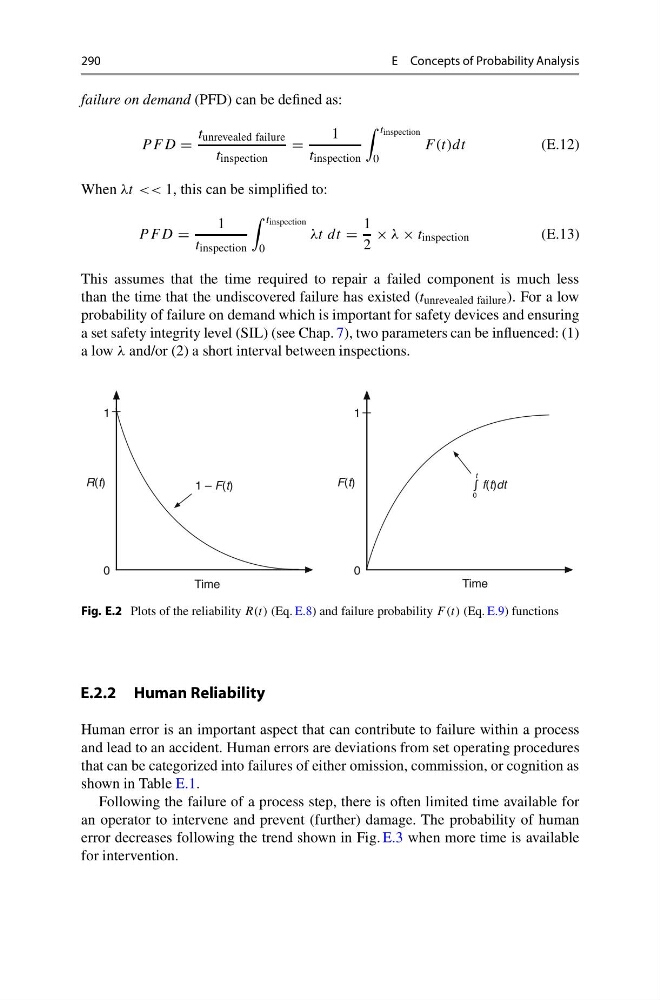
Fig. E.2 Plots of the reliability R(t) (Eq. E.8) and failure probability F (t) (Eq. E.9) functions
E.2.2 Human Reliability
Human error is an important aspect that can contribute to failure within a process
and lead to an accident. Human errors are deviations from set operating procedures
that can be categorized into failures of either omission, commission, or cognition as
shown in Table E.1.
Following the failure of a process step, there is often limited time available for
an operator to intervene and prevent (further) damage. The probability of human
error decreases following the trend shown in Fig. E.3 when more time is available
for intervention.
E Concepts of Probability Analysis
failure on demand (PFD) can be defined as:
P F D =
t unrevealed failure
t inspection
=
1
t inspection
t inspection
0
F (t)dt
(E.12)
When λt << 1, this can be simplified to:
P F D =
1
t inspection
t inspection
0
λt dt =
1
2
× λ × t inspection
(E.13)
This assumes that the time required to repair a failed component is much less
than the time that the undiscovered failure has existed (t unrevealed failure ). For a low
probability of failure on demand which is important for safety devices and ensuring
a set safety integrity level (SIL) (see Chap. 7), two parameters can be influenced: (1)
a low λ and/or (2) a short interval between inspections.
Fig. E.2 Plots of the reliability R(t) (Eq. E.8) and failure probability F (t) (Eq. E.9) functions
E.2.2 Human Reliability
Human error is an important aspect that can contribute to failure within a process
and lead to an accident. Human errors are deviations from set operating procedures
that can be categorized into failures of either omission, commission, or cognition as
shown in Table E.1.
Following the failure of a process step, there is often limited time available for
an operator to intervene and prevent (further) damage. The probability of human
error decreases following the trend shown in Fig. E.3 when more time is available
for intervention.