

D.4 Gas Penetration into Buildings
283
and:
σ
2
z =
2 K z (x)
u
× x = 2 K z (x) × t
(D.9)
where σ y and σ z are empirical quantities. They depend strongly on the state
of atmospheric turbulence, which in turn is mainly determined by the vertical
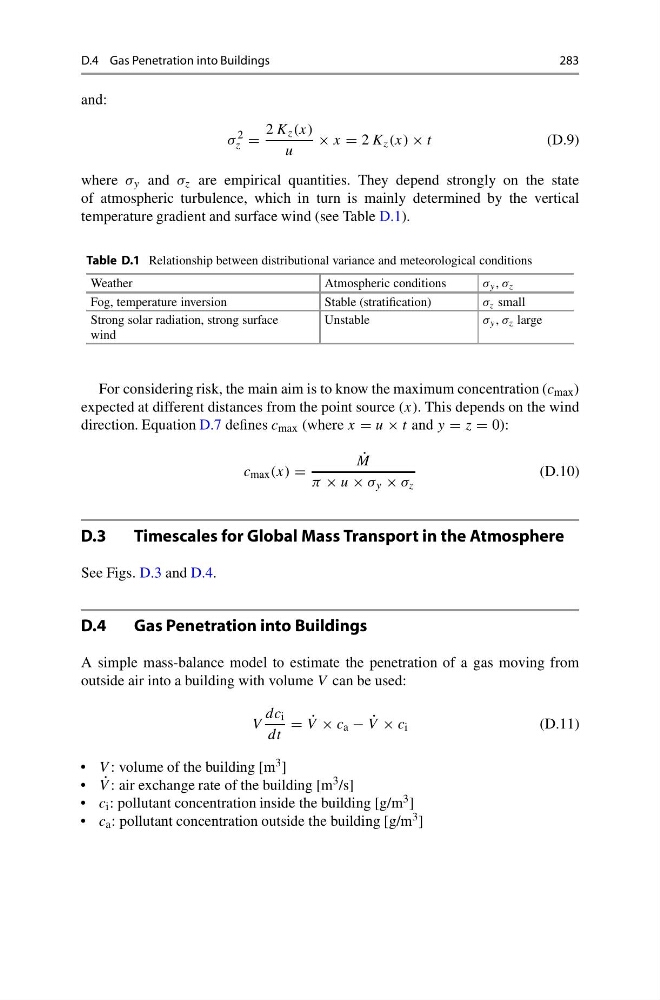
temperature gradient and surface wind (see Table D.1).
Table D.1 Relationship between distributional variance and meteorological conditions
Weather
Atmospheric conditions
σ y , σ z
Fog, temperature inversion
Stable (stratification)
σ z small
Strong solar radiation, strong surface
wind
Unstable
σ y , σ z large
For considering risk, the main aim is to know the maximum concentration (c max )
expected at different distances from the point source (x). This depends on the wind
direction. Equation D.7 defines c max (where x = u × t and y = z = 0):
c max (x) =
˙
M
π × u × σ y × σ z
(D.10)
D.3
Timescales for Global Mass Transport in the Atmosphere
See Figs. D.3 and D.4.
D.4
Gas Penetration into Buildings
A simple mass-balance model to estimate the penetration of a gas moving from
outside air into a building with volume V can be used:
V
dc i
dt
= ˙
V × c a − ˙
V × c i
(D.11)
• V : volume of the building [m 3 ]
• ˙
V : air exchange rate of the building [m 3 /s]
• c i : pollutant concentration inside the building [g/m 3 ]
• c a : pollutant concentration outside the building [g/m 3 ]
283
and:
σ
2
z =
2 K z (x)
u
× x = 2 K z (x) × t
(D.9)
where σ y and σ z are empirical quantities. They depend strongly on the state
of atmospheric turbulence, which in turn is mainly determined by the vertical
temperature gradient and surface wind (see Table D.1).
Table D.1 Relationship between distributional variance and meteorological conditions
Weather
Atmospheric conditions
σ y , σ z
Fog, temperature inversion
Stable (stratification)
σ z small
Strong solar radiation, strong surface
wind
Unstable
σ y , σ z large
For considering risk, the main aim is to know the maximum concentration (c max )
expected at different distances from the point source (x). This depends on the wind
direction. Equation D.7 defines c max (where x = u × t and y = z = 0):
c max (x) =
˙
M
π × u × σ y × σ z
(D.10)
D.3
Timescales for Global Mass Transport in the Atmosphere
See Figs. D.3 and D.4.
D.4
Gas Penetration into Buildings
A simple mass-balance model to estimate the penetration of a gas moving from
outside air into a building with volume V can be used:
V
dc i
dt
= ˙
V × c a − ˙
V × c i
(D.11)
• V : volume of the building [m 3 ]
• ˙
V : air exchange rate of the building [m 3 /s]
• c i : pollutant concentration inside the building [g/m 3 ]
• c a : pollutant concentration outside the building [g/m 3 ]