

C.3 Labeling of Fire and Explosion Hazards
275
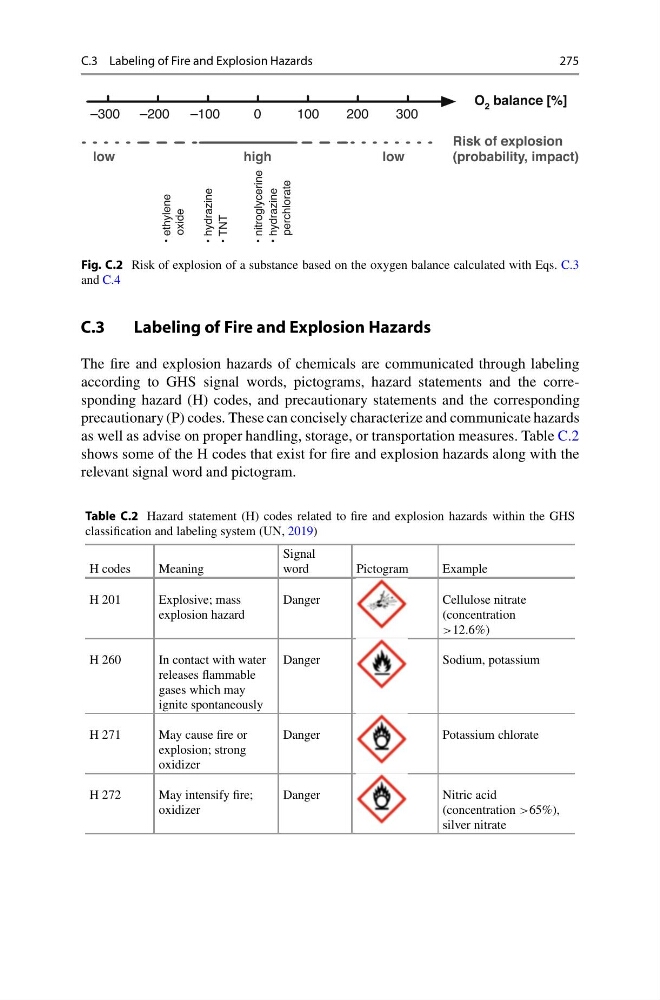
Fig. C.2 Risk of explosion of a substance based on the oxygen balance calculated with Eqs. C.3
and C.4
C.3
Labeling of Fire and Explosion Hazards
The fire and explosion hazards of chemicals are communicated through labeling
according to GHS signal words, pictograms, hazard statements and the corresponding hazard (H) codes, and precautionary statements and the corresponding
precautionary (P) codes. These can concisely characterize and communicate hazards
as well as advise on proper handling, storage, or transportation measures. Table C.2
shows some of the H codes that exist for fire and explosion hazards along with the
relevant signal word and pictogram.
Table C.2 Hazard statement (H) codes related to fire and explosion hazards within the GHS
classification and labeling system (UN, 2019)
H codes
Meaning
Signal
word
Pictogram
Example
H 201
Explosive; mass
explosion hazard
Danger
Cellulose nitrate
(concentration
>12.6%)
H 260
In contact with water
releases flammable
gases which may
ignite spontaneously
Danger
Sodium, potassium
H 271
May cause fire or
explosion; strong
oxidizer
Danger
Potassium chlorate
H 272
May intensify fire;
oxidizer
Danger
Nitric acid
(concentration >65%),
silver nitrate
275
Fig. C.2 Risk of explosion of a substance based on the oxygen balance calculated with Eqs. C.3
and C.4
C.3
Labeling of Fire and Explosion Hazards
The fire and explosion hazards of chemicals are communicated through labeling
according to GHS signal words, pictograms, hazard statements and the corresponding hazard (H) codes, and precautionary statements and the corresponding
precautionary (P) codes. These can concisely characterize and communicate hazards
as well as advise on proper handling, storage, or transportation measures. Table C.2
shows some of the H codes that exist for fire and explosion hazards along with the
relevant signal word and pictogram.
Table C.2 Hazard statement (H) codes related to fire and explosion hazards within the GHS
classification and labeling system (UN, 2019)
H codes
Meaning
Signal
word
Pictogram
Example
H 201
Explosive; mass
explosion hazard
Danger
Cellulose nitrate
(concentration
>12.6%)
H 260
In contact with water
releases flammable
gases which may
ignite spontaneously
Danger
Sodium, potassium
H 271
May cause fire or
explosion; strong
oxidizer
Danger
Potassium chlorate
H 272
May intensify fire;
oxidizer
Danger
Nitric acid
(concentration >65%),
silver nitrate