

274
C Fires and Explosions
7. Thermal Explosion: when the heat generated by a reaction increases its reaction
rate (leading to even more heat), a thermal explosion can occur at a determinable
ignition temperature when the rate of heat generation exceeds the rate of heat
leaving the system (see Chap. 8).
8. Deflagration: a locally triggered exothermic decomposition of a solid that can
propagate also without oxygen. The reaction propagates at subsonic speeds
(0.1 mm/s to 10 m/s) and is driven by the transfer of heat.
9. Detonation: a reaction that results in a shock wave that propagates at supersonic
speed (≥2000 m/s). The compound-specific maximal detonation rate is a key
parameter for explosion control.
10. Explosive Material: a substance that causes a sudden release of pressure,
gas, and heat when subjected to sudden shock, pressure, or heat. A simple
method to screen for chemicals having the formula C x H y O z that may be
explosive is through calculating their oxygen balance. Equation C.3 outlines
the stoichiometry of the combustion reaction used with the explosive material
on the left side of the equation, and Eq. C.4 shows the formula for calculation
of the oxygen balance where MW is the molecular weight of the explosive
material. The resulting risk of explosion based on the calculated oxygen balance
is characterized in Fig. C.2:
C x H y O z → x CO 2 +
y
2
H 2 O +
z
2
− x −
y
4
O 2
(C.3)
Oxygen balance in % = 100
16
MW C x H y O z
z − 2x −
y
2
(C.4)
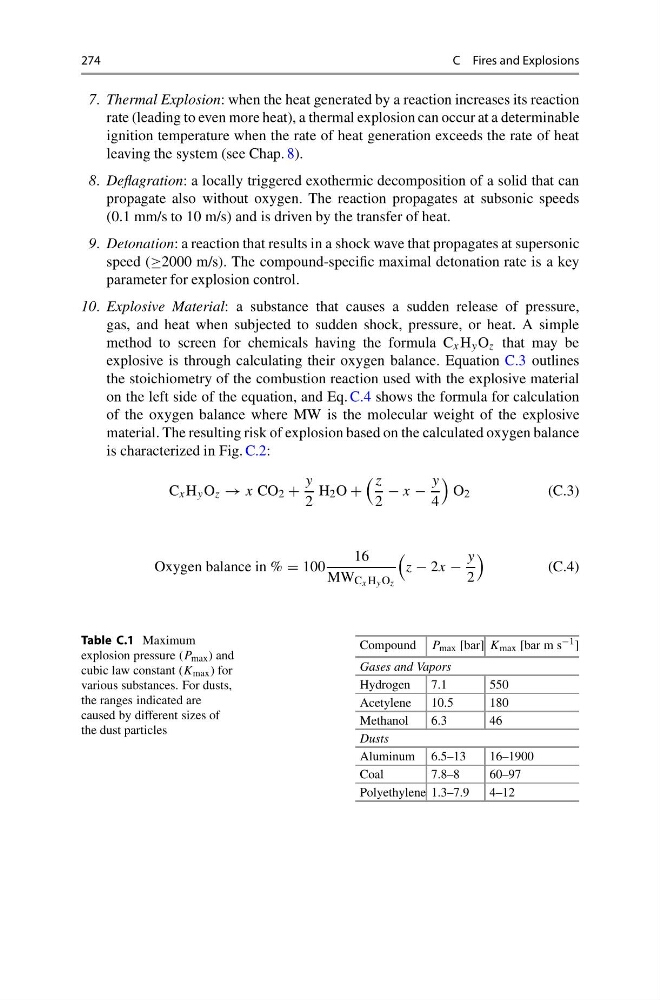
Table C.1 Maximum
explosion pressure (P max ) and
cubic law constant (K max ) for
various substances. For dusts,
the ranges indicated are
caused by different sizes of
the dust particles
Compound P max [bar] K max [bar m s −1 ]
Gases and Vapors
Hydrogen
7.1
550
Acetylene
10.5
180
Methanol
6.3
46
Dusts
Aluminum 6.5–13
16–1900
Coal
7.8–8
60–97
Polyethylene 1.3–7.9
4–12
C Fires and Explosions
7. Thermal Explosion: when the heat generated by a reaction increases its reaction
rate (leading to even more heat), a thermal explosion can occur at a determinable
ignition temperature when the rate of heat generation exceeds the rate of heat
leaving the system (see Chap. 8).
8. Deflagration: a locally triggered exothermic decomposition of a solid that can
propagate also without oxygen. The reaction propagates at subsonic speeds
(0.1 mm/s to 10 m/s) and is driven by the transfer of heat.
9. Detonation: a reaction that results in a shock wave that propagates at supersonic
speed (≥2000 m/s). The compound-specific maximal detonation rate is a key
parameter for explosion control.
10. Explosive Material: a substance that causes a sudden release of pressure,
gas, and heat when subjected to sudden shock, pressure, or heat. A simple
method to screen for chemicals having the formula C x H y O z that may be
explosive is through calculating their oxygen balance. Equation C.3 outlines
the stoichiometry of the combustion reaction used with the explosive material
on the left side of the equation, and Eq. C.4 shows the formula for calculation
of the oxygen balance where MW is the molecular weight of the explosive
material. The resulting risk of explosion based on the calculated oxygen balance
is characterized in Fig. C.2:
C x H y O z → x CO 2 +
y
2
H 2 O +
z
2
− x −
y
4
O 2
(C.3)
Oxygen balance in % = 100
16
MW C x H y O z
z − 2x −
y
2
(C.4)
Table C.1 Maximum
explosion pressure (P max ) and
cubic law constant (K max ) for
various substances. For dusts,
the ranges indicated are
caused by different sizes of
the dust particles
Compound P max [bar] K max [bar m s −1 ]
Gases and Vapors
Hydrogen
7.1
550
Acetylene
10.5
180
Methanol
6.3
46
Dusts
Aluminum 6.5–13
16–1900
Coal
7.8–8
60–97
Polyethylene 1.3–7.9
4–12