

A A Short Chronicle of Chemical Accidents
263
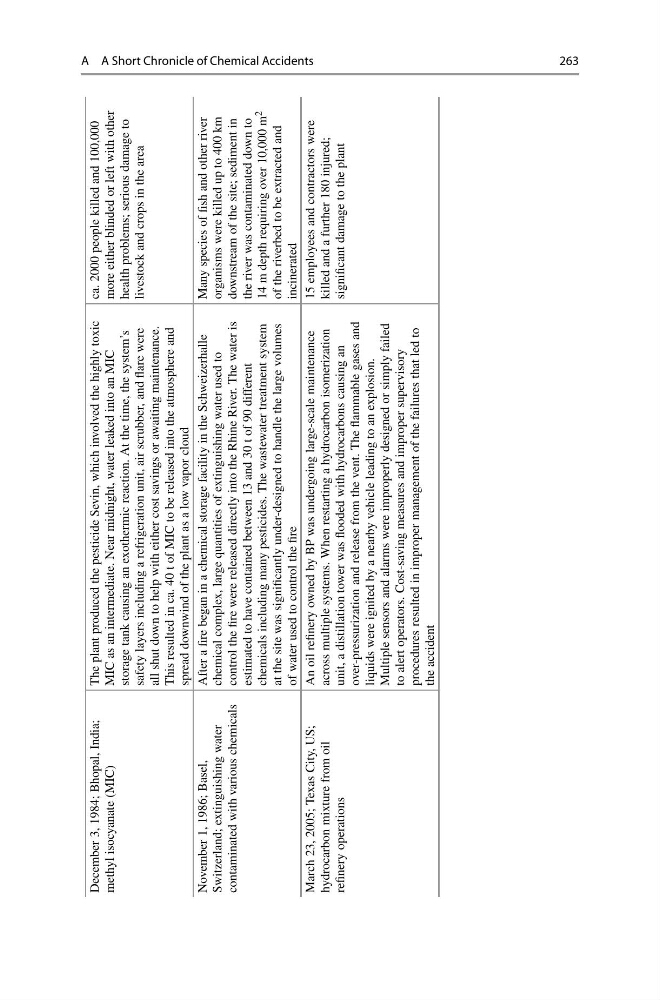
December 3, 1984; Bhopal, India;
methyl isocyanate (MIC)
The plant produced the pesticide Sevin, which involved the highly toxic
MIC as an intermediate. Near midnight, water leaked into an MIC
storage tank causing an exothermic reaction. At the time, the system’s
safety layers including a refrigeration unit, air scrubber, and flare were
all shut down to help with either cost savings or awaiting maintenance.
This resulted in ca. 40 t of MIC to be released into the atmosphere and
spread downwind of the plant as a low vapor cloud
ca. 2000 people killed and 100,000
more either blinded or left with other
health problems; serious damage to
livestock and crops in the area
November 1, 1986; Basel,
Switzerland; extinguishing water
contaminated with various chemicals
After a fire began in a chemical storage facility in the Schweizerhalle
chemical complex, large quantities of extinguishing water used to
control the fire were released directly into the Rhine River. The water is
estimated to have contained between 13 and 30 t of 90 different
chemicals including many pesticides. The wastewater treatment system
at the site was significantly under-designed to handle the large volumes
of water used to control the fire
Many species of fish and other river
organisms were killed up to 400 km
downstream of the site; sediment in
the river was contaminated down to
14 m depth requiring over 10,000 m 2
of the riverbed to be extracted and
incinerated
March 23, 2005; Texas City, US;
hydrocarbon mixture from oil
refinery operations
An oil refinery owned by BP was undergoing large-scale maintenance
across multiple systems. When restarting a hydrocarbon isomerization
unit, a distillation tower was flooded with hydrocarbons causing an
over-pressurization and release from the vent. The flammable gases and
liquids were ignited by a nearby vehicle leading to an explosion.
Multiple sensors and alarms were improperly designed or simply failed
to alert operators. Cost-saving measures and improper supervisory
procedures resulted in improper management of the failures that led to
the accident
15 employees and contractors were
killed and a further 180 injured;
significant damage to the plant
263
December 3, 1984; Bhopal, India;
methyl isocyanate (MIC)
The plant produced the pesticide Sevin, which involved the highly toxic
MIC as an intermediate. Near midnight, water leaked into an MIC
storage tank causing an exothermic reaction. At the time, the system’s
safety layers including a refrigeration unit, air scrubber, and flare were
all shut down to help with either cost savings or awaiting maintenance.
This resulted in ca. 40 t of MIC to be released into the atmosphere and
spread downwind of the plant as a low vapor cloud
ca. 2000 people killed and 100,000
more either blinded or left with other
health problems; serious damage to
livestock and crops in the area
November 1, 1986; Basel,
Switzerland; extinguishing water
contaminated with various chemicals
After a fire began in a chemical storage facility in the Schweizerhalle
chemical complex, large quantities of extinguishing water used to
control the fire were released directly into the Rhine River. The water is
estimated to have contained between 13 and 30 t of 90 different
chemicals including many pesticides. The wastewater treatment system
at the site was significantly under-designed to handle the large volumes
of water used to control the fire
Many species of fish and other river
organisms were killed up to 400 km
downstream of the site; sediment in
the river was contaminated down to
14 m depth requiring over 10,000 m 2
of the riverbed to be extracted and
incinerated
March 23, 2005; Texas City, US;
hydrocarbon mixture from oil
refinery operations
An oil refinery owned by BP was undergoing large-scale maintenance
across multiple systems. When restarting a hydrocarbon isomerization
unit, a distillation tower was flooded with hydrocarbons causing an
over-pressurization and release from the vent. The flammable gases and
liquids were ignited by a nearby vehicle leading to an explosion.
Multiple sensors and alarms were improperly designed or simply failed
to alert operators. Cost-saving measures and improper supervisory
procedures resulted in improper management of the failures that led to
the accident
15 employees and contractors were
killed and a further 180 injured;
significant damage to the plant