

262
A A Short Chronicle of Chemical Accidents
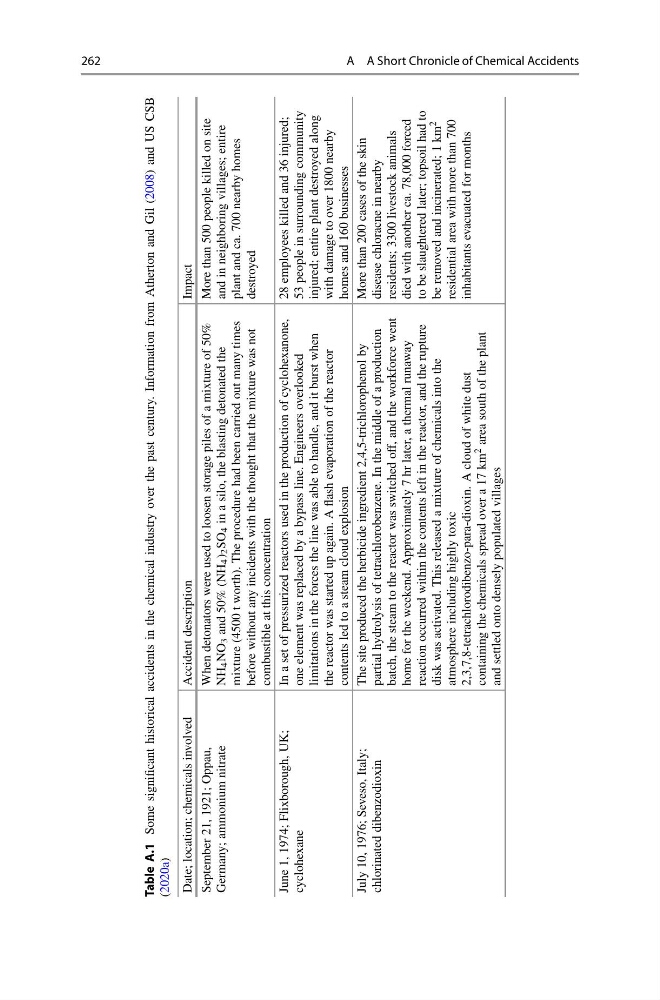
Table A.1
Some significant historical accidents in the chemical industry over the past century. Information from Atherton and Gil (2008) and US CSB
(2020a)
Date; location; chemicals involved
Accident description
Impact
September 21, 1921; Oppau,
Germany; ammonium nitrate
When detonators were used to loosen storage piles of a mixture of 50%
NH
4 NO
3 and 50% (NH
4 )
2 SO
4 in a silo, the blasting detonated the
mixture (4500 t worth). The procedure had been carried out many times
before without any incidents with the thought that the mixture was not
combustible at this concentration
More than 500 people killed on site
and in neighboring villages; entire
plant and ca. 700 nearby homes
destroyed
June 1, 1974; Flixborough, UK;
cyclohexane
In a set of pressurized reactors used in the production of cyclohexanone,
one element was replaced by a bypass line. Engineers overlooked
limitations in the forces the line was able to handle, and it burst when
the reactor was started up again. A flash evaporation of the reactor
contents led to a steam cloud explosion
28 employees killed and 36 injured;
53 people in surrounding community
injured; entire plant destroyed along
with damage to over 1800 nearby
homes and 160 businesses
July 10, 1976; Seveso, Italy;
chlorinated dibenzodioxin
The site produced the herbicide ingredient 2,4,5-trichlorophenol by
partial hydrolysis of tetrachlorobenzene. In the middle of a production
batch, the steam to the reactor was switched off, and the workforce went
home for the weekend. Approximately 7 hr later, a thermal runaway
reaction occurred within the contents left in the reactor, and the rupture
disk was activated. This released a mixture of chemicals into the
atmosphere including highly toxic
2,3,7,8-tetrachlorodibenzo-para-dioxin. A cloud of white dust
containing the chemicals spread over a 17 km 2
area south of the plant
and settled onto densely populated villages
More than 200 cases of the skin
disease chloracne in nearby
residents; 3300 livestock animals
died with another ca. 78,000 forced
to be slaughtered later; topsoil had to
be removed and incinerated; 1 km 2
residential area with more than 700
inhabitants evacuated for months
A A Short Chronicle of Chemical Accidents
Table A.1
Some significant historical accidents in the chemical industry over the past century. Information from Atherton and Gil (2008) and US CSB
(2020a)
Date; location; chemicals involved
Accident description
Impact
September 21, 1921; Oppau,
Germany; ammonium nitrate
When detonators were used to loosen storage piles of a mixture of 50%
NH
4 NO
3 and 50% (NH
4 )
2 SO
4 in a silo, the blasting detonated the
mixture (4500 t worth). The procedure had been carried out many times
before without any incidents with the thought that the mixture was not
combustible at this concentration
More than 500 people killed on site
and in neighboring villages; entire
plant and ca. 700 nearby homes
destroyed
June 1, 1974; Flixborough, UK;
cyclohexane
In a set of pressurized reactors used in the production of cyclohexanone,
one element was replaced by a bypass line. Engineers overlooked
limitations in the forces the line was able to handle, and it burst when
the reactor was started up again. A flash evaporation of the reactor
contents led to a steam cloud explosion
28 employees killed and 36 injured;
53 people in surrounding community
injured; entire plant destroyed along
with damage to over 1800 nearby
homes and 160 businesses
July 10, 1976; Seveso, Italy;
chlorinated dibenzodioxin
The site produced the herbicide ingredient 2,4,5-trichlorophenol by
partial hydrolysis of tetrachlorobenzene. In the middle of a production
batch, the steam to the reactor was switched off, and the workforce went
home for the weekend. Approximately 7 hr later, a thermal runaway
reaction occurred within the contents left in the reactor, and the rupture
disk was activated. This released a mixture of chemicals into the
atmosphere including highly toxic
2,3,7,8-tetrachlorodibenzo-para-dioxin. A cloud of white dust
containing the chemicals spread over a 17 km 2
area south of the plant
and settled onto densely populated villages
More than 200 cases of the skin
disease chloracne in nearby
residents; 3300 livestock animals
died with another ca. 78,000 forced
to be slaughtered later; topsoil had to
be removed and incinerated; 1 km 2
residential area with more than 700
inhabitants evacuated for months