

10.2 Process Risk Assessment
241
After completion of the reaction, the mixture is cooled down and diluted with
180 kg of methyl ethyl ketone. Subsequently, sodium sulfide (Na 2 S) is added to the
reaction mixture in semi-batch mode to react for 2 hr and precipitate the copper(I)
as copper sulfide (Cu 2 S), which can then be separated from the reaction mixture and
disposed of or recycled accordingly.
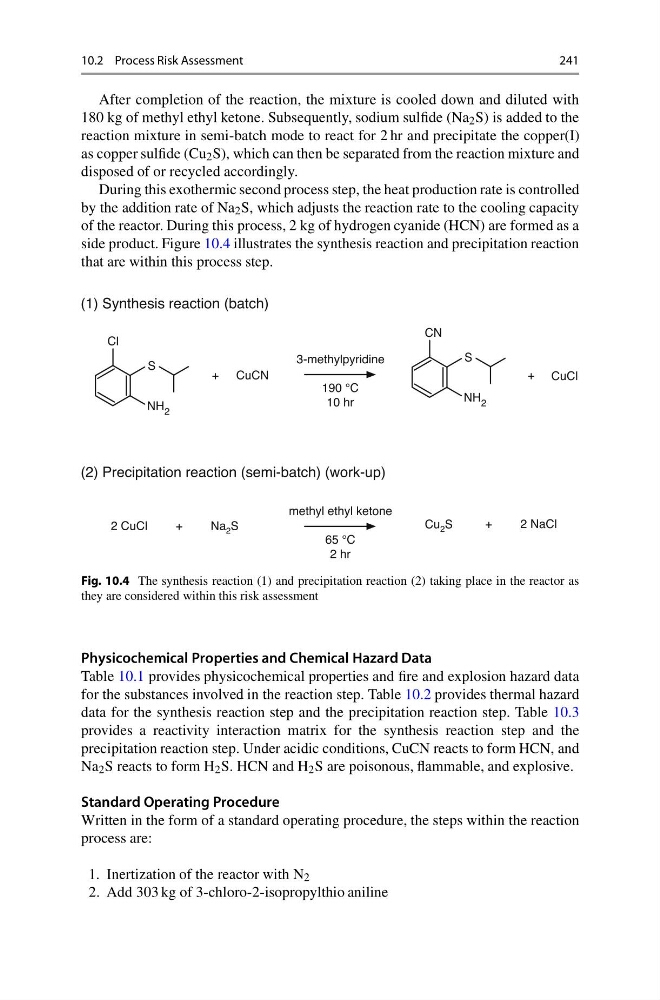
During this exothermic second process step, the heat production rate is controlled
by the addition rate of Na 2 S, which adjusts the reaction rate to the cooling capacity
of the reactor. During this process, 2 kg of hydrogen cyanide (HCN) are formed as a
side product. Figure 10.4 illustrates the synthesis reaction and precipitation reaction
that are within this process step.
Fig. 10.4 The synthesis reaction (1) and precipitation reaction (2) taking place in the reactor as
they are considered within this risk assessment
Physicochemical Properties and Chemical Hazard Data
Table 10.1 provides physicochemical properties and fire and explosion hazard data
for the substances involved in the reaction step. Table 10.2 provides thermal hazard
data for the synthesis reaction step and the precipitation reaction step. Table 10.3
provides a reactivity interaction matrix for the synthesis reaction step and the
precipitation reaction step. Under acidic conditions, CuCN reacts to form HCN, and
Na 2 S reacts to form H 2 S. HCN and H 2 S are poisonous, flammable, and explosive.
Standard Operating Procedure
Written in the form of a standard operating procedure, the steps within the reaction
process are:
1. Inertization of the reactor with N 2
2. Add 303 kg of 3-chloro-2-isopropylthio aniline
241
After completion of the reaction, the mixture is cooled down and diluted with
180 kg of methyl ethyl ketone. Subsequently, sodium sulfide (Na 2 S) is added to the
reaction mixture in semi-batch mode to react for 2 hr and precipitate the copper(I)
as copper sulfide (Cu 2 S), which can then be separated from the reaction mixture and
disposed of or recycled accordingly.
During this exothermic second process step, the heat production rate is controlled
by the addition rate of Na 2 S, which adjusts the reaction rate to the cooling capacity
of the reactor. During this process, 2 kg of hydrogen cyanide (HCN) are formed as a
side product. Figure 10.4 illustrates the synthesis reaction and precipitation reaction
that are within this process step.
Fig. 10.4 The synthesis reaction (1) and precipitation reaction (2) taking place in the reactor as
they are considered within this risk assessment
Physicochemical Properties and Chemical Hazard Data
Table 10.1 provides physicochemical properties and fire and explosion hazard data
for the substances involved in the reaction step. Table 10.2 provides thermal hazard
data for the synthesis reaction step and the precipitation reaction step. Table 10.3
provides a reactivity interaction matrix for the synthesis reaction step and the
precipitation reaction step. Under acidic conditions, CuCN reacts to form HCN, and
Na 2 S reacts to form H 2 S. HCN and H 2 S are poisonous, flammable, and explosive.
Standard Operating Procedure
Written in the form of a standard operating procedure, the steps within the reaction
process are:
1. Inertization of the reactor with N 2
2. Add 303 kg of 3-chloro-2-isopropylthio aniline