

240
10 Illustrative Case Study
10.2.1.2 System Definition
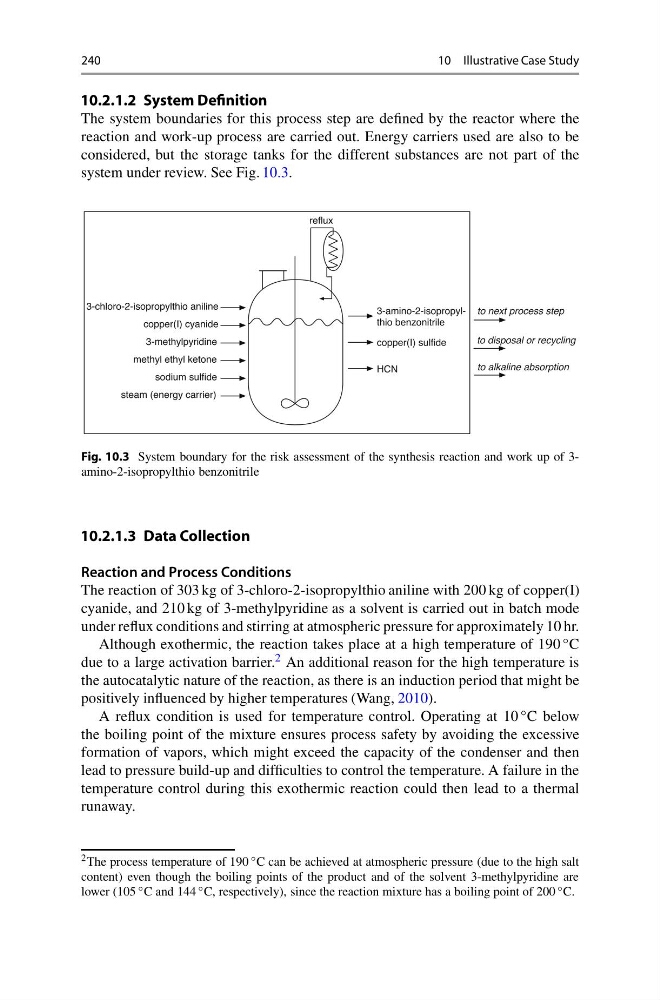
The system boundaries for this process step are defined by the reactor where the
reaction and work-up process are carried out. Energy carriers used are also to be
considered, but the storage tanks for the different substances are not part of the
system under review. See Fig. 10.3.
Fig. 10.3 System boundary for the risk assessment of the synthesis reaction and work up of 3amino-2-isopropylthio benzonitrile
10.2.1.3 Data Collection
Reaction and Process Conditions
The reaction of 303 kg of 3-chloro-2-isopropylthio aniline with 200 kg of copper(I)
cyanide, and 210 kg of 3-methylpyridine as a solvent is carried out in batch mode
under reflux conditions and stirring at atmospheric pressure for approximately 10 hr.
Although exothermic, the reaction takes place at a high temperature of 190 ◦ C
due to a large activation barrier. 2 An additional reason for the high temperature is
the autocatalytic nature of the reaction, as there is an induction period that might be
positively influenced by higher temperatures (Wang, 2010).
A reflux condition is used for temperature control. Operating at 10 ◦ C below
the boiling point of the mixture ensures process safety by avoiding the excessive
formation of vapors, which might exceed the capacity of the condenser and then
lead to pressure build-up and difficulties to control the temperature. A failure in the
temperature control during this exothermic reaction could then lead to a thermal
runaway.
2 The process temperature of 190 ◦ C can be achieved at atmospheric pressure (due to the high salt
content) even though the boiling points of the product and of the solvent 3-methylpyridine are
lower (105 ◦ C and 144 ◦ C, respectively), since the reaction mixture has a boiling point of 200 ◦ C.
10 Illustrative Case Study
10.2.1.2 System Definition
The system boundaries for this process step are defined by the reactor where the
reaction and work-up process are carried out. Energy carriers used are also to be
considered, but the storage tanks for the different substances are not part of the
system under review. See Fig. 10.3.
Fig. 10.3 System boundary for the risk assessment of the synthesis reaction and work up of 3amino-2-isopropylthio benzonitrile
10.2.1.3 Data Collection
Reaction and Process Conditions
The reaction of 303 kg of 3-chloro-2-isopropylthio aniline with 200 kg of copper(I)
cyanide, and 210 kg of 3-methylpyridine as a solvent is carried out in batch mode
under reflux conditions and stirring at atmospheric pressure for approximately 10 hr.
Although exothermic, the reaction takes place at a high temperature of 190 ◦ C
due to a large activation barrier. 2 An additional reason for the high temperature is
the autocatalytic nature of the reaction, as there is an induction period that might be
positively influenced by higher temperatures (Wang, 2010).
A reflux condition is used for temperature control. Operating at 10 ◦ C below
the boiling point of the mixture ensures process safety by avoiding the excessive
formation of vapors, which might exceed the capacity of the condenser and then
lead to pressure build-up and difficulties to control the temperature. A failure in the
temperature control during this exothermic reaction could then lead to a thermal
runaway.
2 The process temperature of 190 ◦ C can be achieved at atmospheric pressure (due to the high salt
content) even though the boiling points of the product and of the solvent 3-methylpyridine are
lower (105 ◦ C and 144 ◦ C, respectively), since the reaction mixture has a boiling point of 200 ◦ C.