

212
8 Thermal Process Safety
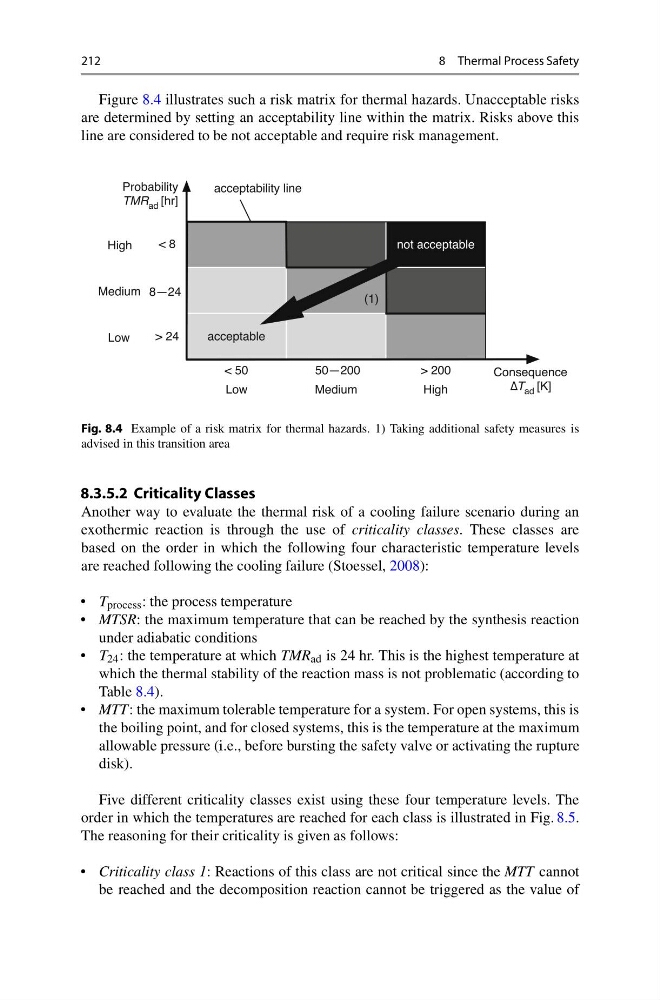
Figure 8.4 illustrates such a risk matrix for thermal hazards. Unacceptable risks
are determined by setting an acceptability line within the matrix. Risks above this
line are considered to be not acceptable and require risk management.
Fig. 8.4 Example of a risk matrix for thermal hazards. 1) Taking additional safety measures is
advised in this transition area
8.3.5.2 Criticality Classes
Another way to evaluate the thermal risk of a cooling failure scenario during an
exothermic reaction is through the use of criticality classes. These classes are
based on the order in which the following four characteristic temperature levels
are reached following the cooling failure (Stoessel, 2008):
• T process : the process temperature
• MTSR: the maximum temperature that can be reached by the synthesis reaction
under adiabatic conditions
• T 24 : the temperature at which TMR ad is 24 hr. This is the highest temperature at
which the thermal stability of the reaction mass is not problematic (according to
Table 8.4).
• MTT: the maximum tolerable temperature for a system. For open systems, this is
the boiling point, and for closed systems, this is the temperature at the maximum
allowable pressure (i.e., before bursting the safety valve or activating the rupture
disk).
Five different criticality classes exist using these four temperature levels. The
order in which the temperatures are reached for each class is illustrated in Fig. 8.5.
The reasoning for their criticality is given as follows:
• Criticality class 1: Reactions of this class are not critical since the MTT cannot
be reached and the decomposition reaction cannot be triggered as the value of
8 Thermal Process Safety
Figure 8.4 illustrates such a risk matrix for thermal hazards. Unacceptable risks
are determined by setting an acceptability line within the matrix. Risks above this
line are considered to be not acceptable and require risk management.
Fig. 8.4 Example of a risk matrix for thermal hazards. 1) Taking additional safety measures is
advised in this transition area
8.3.5.2 Criticality Classes
Another way to evaluate the thermal risk of a cooling failure scenario during an
exothermic reaction is through the use of criticality classes. These classes are
based on the order in which the following four characteristic temperature levels
are reached following the cooling failure (Stoessel, 2008):
• T process : the process temperature
• MTSR: the maximum temperature that can be reached by the synthesis reaction
under adiabatic conditions
• T 24 : the temperature at which TMR ad is 24 hr. This is the highest temperature at
which the thermal stability of the reaction mass is not problematic (according to
Table 8.4).
• MTT: the maximum tolerable temperature for a system. For open systems, this is
the boiling point, and for closed systems, this is the temperature at the maximum
allowable pressure (i.e., before bursting the safety valve or activating the rupture
disk).
Five different criticality classes exist using these four temperature levels. The
order in which the temperatures are reached for each class is illustrated in Fig. 8.5.
The reasoning for their criticality is given as follows:
• Criticality class 1: Reactions of this class are not critical since the MTT cannot
be reached and the decomposition reaction cannot be triggered as the value of