

196
7 Risk Assessment and Management of Chemical Processes
7.9.5 Risk Evaluation (Step 5)
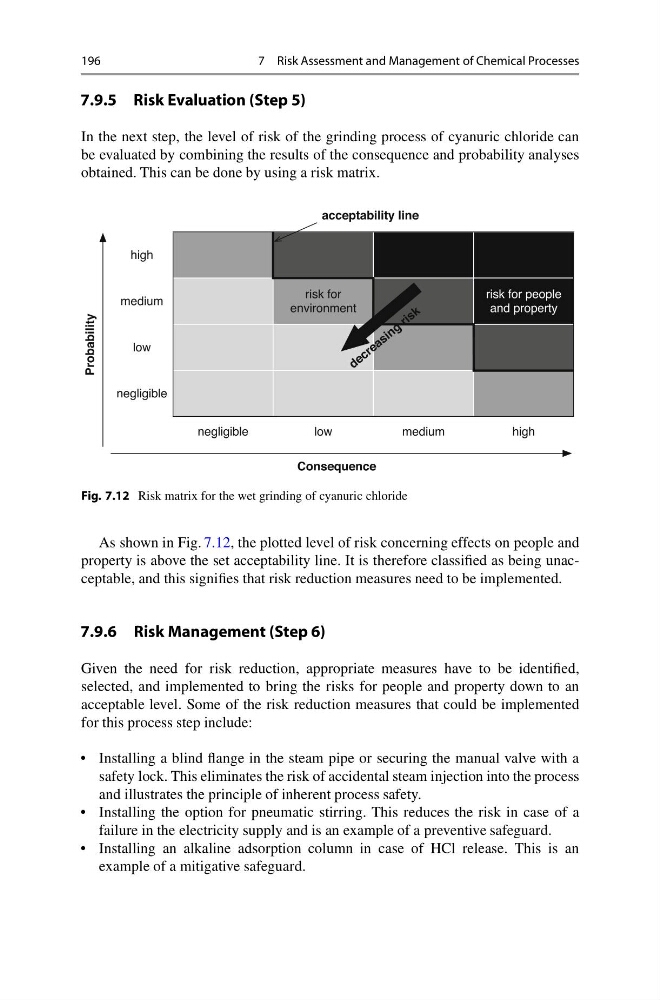
In the next step, the level of risk of the grinding process of cyanuric chloride can
be evaluated by combining the results of the consequence and probability analyses
obtained. This can be done by using a risk matrix.
Fig. 7.12 Risk matrix for the wet grinding of cyanuric chloride
As shown in Fig. 7.12, the plotted level of risk concerning effects on people and
property is above the set acceptability line. It is therefore classified as being unacceptable, and this signifies that risk reduction measures need to be implemented.
7.9.6 Risk Management (Step 6)
Given the need for risk reduction, appropriate measures have to be identified,
selected, and implemented to bring the risks for people and property down to an
acceptable level. Some of the risk reduction measures that could be implemented
for this process step include:
• Installing a blind flange in the steam pipe or securing the manual valve with a
safety lock. This eliminates the risk of accidental steam injection into the process
and illustrates the principle of inherent process safety.
• Installing the option for pneumatic stirring. This reduces the risk in case of a
failure in the electricity supply and is an example of a preventive safeguard.
• Installing an alkaline adsorption column in case of HCl release. This is an
example of a mitigative safeguard.
7 Risk Assessment and Management of Chemical Processes
7.9.5 Risk Evaluation (Step 5)
In the next step, the level of risk of the grinding process of cyanuric chloride can
be evaluated by combining the results of the consequence and probability analyses
obtained. This can be done by using a risk matrix.
Fig. 7.12 Risk matrix for the wet grinding of cyanuric chloride
As shown in Fig. 7.12, the plotted level of risk concerning effects on people and
property is above the set acceptability line. It is therefore classified as being unacceptable, and this signifies that risk reduction measures need to be implemented.
7.9.6 Risk Management (Step 6)
Given the need for risk reduction, appropriate measures have to be identified,
selected, and implemented to bring the risks for people and property down to an
acceptable level. Some of the risk reduction measures that could be implemented
for this process step include:
• Installing a blind flange in the steam pipe or securing the manual valve with a
safety lock. This eliminates the risk of accidental steam injection into the process
and illustrates the principle of inherent process safety.
• Installing the option for pneumatic stirring. This reduces the risk in case of a
failure in the electricity supply and is an example of a preventive safeguard.
• Installing an alkaline adsorption column in case of HCl release. This is an
example of a mitigative safeguard.