

7.9 Example: Wet Grinding of Cyanuric Chloride
191
7.9.3 Risk Identification (Step 3)
In this example, risk identification is carried out using a HAZOP study. As
introduced in Sect. 7.5.1, this technique focuses on identifying deviations and uses
guide words combined with specific process parameters.
Table 7.12 presents the results of the HAZOP analysis. The guide words
used to address potential deviations in this process step are “high temperature,”
“low pH,” and “no mixing.” In this example, the loss event resulting from these
deviations is identified as being the hydrolytic decomposition of cyanuric chloride.
An autocatalytic runaway reaction, thermal explosion, and subsequent release of
HCl in the environment are the worst-case consequences of these deviations. The
hazards inherent to the process, as well as potential process failures (causes), and
existing preventive and mitigative safeguards are also shown in Table 7.12. Note
that this table does not present the results of a truly exhaustive HAZOP study.
7.9.4 Risk Analysis (Step 4)
Within the risk analysis step, the identified consequences from the HAZOP study
are further investigated along with their probabilities of occurrence.
7.9.4.1 Consequence Analysis
From the HAZOP study, a worst-case consequence from a decomposition reaction
of cyanuric chloride and the failure of safeguards would be a thermal runaway,
explosion, and the resulting release of hydrochloric acid (HCl) into the atmosphere.
To help analyze the consequences of the HCl release, Eq. 7.1 can be used to estimate
the distance from the release source (x) that the vapor cloud would need to travel
before its concentration (c) falls below the safe maximum exposure levels. The risk
of a thermal runaway specifically for this example will be presented in Sect. 8.4 in
Chap. 8.
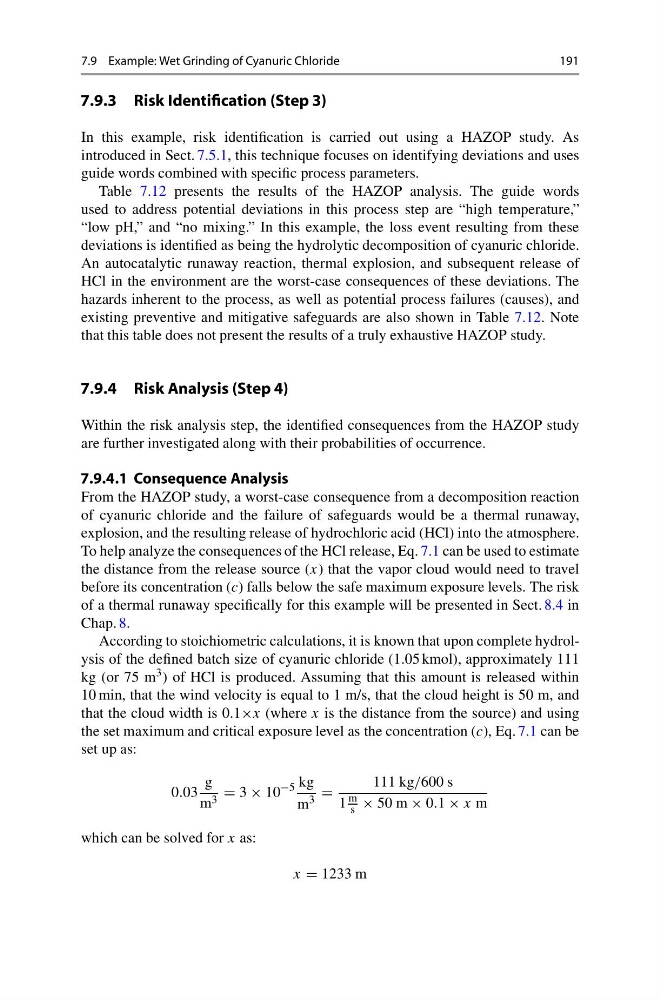
According to stoichiometric calculations, it is known that upon complete hydrolysis of the defined batch size of cyanuric chloride (1.05 kmol), approximately 111
kg (or 75 m 3 ) of HCl is produced. Assuming that this amount is released within
10 min, that the wind velocity is equal to 1 m/s, that the cloud height is 50 m, and
that the cloud width is 0.1×x (where x is the distance from the source) and using
the set maximum and critical exposure level as the concentration (c), Eq. 7.1 can be
set up as:
0.03
g
m 3 = 3 × 10
−5 kg
m 3 =
111 kg/600 s
1
m
s × 50 m × 0.1 × x m
which can be solved for x as:
x = 1233 m
191
7.9.3 Risk Identification (Step 3)
In this example, risk identification is carried out using a HAZOP study. As
introduced in Sect. 7.5.1, this technique focuses on identifying deviations and uses
guide words combined with specific process parameters.
Table 7.12 presents the results of the HAZOP analysis. The guide words
used to address potential deviations in this process step are “high temperature,”
“low pH,” and “no mixing.” In this example, the loss event resulting from these
deviations is identified as being the hydrolytic decomposition of cyanuric chloride.
An autocatalytic runaway reaction, thermal explosion, and subsequent release of
HCl in the environment are the worst-case consequences of these deviations. The
hazards inherent to the process, as well as potential process failures (causes), and
existing preventive and mitigative safeguards are also shown in Table 7.12. Note
that this table does not present the results of a truly exhaustive HAZOP study.
7.9.4 Risk Analysis (Step 4)
Within the risk analysis step, the identified consequences from the HAZOP study
are further investigated along with their probabilities of occurrence.
7.9.4.1 Consequence Analysis
From the HAZOP study, a worst-case consequence from a decomposition reaction
of cyanuric chloride and the failure of safeguards would be a thermal runaway,
explosion, and the resulting release of hydrochloric acid (HCl) into the atmosphere.
To help analyze the consequences of the HCl release, Eq. 7.1 can be used to estimate
the distance from the release source (x) that the vapor cloud would need to travel
before its concentration (c) falls below the safe maximum exposure levels. The risk
of a thermal runaway specifically for this example will be presented in Sect. 8.4 in
Chap. 8.
According to stoichiometric calculations, it is known that upon complete hydrolysis of the defined batch size of cyanuric chloride (1.05 kmol), approximately 111
kg (or 75 m 3 ) of HCl is produced. Assuming that this amount is released within
10 min, that the wind velocity is equal to 1 m/s, that the cloud height is 50 m, and
that the cloud width is 0.1×x (where x is the distance from the source) and using
the set maximum and critical exposure level as the concentration (c), Eq. 7.1 can be
set up as:
0.03
g
m 3 = 3 × 10
−5 kg
m 3 =
111 kg/600 s
1
m
s × 50 m × 0.1 × x m
which can be solved for x as:
x = 1233 m