

6.5 Effect Assessment (Step 3)
139
Defining this safe level for humans can be difficult, since testing directly on
humans is usually not possible or not allowed for ethical reasons. For environmental
toxicity, testing is less restricted, but it has to be able to lead to a result that takes
into account the thousands of different species that exist in an ecosystem, which can
each have varying (and often unknown) sensitivities to the same substance.
To address these limitations, assessment factors are applied as a method to
consider the uncertainty and variability within and between different species and to
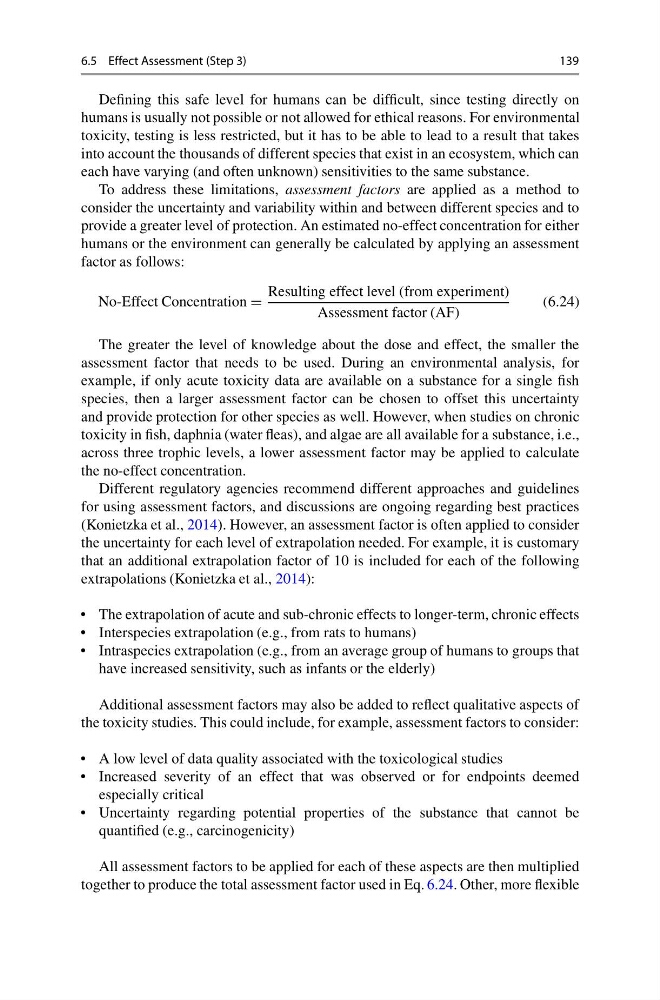
provide a greater level of protection. An estimated no-effect concentration for either
humans or the environment can generally be calculated by applying an assessment
factor as follows:
No-Effect Concentration =
Resulting effect level (from experiment)
Assessment factor (AF)
(6.24)
The greater the level of knowledge about the dose and effect, the smaller the
assessment factor that needs to be used. During an environmental analysis, for
example, if only acute toxicity data are available on a substance for a single fish
species, then a larger assessment factor can be chosen to offset this uncertainty
and provide protection for other species as well. However, when studies on chronic
toxicity in fish, daphnia (water fleas), and algae are all available for a substance, i.e.,
across three trophic levels, a lower assessment factor may be applied to calculate
the no-effect concentration.
Different regulatory agencies recommend different approaches and guidelines
for using assessment factors, and discussions are ongoing regarding best practices
(Konietzka et al., 2014). However, an assessment factor is often applied to consider
the uncertainty for each level of extrapolation needed. For example, it is customary
that an additional extrapolation factor of 10 is included for each of the following
extrapolations (Konietzka et al., 2014):
• The extrapolation of acute and sub-chronic effects to longer-term, chronic effects
• Interspecies extrapolation (e.g., from rats to humans)
• Intraspecies extrapolation (e.g., from an average group of humans to groups that
have increased sensitivity, such as infants or the elderly)
Additional assessment factors may also be added to reflect qualitative aspects of
the toxicity studies. This could include, for example, assessment factors to consider:
• A low level of data quality associated with the toxicological studies
• Increased severity of an effect that was observed or for endpoints deemed
especially critical
• Uncertainty regarding potential properties of the substance that cannot be
quantified (e.g., carcinogenicity)
All assessment factors to be applied for each of these aspects are then multiplied
together to produce the total assessment factor used in Eq. 6.24. Other, more flexible
139
Defining this safe level for humans can be difficult, since testing directly on
humans is usually not possible or not allowed for ethical reasons. For environmental
toxicity, testing is less restricted, but it has to be able to lead to a result that takes
into account the thousands of different species that exist in an ecosystem, which can
each have varying (and often unknown) sensitivities to the same substance.
To address these limitations, assessment factors are applied as a method to
consider the uncertainty and variability within and between different species and to
provide a greater level of protection. An estimated no-effect concentration for either
humans or the environment can generally be calculated by applying an assessment
factor as follows:
No-Effect Concentration =
Resulting effect level (from experiment)
Assessment factor (AF)
(6.24)
The greater the level of knowledge about the dose and effect, the smaller the
assessment factor that needs to be used. During an environmental analysis, for
example, if only acute toxicity data are available on a substance for a single fish
species, then a larger assessment factor can be chosen to offset this uncertainty
and provide protection for other species as well. However, when studies on chronic
toxicity in fish, daphnia (water fleas), and algae are all available for a substance, i.e.,
across three trophic levels, a lower assessment factor may be applied to calculate
the no-effect concentration.
Different regulatory agencies recommend different approaches and guidelines
for using assessment factors, and discussions are ongoing regarding best practices
(Konietzka et al., 2014). However, an assessment factor is often applied to consider
the uncertainty for each level of extrapolation needed. For example, it is customary
that an additional extrapolation factor of 10 is included for each of the following
extrapolations (Konietzka et al., 2014):
• The extrapolation of acute and sub-chronic effects to longer-term, chronic effects
• Interspecies extrapolation (e.g., from rats to humans)
• Intraspecies extrapolation (e.g., from an average group of humans to groups that
have increased sensitivity, such as infants or the elderly)
Additional assessment factors may also be added to reflect qualitative aspects of
the toxicity studies. This could include, for example, assessment factors to consider:
• A low level of data quality associated with the toxicological studies
• Increased severity of an effect that was observed or for endpoints deemed
especially critical
• Uncertainty regarding potential properties of the substance that cannot be
quantified (e.g., carcinogenicity)
All assessment factors to be applied for each of these aspects are then multiplied
together to produce the total assessment factor used in Eq. 6.24. Other, more flexible