

6.4 Exposure Assessment (Step 2)
121
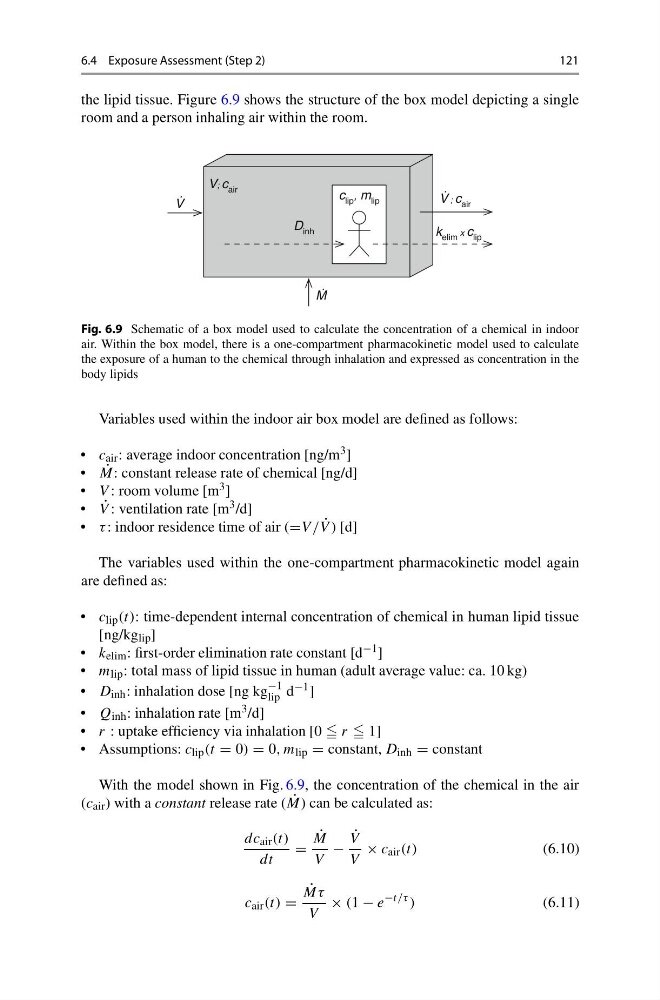
the lipid tissue. Figure 6.9 shows the structure of the box model depicting a single
room and a person inhaling air within the room.
Fig. 6.9 Schematic of a box model used to calculate the concentration of a chemical in indoor
air. Within the box model, there is a one-compartment pharmacokinetic model used to calculate
the exposure of a human to the chemical through inhalation and expressed as concentration in the
body lipids
Variables used within the indoor air box model are defined as follows:
• c air : average indoor concentration [ng/m 3 ]
• ˙
M: constant release rate of chemical [ng/d]
• V : room volume [m 3 ]
• ˙
V : ventilation rate [m 3 /d]
• τ : indoor residence time of air (=V / ˙
V ) [d]
The variables used within the one-compartment pharmacokinetic model again
are defined as:
• c lip (t): time-dependent internal concentration of chemical in human lipid tissue
[ng/kg lip ]
• k elim : first-order elimination rate constant [d −1 ]
• m lip : total mass of lipid tissue in human (adult average value: ca. 10 kg)
• D inh : inhalation dose [ng kg
−1
lip d −1 ]
• Q inh : inhalation rate [m 3 /d]
• r : uptake efficiency via inhalation [0 r 1]
• Assumptions: c lip (t = 0) = 0, m lip = constant, D inh = constant
With the model shown in Fig. 6.9, the concentration of the chemical in the air
(c air ) with a constant release rate ( ˙
M) can be calculated as:
dc air (t)
dt
=
˙
M
V
−
˙
V
V
× c air (t)
(6.10)
c air (t) =
˙
Mτ
V
× (1 − e
−t/τ )
(6.11)
121
the lipid tissue. Figure 6.9 shows the structure of the box model depicting a single
room and a person inhaling air within the room.
Fig. 6.9 Schematic of a box model used to calculate the concentration of a chemical in indoor
air. Within the box model, there is a one-compartment pharmacokinetic model used to calculate
the exposure of a human to the chemical through inhalation and expressed as concentration in the
body lipids
Variables used within the indoor air box model are defined as follows:
• c air : average indoor concentration [ng/m 3 ]
• ˙
M: constant release rate of chemical [ng/d]
• V : room volume [m 3 ]
• ˙
V : ventilation rate [m 3 /d]
• τ : indoor residence time of air (=V / ˙
V ) [d]
The variables used within the one-compartment pharmacokinetic model again
are defined as:
• c lip (t): time-dependent internal concentration of chemical in human lipid tissue
[ng/kg lip ]
• k elim : first-order elimination rate constant [d −1 ]
• m lip : total mass of lipid tissue in human (adult average value: ca. 10 kg)
• D inh : inhalation dose [ng kg
−1
lip d −1 ]
• Q inh : inhalation rate [m 3 /d]
• r : uptake efficiency via inhalation [0 r 1]
• Assumptions: c lip (t = 0) = 0, m lip = constant, D inh = constant
With the model shown in Fig. 6.9, the concentration of the chemical in the air
(c air ) with a constant release rate ( ˙
M) can be calculated as:
dc air (t)
dt
=
˙
M
V
−
˙
V
V
× c air (t)
(6.10)
c air (t) =
˙
Mτ
V
× (1 − e
−t/τ )
(6.11)